In a vibrant democracy like Bharat, the electoral roll is more than just a bureaucratic list of names—it is a sacred document of sovereignty. It determines who among the 1.4 billion people bears responsibility for shaping the nation’s future. Yet, for decades, the sanctity of this democratic ledger has been steadily eroded, not by accident, but through a deliberate political economy of “inclusive” vote-bank cultivation that prioritised electoral arithmetic over citizenship.
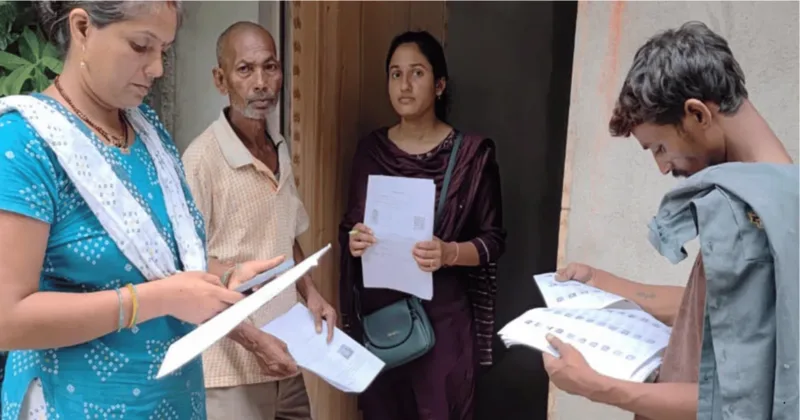
The Election Commission of India’s Special Intensive Revision (SIR) across 12 States and UTs has therefore arrived not a moment too soon. While predictable panic radiates from certain political quarters, for the nationalist observer, SIR is more than an administrative cleanup; it is a long-awaited Shuddhikaran—a purification of the democratic process. It aims to remove ghosts, duplicates, non-citizens, and manufactured voters that have, for years, undermined the legitimate rights of the indigenous population.
Correcting Historical Wrongs: The Unfinished Task of the Republic
The urgency of SIR cannot be understood without revisiting the historical mistakes that created today’s crisis. From the very foundation of the Republic, Bharat’s electoral architecture suffered due to rushed, paper-based roll compilations that lacked verification, documentation, and demographic safeguards. Throughout the 1970s and 1980s, states such as Assam and West Bengal experienced unprecedented infiltration across porous borders, yet successive governments failed to conduct comprehensive reviews of the rolls.
The Assam Agitation (1979–85) was itself a revolt against the mass inclusion of illegal migrants as voters, culminating in the Assam Accord—an agreement that recognised the scale of demographic distortion but remained only partially implemented. In West Bengal, too, demographic patterns in border districts shifted so sharply that local communities accused political leaders of granting ration cards and voter IDs to non-citizens to manufacture vote banks. These distortions hardened after the incomplete 2002–04 Special Revision, which created a legacy roll riddled with missing surnames, spelling variations, unverifiable entries, and duplicates—yet this faulty roll has remained the foundation for two decades.
Data confirms the scale of this demographic aggression. Between 2001 and 2011, while the national decadal growth rate stabilised, border and sensitive districts in Assam witnessed abnormal population spikes: Dhubri (24.44 per cent), Morigaon (23.34 per cent), and Goalpara (22.64 per cent ) all grew at rates far outstripping the national average (Kar, 2022). Similarly, West Bengal’s border seats, such as Domkal, have seen abnormal voter surges of nearly 30 per cent in a single electoral cycle. The recent SIR in Bihar proves the necessity of this cleanup: the exercise successfully deleted over 65 lakh invalid entries—including duplicates, deceased persons, and non-citizens—restoring the sanctity of the electoral roll (India Today, 2025).
SIR, therefore, is not an isolated bureaucratic initiative. It is the first systematic attempt to rectify decades of administrative negligence, restore demographic truth, and protect constitutional sovereignty that earlier policymakers failed to secure. It marks the long-delayed closing of a national wound.
The Ghost in the Machine: How Neglect Corroded Democracy
Why has a routine voter-roll revision triggered political tremors in West Bengal, Kerala, and the North-eastern region? The SIR strikes at the heart of demographic manipulation, enabled by porous borders, administrative inaction, and political complicity. Illegal infiltration, especially through the eastern borders, has not only altered settlement patterns but penetrated deeply into welfare systems and, ultimately, into electoral rolls.
The scale of this challenge is not speculative. In 2016, the government formally estimated the presence of nearly 20 million illegal migrants in India (MHA, 2016). This silent invasion utilises the porous riverine borders of West Bengal and the unfenced ‘char’ lands of Assam. More alarmingly, intelligence reports now indicate a ‘backdoor’ entry via the open Nepal border into Bihar, where infiltrators procure fake documents before dispersing into India’s hinterland.
These legacy rolls—never properly digitised or verified—are the rot at the foundation of the system. Residents in border districts face immense pressure on land, resources, and employment due to demographic changes. These are not harmless clerical errors. They represent a systematic erosion of democratic legitimacy. When a non-citizen votes, they cancel out the voice of a legitimate Indian. When a deceased voter remains on the voter rolls, their identity is misused. When an individual appears in multiple constituencies, the integrity of the “one person, one vote” principle collapses.
SIR’s decision to base verification on the 2003 legacy rolls is therefore prudent. In 2003, a major amendment to the Citizenship Act tightened the eligibility criteria for citizenship by birth. If a person—or their parents—appeared on pre-2003 rolls, their legitimacy is already established. If not, further verification becomes necessary.
However, using 2003 as the base year allows information from three generations of voters to be addressed simultaneously. Ideally, from 2003 to 2025, the voters’ list will include the son, his father, and his grandfather. The SIR of 2025 is designed to allow voters to provide up-to-date information about their residence, leveraging information already registered for their parents and grandparents. In this way, a fresh enumeration of voters, along with their previous two generations, has been possible.
Opposition Resistance: A Confession of Guilt?
The sharp accusations from certain Opposition parties—that SIR is a plan for “mass disenfranchisement” or a “stealth NRC”—are unbecoming of a democratic political ecosystem. They expose the fragility of political strongholds dependent on bogus voters, manipulated rolls, and demographic engineering. The question is simple: If your voters are genuine citizens, why fear verification?
The legal framework is clear: Article 324 empowers the Election Commission of India (ECI) to conduct free and fair elections. States are constitutionally obliged to cooperate. Obstructing SIR is a direct challenge to constitutional authority. Not surprisingly, the states experiencing the highest levels of demographic change are the loudest opponents. Their concern is not about citizens losing rights—it is about losing illegitimate electoral capital that was accumulated over decades of vote-bank politics.
Modernising the Shield: Why Digitisation Is Non-Negotiable
While the intent behind SIR is solid, its execution must move decisively beyond the paper-era mindset. Despite being the world’s IT powerhouse, many districts still rely on:
• non-searchable PDFs from 2002–04,
• error-prone manual enumeration forms,
• double-digitisation loops,
• decaying archival data.
This outdated process harms genuine middle-class and migrant voters who struggle to locate their legacy data, while organised vote-bank networks—accustomed to exploiting administrative loopholes—navigate the system effortlessly.
India cannot fight 21st-century infiltration with 20th-century paper files. With fibre networks expanding and 5G/6G on the horizon, India has the technological foundation to authenticate voter information swiftly and transparently. Digital verification also helps the government estimate manpower and logistical needs for smooth elections.
Millions of migrant workers living in urban centres for years lack easy access to voting processes in their hometowns. They deserve a seamless digital system that allows them to verify their identity without bureaucratic hurdles.
India already has ECINet, one of the world’s most advanced electoral management systems. Yet SIR remains burdened by outdated workflows. A nationalist vision demands full digital fortification of the process:
• Digitising and indexing the 2002–04 legacy rolls.
• Integrating verification with Aadhaar and official databases.
• Deploying mobile digital kiosks for non-tech users.
• Ensuring real-time transparency in approvals and corrections.
A fully digital SIR will eliminate bureaucratic manipulation and political interference.
Migration, Demography, and the National Security Imperative
Internal migration in India is massive—over 54 per cent of it is rural-to-rural—and millions of people move across states for work. Static voter rolls become outdated almost immediately.
But internal migration is not the primary concern. The far more serious threat is illegal immigration, especially in border states. SIR is not just an electoral reform. It is a national security instrument.
Demographic change in sensitive districts is no longer a theory—it is visible and measurable. If contaminated rolls persist, then policies, legislations, and even state leadership can be influenced by individuals with no allegiance to Bharat. A democracy cannot outsource its destiny to non-citizens. SIR ensures that only legitimate stakeholders determine Bharat’s political future.
A Constitutional Purification, not a Political Operation
Much of the criticism surrounding SIR is rooted in misinformation. The facts are straightforward:
• No one is being asked for “citizenship proof.”
• Wrongful deletions are punishable under Section 32 of the RPA 1950.
• Multi-stage objections, hearings, and appeals ensure safeguards.
• The timeline is transparent and publicly announced.
SIR is not intended to exclude citizens. It aims only to remove non-citizens, duplicates, and deceased entries. It protects, rather than threatens, the franchise.
Toward a Clean Roll, a Strong State, and a Secure Nation
Civilisational nationalism rests on three pillars: (i). Demographic integrity (ii). National security (iii). Democratic legitimacy
The Special Intensive Revision strengthens all three. It restores demographic truth. It prevents electoral distortions. It prepares Bharat for the 2029 delimitation. It dismantles long-standing vote-bank mechanisms. Above all, it reinforces the foundational principle: Only the citizens of Bharat will decide the future of Bharat.
The Time for Ambiguity Is Over
SIR is not optional. It is a national imperative. A clean electoral roll is Bharat’s first line of defence against illegal infiltration, demographic aggression, voter fraud, and political corruption. If we fail to act now, we risk a future where India’s policies are shaped not by her citizens, but by those who owe her no loyalty.
The SIR is a test of our democratic will. It is the line separating the Praja from the Ghuspaithiya. It is the firewall that will protect the Republic for the next century. In this defining moment, Bharat must choose clarity over convenience, sovereignty over sentiment, and truth over appeasement.