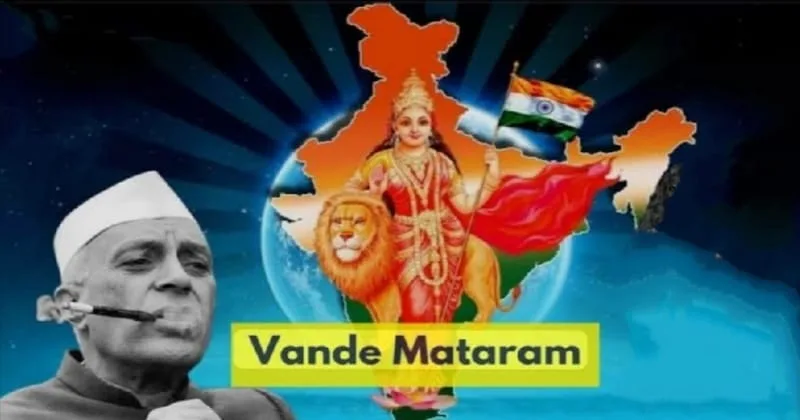
The history of Vande Mataram is the history of India’s struggle for soul and sovereignty. However, as this report meticulously documents, the journey of this sacred hymn from 1938 to 2025 has been marred by a consistent “Politics of Veto.” What began as a strategic surrender by Pandit Jawaharlal Nehru in 1937 – partitioning the song to appease the Muslim League – has evolved into a modern-day tool for communal grandstanding. Whether under the guise of “secularism” or “religious freedom,” the leaders of the I.N.D.I Alliance and AIMIM have repeatedly treated India’s national identity as an optional commitment, often prioritising extremist sensitivities over the unified cultural heritage of the Republic.
During a landmark discussion in the Rajya Sabha on December 8, 2025, marking 150 years of ‘Vande Mataram’, the Union Home Minister Amit Shah launched a scathing attack on Congress’s legacy of appeasement politics. He revealed how, in 1937, Pandit Jawaharlal Nehru capitulated to the pressure of the Muslim League by partitioning the sacred national song and stripping away several of its most spiritually and nationally significant verses, effectively compromising the soul of Bharat’s freedom struggle for the sake of a divisive political agenda.
This report chronicles 19 key instances between 1938 and 2025 where Congress and I.N.D.I Alliance leaders systematically opposed or disrespected ‘Vande Mataram’, exposing a long-standing legacy of cultural and national compromise.
Here is the comprehensive report rewritten in English, structured with distinct headlines for each event. The tone reflects a right-wing perspective, emphasizing the defense of national symbols against what is characterised as a legacy of appeasement and communal vetoes.
The Original Sin: Nehru’s Capitulation and the Partition of Vande Mataram (1937)
On December 8, 2025, during a landmark discussion in the Rajya Sabha marking the 150th anniversary of the national song, Union Home Minister Amit Shah launched a scathing offensive against the Congress party’s deep-rooted culture of “appeasement politics.” Shah presented a historical indictment of Pandit Jawaharlal Nehru, alleging that in 1937, Nehru bowed to the communal demands of the Muslim League by literally partitioning the sacred hymn. By stripping away spiritually and nationally significant verses to satisfy separatist sentiments, Nehru did not just edit a song but compromised the soul of India’s identity. The home minister asserted that this act of weakness laid the very foundation of appeasement that ultimately carved the path for the tragic Partition of the country, proving that the Congress has historically prioritized political convenience over national integrity.
Communal Veto: Imran Masood Places Religious Dogma Above National Pride (2025)
The persistent refusal of the Congress ecosystem to fully embrace Bharat’s national symbols was on full display on November 11, 2025, when Congress MP Imran Masood expressed his blatant objection to ‘Vande Mataram.’ During a press conference in Delhi, Masood sought to undermine the national song by claiming its lyrics conflicted with his religious beliefs, specifically stating that he could not offer “Sajda” (prostration) to anything other than Allah. By framing a patriotic salute to the motherland as a religious violation, Masood reinforced the divisive “veto culture” often associated with the I.N.D.I Alliance. While he made passing remarks about national security, his inability to honor the song that inspired countless freedom fighters highlights a troubling priority of religious identity over unified national devotion.
Separatist Defiance: MMU Labels National Integration as ‘Un-Islamic’ in J&K (2025)
In a clear attempt to keep the youth of Jammu and Kashmir alienated from the national mainstream, the Muttahida Majlis-e-Ulema (MMU), led by Mirwaiz Umar Farooq, vociferously opposed the government’s order to celebrate the 150th anniversary of ‘Vande Mataram’ in schools. On November 6, 2025, the MMU characterised the mandatory singing of the national song as “un-Islamic” and a “calculated imposition of RSS ideology.” This extremist rhetoric seeks to weaponise religion against a secular patriotic duty, revealing a separatist mindset that views any attempt at national integration or the honouring of Bharat’s cultural heritage as an existential threat to their communal narrative.
Rajasthan Waqf Leader Issues ‘Warnings’ Against Patriotic Mandates (2025)
The pushback against national unity reached Rajasthan on November 6, 2025, when Khanu Khan Budhwali, the former Chairman of the State Waqf Board, issued an aggressive “warning” to the government regarding the mandatory singing of ‘Vande Mataram.’ Equating a national hymn with a specific religious prayer, Budhwali argued that the state has no right to dictate “how people pray,” effectively seeking to exclude a major segment of society from a national celebration. He further attempted to deflect from this act of defiance by accusing the government of neglecting the modernisation of Madrasas, using communal grievances to justify his opposition to a song that symbolises the shared sacrifice of all Indians.
Socialist Obstructionism: Rais Shaikh Opposes National Honour in Maharashtra (2025)
The I.N.D.I Alliance’s disregard for national symbols was further exemplified in Mumbai on November 1, 2025, when Samajwadi Party MLA Rais Shaikh sparked a massive controversy by opposing the Maharashtra government’s directive to sing ‘Vande Mataram’ in schools. Shaikh dismissed the week-long tribute celebrating the song’s 150th anniversary as “forced patriotism” and a violation of “religious and individual freedom.” This labeling of a national honor as a burden demonstrates a growing trend among socialist and secularist parties to treat national identity as an optional commitment, often siding with communal sensitivities at the cost of the very symbols that bind the Indian Union together.
This report chronicles the persistent and systematic disrespect shown toward India’s national song by leaders of the I.N.D.I Alliance and allied communal parties. These instances highlight a troubling trend of prioritising religious and ideological dogmas over national symbols.
Religious Obstructionism: Abu Asim Azmi Refuses the National Chant (2023)
The trend of placing religious identity above the motherland was starkly visible on July 19, 2023, when Samajwadi Party MLA Abu Asim Azmi declared in the Maharashtra Assembly that his religion “forbids” him from reciting Vande Mataram. While Azmi claimed this did not affect his patriotism, his refusal to utter the very words that inspired India’s martyrs was condemned as an act of political grandstanding. Critics argue that such statements seek to create a “religious exemption” from national duties, setting a dangerous precedent for national integration.
Communal Defiance in Meerut: AIMIM’s Disrespect Triggers Clashes (2023)
The refusal to honor the national song took an aggressive turn in Meerut on May 26, 2023. During a municipal oath-taking ceremony, AIMIM corporators deliberately refused to stand or sing during Vande Mataram. This blatant disrespect toward a national symbol led to a heated confrontation and physical scuffles with BJP members. This incident illustrates how the defiance of national decorum by communal parties is often used as a tool to incite social unrest and demonstrate a lack of alignment with India’s shared cultural heritage.
The Congress Dilemma: Siddaramaiah’s Hesitation Over National Pride (2022)
On November 26, 2022, during a Constitution Day event at the Karnataka Congress office, senior leader Siddaramaiah displayed visible discomfort when asked to start the program with Vande Mataram. He initially questioned the need to sing the hymn, only to backtrack seconds later to avoid public backlash, stating that “those who want to sing can do so.” This “doublespeak” and visible hesitation are seen by observers as reflective of the Congress party’s inner struggle – caught between honouring national traditions and maintaining its core policy of minority appeasement.
Secularism as a Shield: RJD MLA Remains Seated in Disrespect (2022)
On June 30, 2022, RJD MLA Saud Alam sparked outrage by remaining seated while Vande Mataramwas being played in the Bihar Assembly. Defending his actions, Alam disingenuously argued that India is a “secular country and not a Hindu Rashtra,” implying that the national song—a pillar of the anti-colonial struggle—is a partisan religious chant. This stance is widely criticised as a weaponization of “secularism” to justify the disrespect of established national protocols and protocols of the House.
Far-Left Extremism: CPI-ML Brands National Song as ‘Saffronisation’ (2022)
In the Bihar Assembly on June 30, 2022, CPI-ML MLA Mahboob Alam branded Vande Mataram as a “song of saffronisation.” By labeling a historic anthem of the freedom movement as a tool of a specific political ideology, the far-left leader attempted to delegitimize the song’s status. This aligns with the broader far-left agenda of dismantling India’s cultural landmarks and constitutional traditions under the guise of resisting ideological shifts, effectively joining hands with communal forces to oppose national unity.
Extremist Defiance: Akhtarul Iman Brands Patriotism as ‘Non-Islamic’ (2021–2022)
In multiple instances within the Bihar Assembly on February 16, 2022, and December 3, 2021, AIMIM MLA Akhtarul Iman sparked outrage by leading a boycott of Vande Mataram. Iman categorised the national song as a purely “religious hymn,” claiming certain verses were “unsuitable” according to Islam. By dismissing a 150-year-old tradition of national honour as “unnecessary” and “not constitutionally mandatory,” Iman signaled a dangerous refusal to participate in the shared rituals of the Indian Republic, prioritising hardline theology over the call of the motherland.
The ‘One God’ Pretext: Abdul Bari Siddiqui Rejects the National Song (2019)
On April 22, 2019, senior RJD leader Abdul Bari Siddiqui weaponized his religious beliefs to justify his refusal to sing Vande Mataram. Siddiqui asserted that those who believe in “one God” cannot sing the song, effectively framing a patriotic tribute to Bharat as an act of religious betrayal. This stance is seen by critics as a classic example of how RJD leaders use “secularism” to shield communal exclusivism, suggesting that national loyalty is secondary to religious doctrine.
The Politics of Evasion: Owaisi’s Challenge to National Mandates (2019)
AIMIM President Asaduddin Owaisi, on March 8, 2019, sought to delegitimize the mandatory nature of national honor. While claiming he had no personal “objection,” he vehemently opposed the idea of “imposing” Vande Mataram on citizens. Critics view this as a strategic attempt to weaken the threads of national unity by treating respect for the national song as a “choice” rather than a duty, thereby encouraging a culture of selective allegiance.
Sharia Above the State: Congress MLA Arif Masood’s Defiant Stand (2019)
The Congress party’s alignment with hardline sentiments was exposed on February 26, 2019, when MLA Arif Masood refused to sing Vande Mataram during a public event in Madhya Pradesh. Masood explicitly stated that the song violated “Islamic Sharia law.” Despite claiming a willingness to sacrifice his life for the country, his refusal to honor the national song demonstrated a troubling hierarchy of loyalty where Sharia principles were placed above the cultural symbols of the Indian State.
Contempt for Protocol: Imtiyaz Jaleel Suspended for Disrespect (2017)
On August 17, 2017, the refusal to follow national protocol led to the suspension of AIMIM’s Imtiyaz Jaleel. During a municipal proceeding, Jaleel remained seated while Vande Mataram was being played. This deliberate act of defiance forced the Mayor to adjourn the session and eject the AIMIM members. Such actions are viewed as a calculated attempt to normalize the disrespect of national decorum within institutional spaces.
Waris Pathan’s Radical Stance (2016)
In a radical display of defiance on March 16, 2016, AIMIM MLA Waris Pathan told the Assembly that he would not sing Vande Mataram “even if his life was at stake.” Pathan claimed Islam did not allow such reverence, leading to his suspension from the House. His statement was widely condemned as an abuse of the freedom of speech and a blatant insult to the very nation that provides him constitutional protections.
Walkout of Shame: Shafiqur Rahman Barq Insults Parliament (2013)
On May 9, 2013, the sanctity of the Lok Sabha was violated when BSP MP Shafiqur Rahman Barq staged a walkout during the playing of the national song. Citing “religious beliefs,” Barq’s exit was labeled a “national insult” by then-Speaker Meira Kumar. This act demonstrated that even within the highest temple of democracy, some leaders prioritize communal identity over the collective national spirit.
The Roots of Divisiveness: Jinnah’s 1938 Campaign Against Vande Mataram
The modern-day opposition to Vande Mataram finds its ideological roots in the campaign launched by Muslim League President Muhammad Ali Jinnah on March 1, 1938. Writing in The New Times of Lahore, Jinnah branded the song as “anti-Muslim” and mobilised a boycott across Bharat. This historical context confirms that the current opposition by I.N.D.I Alliance and AIMIM leaders is a continuation of the same separatist mindset that sought to fracture the Indian identity long before Partition.
The 19 incidents detailed in this report reveal that the opposition to Vande Mataram is not merely a series of isolated events, but a continuous ideological thread that links the separatist rhetoric of Muhammad Ali Jinnah to the modern-day obstructionism of contemporary leaders. By branding a patriotic salute to the motherland as “non-Islamic,” “forced,” or a “tool of saffronisation,” these political actors continue to fuel the fires of divisiveness. As Bharat celebrates 150 years of this historic anthem, the contrast remains stark: while the nation looks toward a “Viksit Bharat” built on unity, these political factions remain anchored in a legacy of appeasement that threatens to undermine the very symbols that bind the country together.