SHANTI Bill 2025: India rewrites the nuclear rulebook
September 15, 2026
  • Read Ecopy
  • Circulation
  • Advertise
  • Careers
  • About Us
  • Contact Us
Android AppiPhone AppArattai
Organiser
  • ‌
  • Bharat
    • Assam
    • Bihar
    • Chhattisgarh
    • Jharkhand
    • Maharashtra
    • View All States
  • World
    • Asia
    • Europe
    • North America
    • South America
    • Africa
    • Australia
  • Editorial
  • International
  • Opinion
  • RSS @ 100
  • More
    • World Hindu Congress 2026
    • Op Sindoor
    • Analysis
    • Sports
    • Defence
    • Politics
    • Business
    • Economy
    • Culture
    • Special Report
    • Sci & Tech
    • Entertainment
    • G20
    • Azadi Ka Amrit Mahotsav
    • Vocal4Local
    • Web Stories
    • Education
    • Employment
    • Books
    • Interviews
    • Travel
    • Law
    • Health
    • Obituary
  • Subscribe
    • Subscribe Print Edition
    • Subscribe Ecopy
    • Read Ecopy
  • ‌
  • Bharat
    • Assam
    • Bihar
    • Chhattisgarh
    • Jharkhand
    • Maharashtra
    • View All States
  • World
    • Asia
    • Europe
    • North America
    • South America
    • Africa
    • Australia
  • Editorial
  • International
  • Opinion
  • RSS @ 100
  • More
    • World Hindu Congress 2026
    • Op Sindoor
    • Analysis
    • Sports
    • Defence
    • Politics
    • Business
    • Economy
    • Culture
    • Special Report
    • Sci & Tech
    • Entertainment
    • G20
    • Azadi Ka Amrit Mahotsav
    • Vocal4Local
    • Web Stories
    • Education
    • Employment
    • Books
    • Interviews
    • Travel
    • Law
    • Health
    • Obituary
  • Subscribe
    • Subscribe Print Edition
    • Subscribe Ecopy
    • Read Ecopy
Organiser
  • Home
  • Bharat
  • World
  • Operation Sindoor
  • Editorial
  • Analysis
  • Opinion
  • Culture
  • Defence
  • International Edition
  • RSS @ 100
  • Magazine
  • Read Ecopy
Home Bharat

SHANTI Bill 2025: India rewrites the nuclear rulebook to power a clean, sovereign energy future

The SHANTI Bill 2025 overhauls India’s nuclear framework to enable private and foreign participation under strong state oversight, aiming to scale nuclear capacity to 100 GW by 2047

WEBDESKWEBDESK
Dec 19, 2025, 04:00 pm IST
inBharat
Follow on Google News
Facebook
Twitter
WhatsAppTelegramEmail

New Delhi: India is poised to enter a transformative new phase in its clean energy journey with the proposed SHANTI Bill, 2025, a sweeping legislative reform that seeks to dismantle decades-old constraints on the nuclear power sector and unlock its full strategic, economic, and environmental potential. Designed to propel India toward its ambitious goal of 100 GW of nuclear power capacity by 2047, the Bill marks the most decisive overhaul of India’s nuclear governance framework since Independence.

At its core, the SHANTI Bill replaces the Atomic Energy Act, 1962 and the Civil Liability for Nuclear Damage (CLND) Act, 2010, two laws that while historically significant have increasingly been seen as barriers to scale, innovation, and global collaboration. The new legislation aims to strike a careful balance: opening the nuclear sector to private and foreign participation, while firmly retaining state control over strategic, sensitive, and national-security-related activities.

For decades, India’s nuclear sector has been constrained by limited capital, restricted participation, and a liability regime that deterred long-term investment. The SHANTI Bill directly addresses these bottlenecks by creating a modern, predictable, and globally compatible regulatory and liability environment, enabling nuclear power to finally emerge as a cornerstone of India’s clean energy mix.

The legislation allows measured collaboration with private Indian companies and trusted foreign partners in the construction and operation of nuclear power plants an essential step if India is to rapidly scale capacity while maintaining safety and sovereignty. Crucially, strategic oversight remains firmly with the state, ensuring that national interest is not diluted in the pursuit of growth.

𝐈𝐧𝐝𝐢𝐚 𝐢𝐬 𝐞𝐧𝐭𝐞𝐫𝐢𝐧𝐠 𝐚 𝐝𝐞𝐜𝐢𝐬𝐢𝐯𝐞 𝐧𝐞𝐰 𝐩𝐡𝐚𝐬𝐞 𝐢𝐧 𝐢𝐭𝐬 𝐜𝐥𝐞𝐚𝐧 𝐞𝐧𝐞𝐫𝐠𝐲 𝐣𝐨𝐮𝐫𝐧𝐞𝐲. ⚛️⚡

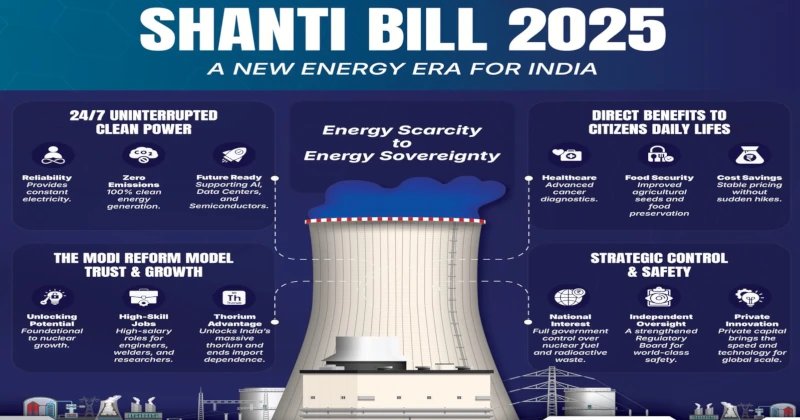
The SHANTI Bill 2025 marks a paradigm shift in India’s nuclear power sector, aimed at delivering 24/7 uninterrupted clean energy while strengthening… pic.twitter.com/Kz8ZSdKC34

— BJP (@BJP4India) December 18, 2025

One of the most consequential provisions of the SHANTI Bill is the granting of statutory status to the Atomic Energy Regulatory Board (AERB). This move strengthens regulatory independence, transparency, and accountability bringing India’s nuclear oversight in line with global best practices.

The Bill also introduces updated safety protocols, a specialised nuclear tribunal for dispute resolution, and targeted reforms to the nuclear liability framework. These changes are aimed at reducing legal uncertainty, enhancing safety assurance, and distributing risk more rationally thereby making nuclear projects bankable without compromising public safety.

Far from diluting safeguards, the reform recalibrates them to reflect modern technology, operational realities, and international norms.

The SHANTI Bill lays the foundation for deploying advanced nuclear technologies, including Small Modular Reactors (SMRs) a game-changer for clean, flexible, and decentralised power generation. SMRs can support industrial clusters, remote regions, and urban centres with 24/7 baseload clean electricity, complementing intermittent renewables like solar and wind.

Also Read: PMMSY delivers major boost to fisheries sector, India records 38% rise in Fish production since 2020

The legislation also strengthens India’s long-term vision of leveraging its vast thorium reserves, a strategic asset that could redefine global nuclear energy in the decades ahead and dramatically reduce import dependence.

Beyond electricity generation, the Bill recognises nuclear energy as a strategic enabler across sectors—from healthcare and agriculture to manufacturing, desalination, and advanced research. Reliable nuclear power underpins food security, stable electricity pricing, and industrial competitiveness, while significantly reducing carbon emissions.

By treating Indian industry as a trusted partner rather than a liability, the SHANTI Bill signals a shift from control-driven policymaking to trust-based reform. The result is a framework that encourages private innovation, high-skill job creation, and technology transfer while keeping national command firmly in public hands.


Topics: BJPAtomic energyTechnology TransferAtomic Energy ActSHANTI BillEnergy sovereignty
Share
Tweet
SendShareSend
✮ Subscribe Organiser YouTube Channel. ✮
✮ Join Organiser's WhatsApp channel for Nationalist views beyond the news. ✮
Previous News

West Bengal: TMC MLA Madan Mitra calls Bhagwan Ram ‘Muslim’, sparks outrage; BJP slams TMC’s ‘Appeasement Politics’

Next News

Islamabad Ashamed Globally: Saudi deports 56000 Pakistani beggars & IMF blocks govt plea to cut condom tax

Related News

The RSS has spent a century building influence through organisation, social networks and ideological formation beyond the electoral arena

RSS at 100: How the Sangh built a century-long network of influence beyond Indian politics

Karnataka: BJP leader Vijayendra turns up heat on DK Shivakumar, calls for pro-farmer, pro-Hindu government

ECI recognises TVK as State party in Tamil Nadu and Puducherry, Whistle symbol reserved

Bombay High Court rejects Rahul Gandhi’s plea in ‘Commander-in-Thief’ defamation case over 2018 rafale remarks against PM Modi

Bombay HC refuses to quash defamation case against Rahul Gandhi over ‘Commander-in-Thief’ jibe at PM Modi

From ‘Fragile Five’ to Global Power: BJP’s ‘Seva Sankalp Abhiyan’ to showcase PM Modi’s 25 year journey

Kanthapuram A.P. Aboobacker Musliyar and MA Baby, CPM general secretary

Keralam: CPI(M) General Secretary MA Baby avoids direct condemnation of Kanthapuram’s anti-women remarks

Load More

Latest News

M.A. Baby with Pinarayi Vijayan - CPIM extended state committee meeting at Kozhikode

Keralam: CPI(M) blames cadre for electoral setback, but keeps Pinarayi and Govindan beyond criticism

Benjamin Netanyahu-Ahmed al-Sharaa
with Recep Tayyip Erdoğan (Left to Right)

Israel–Turkey: A New Strategic Rivalry in the West Asia

BJP Karnataka to launch statewide padayatra against Congress govt over two-stanza Vande Mataram rule

Māori elders invited to India’s global gathering on Ancestral wisdom and modern challenges

BRICS New Delhi Declaration 2026

BRICS New Delhi Declaration 2026: Science, technology, energy & human capital for resilient global south

RSS voluneterss distributing food during Assam flood

RSS: When SEWA is dharma

Representative Image

Post-matric scholarship for SC Students: Who can apply and what does the scheme cover?

Leaders come together at the BRICS Summit in New Delhi on September 12

BRICS Summit 2026: Transforming “Pyramid of privilege” into ” platform of partnership”

BRICS after New Delhi declaration: A strategic makeover

Heads of states at the 18th BRICS Summit 2026

BRICS 18th Summit, 2026 – Bharat ascending with a shared vision into a win-win collaboration of the Global South

Load More
  • Privacy
  • Terms
  • Cookie Policy
  • Refund and Cancellation
  • Delivery and Shipping

© Bharat Prakashan (Delhi) Limited.
Tech-enabled by Ananthapuri Technologies

  • Home
  • Search Organiser
  • Bharat
    • Assam
    • Bihar
    • Chhattisgarh
    • Jharkhand
    • Maharashtra
    • View All States
  • World
    • Asia
    • Africa
    • North America
    • South America
    • Europe
    • Australia
  • Editorial
  • Operation Sindoor
  • Opinion
  • Analysis
  • Defence
  • Culture
  • Sports
  • Business
  • RSS @ 100
  • Entertainment
  • More ..
    • Sci & Tech
    • Vocal4Local
    • Special Report
    • Education
    • Employment
    • Books
    • Interviews
    • Travel
    • Health
    • Politics
    • Law
    • Economy
    • Obituary
  • Subscribe Magazine
  • Read Ecopy
  • Advertise
  • Circulation
  • Careers
  • About Us
  • Contact Us
  • Policies & Terms
    • Privacy Policy
    • Cookie Policy
    • Refund and Cancellation
    • Terms of Use

© Bharat Prakashan (Delhi) Limited.
Tech-enabled by Ananthapuri Technologies