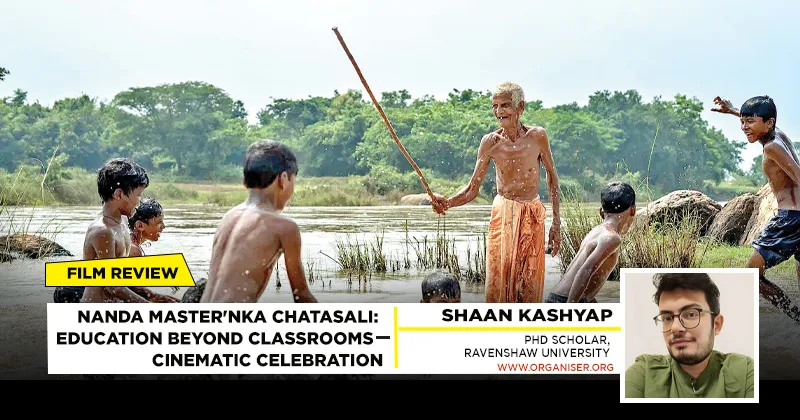
He began with nothing—no certificate, no school room, only a small house in the village called Kantira and a steady faith in letters. Nanda Kishore Prusty (1919-2021), fondly called Nanda Master by the villagers, was a centenarian teacher from Jajpur, Odisha. He taught children and elders for seven decades without charging a penny. His life became a small miracle of devotion: a Class-VII pass-out who turned the absence of formal schooling into a lifetime of service. In 2021, he was honoured with the Padma Shri for his contributions to education; he died on December 7, 2021.
Directed by Pranab Kumar Aich, Master’Nka Chatasali (2025) does not approach his life through dates and declarations. Instead, it enters through memory and performance. A crucial thread in the documentary is Nanda Master’s deep interest in Odia jatra. The docudrama highlights how jatra was not merely entertainment, but a powerful medium of public education for largely illiterate villages. One particular jatra, recalled with care, becomes a turning point in his life. It depicted a British official ridiculing Odias as “illiterate” and incapable of self-rule. Himself an actor in that jatra, young Nanda took a quiet but decisive resolve. If humiliation was rooted in ignorance, then learning had to become resistance. Teaching his people how to read and write became, for him, an act of dignity.
The facts are simple and moving. Nanda Master began teaching children in his village because there was no school nearby. Therefore, he opened a chatasali—a small village learning spot where letters, words, and moral stories were taught under a tree or in a hut. He taught for seven decades, sometimes to children, sometimes to senior citizens, who never had the chance to learn.
He carried the Vishnu Sahasra-naama in his throat and the ledger of simple arithmetic and Odia Barnabodha with him. He also practised what he called his “Vedic Ganit”, which helped him solve day-to-day problems of the local villagers. The local journalists, who first wrote about him, emphasised two things: his refusal to accept money, and his steadfast practice of recitation and discipline.
The docudrama paints his ordinariness as heroic. It does not sculpt him into a monument. Instead, it lingers on small gestures: the way he folds his dhoti, the way he asks a child to sound out a letter, the quiet joy when a student reads for the first time. We see him travel to New Delhi to receive the Padma Shri—and yet his first desire on visiting the capital was not the ceremony but the chance, he said, to visit Mathura. He was a lifelong Krishna bhakt; a hundred years of life had not diminished a taste for pilgrimage and prayer.
Twists in the Tale
But Nanda Master’s story is also one of forgetting and delayed recognition. For most of his life, the village and its surrounding habitations were the full measure of his world. Only after local newspaper reports did national attention follow. This is an old pattern: the village teacher who lives unnoticed until a reporter visits, then a nomination is placed, then—the long delay—an award. The docudrama uses that pattern to ask a quieter question: why do societies so often notice their teachers only after someone else does? The answer it suggests is simple and unsettling: we are still inclined to count the credentialed more carefully than the committed.
This is why the docudrama’s short meditations on indigenous teaching traditions matter. The chatasali is not a quaint relic; it is part of a long Indian practice of local, community schooling—pathshalas, tols, gurukuls—modes that taught literacy, arithmetic, religious learning, and ethics not in formal exam terms but in communal, daily life.
By placing Nanda Master within that wider tapestry, the documentary also signals a broader corrective to national recognition. In the last decade, the Padma awards have included many ‘barefoot’ and grassroots figures: the tribal environmentalist Tulsi Gowda, who planted thousands of saplings and became a viral image as she received the award barefoot; Harekala Hajabba, the orange-seller who raised funds to build a local school; Rahibai Popere, a seed saver and farmer recognised for her indigenous knowledge; and many others whose life’s work was neither urban nor credentialed but profoundly useful. The film gently links Nanda Master’s late citation with this wave of honouring local labour and knowledge.
The documentary does not make political speeches, yet it cannot avoid the civic context. It notes—without polemics—that the gates of national ceremony have, in recent years, opened to figures from the grassroots. Whether one sees this as a moral realignment or a change in optics, the consequence is real: people who served quietly gain public visibility, and their stories become templates for civic memory. The film asks us to let that visibility bring with it material support for local learning, not just applause.
The Selfless Guru
What the film makes especially visible is the social form of self-teaching across the Bharatiya countryside. Autodidacts are not a rarity; they are a recurring type. From village tutors who learned by listening, to community elders who taught crafts and herbal lore, to those Gurus who devoted their lives to Saraswati Shishu Mandirs in the remotest parts of the country, we have a legacy that never dies. The film offers both poetic testimony and a modest policy hint: remembrance should become revival.
Nanda Masters’ Nka Chatasalis ends on a small, luminous moment. The centenarian in a modest wool cap, travelling to New Delhi, touched the material of national ceremony—but his heart longed for Mathura. He wished to stand where his devotion had imagined the world. The film closes on the sound of recitation, the rustle of palm leaves, and the slow shadow of a man who taught generations how to read. That image—of humility, of endurance, of rooted pedagogy—is the documentary’s gift.
If the country remembers Nanda Master now, it is because someone finally told his story. The film asks us to do more than remember: to rebuild the local places of learning, to honour the self-taught, and to ensure that the next village teacher’s work is a vocation made visible not by chance but by design.