NEW DELHI: A simmering controversy over the custody of the Jawaharlal Nehru Papers has now erupted into a full-blown political and constitutional debate, with the Congress party facing serious questions over transparency, public accountability, and its long-standing control over India’s historical narrative.
Union Minister Gajendra Singh Shekhawat in a post on X, has rejected the claim that the Nehru Papers are “missing,” calling it a deliberate misdirection designed to cloud the real issue. According to him, the facts are clear, documented, and inconvenient for Congress: in 2008, 51 cartons of papers relating to Jawaharlal Nehru were formally taken back by the Nehru-Gandhi family from the Prime Ministers’ Museum and Library (PMML), then known as the Nehru Memorial Museum and Library (NMML).
Nehru Papers are not “missing” from PMML.
“Missing” entails that the whereabouts are unknown.
In reality, 51 cartons of Jawaharlal Nehru papers were formally taken back by the family in 2008 from Prime Ministers Museum and Library (then NMML). Their location is known. Hence, they…— Gajendra Singh Shekhawat (@gssjodhpur) December 17, 2025
This was not an informal transfer. It was done officially, on request, with proper records, inventories, and catalogues many of which are still retained by PMML. The location of the papers is known. Their custodians are known. What remains unknown is why these papers have not been returned to the national archive despite repeated reminders.
Shekhawat has pointed out that PMML has written multiple times to the custodians of the papers, urging their return in the interest of public access and historical preservation. These reminders are not relics of the past; they include formal communications sent as recently as January and July 2025.
Yet, the papers remain outside the public domain.
This refusal or prolonged delay has triggered a fundamental question that Congress has so far avoided answering, On what authority does a political family continue to hold documents that belong to the nation’s historical record?
At the core of the issue lies a distinction Congress says it has deliberately blurred. The Nehru Papers are not private letters, family memorabilia, or personal effects. They concern Jawaharlal Nehru in his role as India’s first Prime Minister, documenting decisions, correspondence, and events that shaped the destiny of the Republic.
“These are not family heirlooms,” he emphasised. “They are documents of national importance.”
Such records, by their very nature, belong in a public archive, accessible to scholars, researchers, students, journalists, and citizens seeking to understand India’s early years through original sources rather than curated narratives.
The controversy has also reignited accusations that Congress seeks to control history rather than allow it to be examined. On one hand, critics argue, the party urges the nation not to question or debate the decisions and blunders of the Nehru era.
On the other, it keeps primary source material the very evidence needed for informed debate out of public reach. This contradiction, Shekhawat says, cannot be ignored.
“How can informed discussion take place when original documents are locked away?” he asked, adding that history cannot be selectively curated to suit political convenience. Article 19(1)(a) of the Constitution, which guarantees citizens the right to know. Withholding documents of such national significance, he argues, violates the spirit of transparency that underpins a democratic society.
The Public Trust Doctrine, under which assets of national importance are held in trust for the people. Historical records of a Prime Minister, especially the first Prime Minister of independent India, fall squarely within that trust.
Archives are a public trust, not a family vault. No individual or political dynasty has the moral or constitutional authority to privatise India’s historical memory.
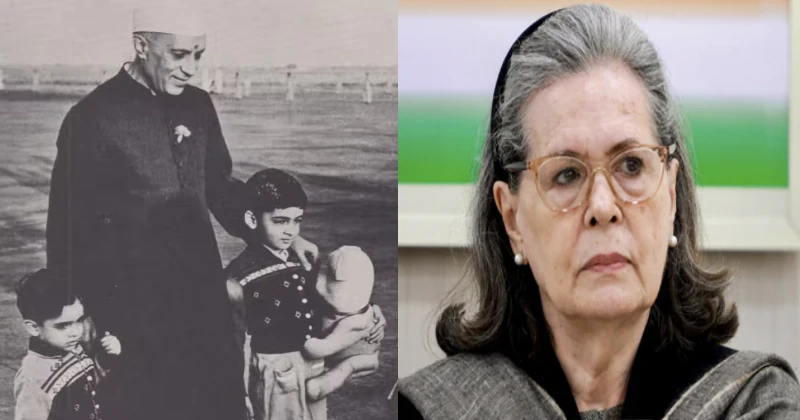
In a pointed appeal, Shekhawat has asked Sonia Gandhi to explain to the nation why these documents remain withheld. What exactly is being protected? What is being delayed? And why are the explanations offered so far failing to address the core issue of public ownership?
The refusal to return the papers, he argues, sets a dangerous precedent one where political families can override national institutions and decide unilaterally what the public may or may not see.