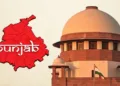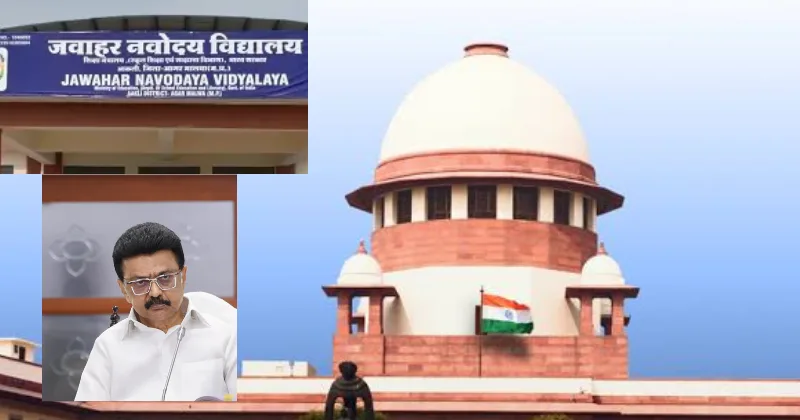
The Supreme Court set ultimatum to set up Jawahar Navodaya vidyalayas (JNV) in Tamil Nadu. Apex court slapped the DMK government saying “Don’t turn this into a language fight. Don’t deny rural students opportunity”.
🚨HUGE. "Are you not a part of this Republic?": Supreme Court’s sharp reminder to Tamil Nadu as it rejects resistance to Navodaya schools.
~ The Court said education is in the Concurrent List & opposing a central scheme goes against Federal Cooperation 👏🏼"Don’t turn this into a… pic.twitter.com/gP4x29cBiQ
— The Analyzer (News Updates🗞️) (@Indian_Analyzer) December 16, 2025
The Court was hearing a plea filed by the State of Tamil Nadu against a judgment of the Madras High Court directing the State to establish a Jawahar Navodaya Vidyalaya in every district.
A division bench comprising justices BV Nagarathna and R Mahadevan, on December 15, asked the Tamil Nadu government to consider setting up of Jawahar Navodaya Vidyaloayas scheme an opportunity rather than a threat to the two language formula of DMK government.
Counsel for state government, P Wilson strongly opposed the scheme saying it is a backdoor entry by the Modi government to impose Hindi in Tamil Nadu which has been following two language formula of Tamil and English in state run schools. Disregarding his submissions, the bench said “we are asking merely to identify the land and not to lay foundation stone”
Justice Nagarathna said “the court is not insisting on Hindi, but on poor and rural children getting an education. You (state) can’t come in the way if they want to study the Central syllabus .. how can you deprive them…We have passed the aforesaid directions only in the interest of those students who are entitled to be admitted to say schools in the State of Tamil Nadu”.
Wilson said “I (state) can build my own schools… We have the highest gross enrolment ratio. Never will any other state match ours. They want 30 acres of land to be given in every district. I have to shell out the money. I had spent Rs.3,548 crores on Samagra Shiksha scheme they still owe us.. this is not the way to treat the State”.
To this, Justice Nagarathna asked “Whether Tamil Nadu was ‘part of our Republic’. We live in a federalist society. There must be a federal discussion. You come one step they will also come one step. They may come two steps. After the bifurcation of Andhra Pradesh, Tamil Nadu has gotten all the glory. It is the largest industrialized state in South India. Everything first. You grab this opportunity. Don’t take it as imposition, it is an opportunity for your students. You can say this is our language policy. They will look into it. They cannot also discredit your policy. Bring to the notice of the Secretaries of the Central Government about your Act and how you are going about it. Please have a positive attitude”.
One word for Stalin 👇🏽 pic.twitter.com/eUQ0ubrpgP
— FalconUpdatesHQ (@FalconUpdatesHQ) December 16, 2025
Justice Nagarathna also advised both sides to avoid public statements and engage directly with each other saying, “Please don’t talk through press or through the media. Go face to face and go on talk to them. Everybody is issuing statements and there is no talking between the actual persons.”
In 2017, the SC had stayed a Madras HC order directing the TN government to set up the centrally funded Jawahar Navodaya Vidyalays in Tamil Nadu. On September 11, 2017, While hearing PIL by Kumari Maha Sabha, Madras HC told the TN govt. to provide temporary land sites and buildings to accommodate 240 children within two months. It had held that Jawahar Navodaya Vidyalayas would not violate the Tamil Nadu Tamil Learning Act, 2006, and directed the State to provide temporary accommodation for 240 students in each district within two months. It had found that the State’s blanket refusal curtailed students’ rights to choose educational institutions and was inconsistent with the Right of Children to Free and Compulsory Education Act.
In its Special Leave Petition, DMK govt argued that education policy falls within its exclusive domain and that its two-language policy under the 2006 Act is incompatible with the three-language formula followed by Navodaya Vidyalayas.
The High Court had rejected this contention after noting that Navodaya Vidyalayas in Tamil-speaking regions use Tamil as the medium of instruction up to Class VIII, offer Tamil as the first language in Classes IX and X, and provide it as an optional subject in Classes XI and XII. The court said that the Central Government bears the full financial burden, with the State required only to provide land”.