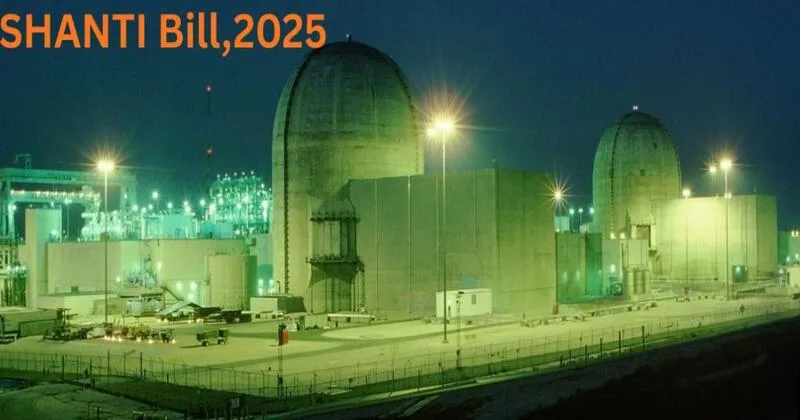
New Delhi: The Indian energy paradigm has reached a stage where only incremental progress through changes is not sufficient. The increasing demand for electricity, growth of industries, requirements for the commitments on global warming and the imperative of strategic independence come together at a single point, then there is the provision of reliable and low-carbon baseload power. The Atomic Energy Bill, 2025, referred to as the SHANTI Bill (Sustainable Harnessing and Advancement of Nuclear Technology for India). The nuclear sector in India has been governed by the Atomic Energy Act, 1962, where ninety-nine per cent control has been entirely vested in the Indian government by the Department of Atomic Energy. The proposed law aims to update the nuclear regulatory regime in the country, which has remained unchanged since the early days of the Indian Republic.
Nature of an atomic energy law
An atomic energy law is more than an electricity law. It encompasses a whole body of law dealing with ownership, safety, licensing, liability, security, waste management, research and international obligations about atomic materials and technology. As atomic energy deals with high-risk materials and has strategic elements, these laws establish where governmental control and non-governmental participation lie.
The previous Indian government were not oriented towards the geopolitical imperatives of post-independent India and nuclear technology. If the previous regime has maintained independence and security on the one hand, effectively and comprehensively on the other hand, the development and innovation were restricted by these parameters themselves. The new ‘SHANTI Bill’ recognises the requirements for non-negotiable control in the strategic sector, and the innovative development of nuclear power for meeting various civil requirements necessitates different paradigms altogether.
Possible reasons behind an overhaul of India’s nuclear strategy
The demand for power in India is expected to increase consistently over the next two decades, with growth drivers including manufacturing, information and communication technology, urbanisation and transportation. Despite rapid growth, intermittent renewable energy generation makes nuclear a stable source of energy with low carbon emissions and land-use requirements. Coal generation is decreased with land and import dependence.
The contribution of nuclear to the energy mix has remained modest in the Indian electric power sector. Perhaps the most important factor for this has remained its restricted ability to execute as a purely public sector initiative. The large outlays and complex technology require diversified engagement and specialised mechanisms for risk-sharing and integration into worldwide supply chain management. The SHANTI Bill is an initiative to address this gap between ambition and ability.
Three pillars of SHANTI Bill
The SHANTI Bill is formed on three main pillars: expanding capacity, regulatory certainty and resilience.
The first aim is to speed up the addition of nuclear capacity by facilitating regulated private participation in the generation of civil nuclear power and electricity. This does not mean the privatisation of nuclear material and strategic resources, but only the addition of private resources to the generation of electricity through state regulation.
Secondly, the Bill streamlines and modernises the regulation regime. Licensing, procedural methods of safety approvals and compliance processes are made easier and simpler through a harmonised legal system, in line with modern global trends. Such simplicity is necessary not only for the local companies but also for global technology collaborators.
Third, the bill aims at future-proofing the nuclear sector in India by accommodating new reactor designs, such as Small Modular Reactors, which have a completely different profile from the conventional large ones.
Economic and industrial implications
Nuclear power is generally perceived as a narrow phenomenon, confined to the production of electricity. To the contrary, nuclear power is a richly complex industry. Building nuclear reactors requires heavy engineering, meticulous manufacturing, sophisticated materials, computerised controls and specialised civil engineering. Running the plant demands highly competent technical staff.
By allowing a larger number of participants, it is able to trigger domestic production, indigenous component localisation and induce high-skill employment. It will perform well with India’s overall industrial policies in terms of developing metallurgy, robots, instrumentation and construction technologies.
Concerning capital markets, nuclear power is considered an infrastructure investment involving long-term assets. Legal certainty removes uncertainties that prevent institutional long-term capital from engaging.
Climate/Sustainability target
The emission cuts by India have made this scenario possible without compromising development. In this scenario, the role of nuclear power stands distinct. This is because, unlike renewable sources of energy, the output produced is consistent. In addition to this, unlike fossil fuels, there is zero emissions.
The SHANTI Bill enhances the capacity of India towards a “balanced” energy transition, wherein nuclear energy can enable the increase of renewables by stabilising the grid. This is especially important for industrial estates, data centres and other urban applications, which require more reliable access to electricity.
This Bill does not position nuclear power as an alternative for renewable sources, but rather as a complement for deep decarbonization.
Safety, regulation and public accountability
Public confidence is a key component in any nuclear policy. The SHANTI Bill enforces the doctrine of safety surveillance as a completely separate and transparent process. Licensing, environmental clearance, emergency response plans and operational audits are designed such that greater participation does not equate to a compromised accountability process.
The Bill further enhances institutional responsibility in respect of the delineation of respective roles of operators, regulators and the State. This, to a certain extent, mitigates any possible issues that may arise in day-to-day as well as different circumstances. The Indian model has aptly identified that nuclear safety and security denote not only a technological need but a social pact between the State and its people.
Liability and risk management
One of the most complicated areas regarding the international regulation of nuclear matters is that of liability. The former Indian regime of liability was uncertain, even though it was framed in a manner that protected the public interest. The SHANTI bill brings in more certainty regarding the matter of liability. This does not mean there is less responsibility. It ensures responsibility is well defined, funded and can be enforced so that local and international players can realistically evaluate risks. An effective liability framework is necessary for technology partnership attraction and the protection of the rights of citizens.
Global context: governance of nuclear energy by other nations
Globally, the regulation of nuclear energy is covered by national legislation in each of the countries operating nuclear plants. In the US, there is a private sector operation of plants with strong federal regulation. For France, there is a state-run but market-based nuclear industry. In Russia and in China, nuclear energy is a component of their industrial policies led by their nation-states. For both Japan and South Korea, there is a private sector operation, but strong regulation of the plants.
More than 30 countries worldwide produce nuclear electric power, and all of them have legislative regimes for nuclear safety and waste management. Other countries have nuclear legislation for research and medical applications of nuclear energy and for control of nuclear radiation.
A previous paradigm in India, in which there was near-exclusivity of control in government, has been historically justified yet increasingly rare. The SHANTI Bill brings India in line with international best practice, maintaining necessary state controls.
How is the SHANTI Bill different from other countries
SHANTI Bill retains its own characteristics that are differentiated according to the realities of Indian strategic circumstances. This differs from the Western model that encompasses fully the role of the private sector regarding ownership and the state’s role regarding fuel cycles and strategic materials.
When contrasted with completely state-controlled models, the Indian system promotes competition and efficiency without sacrificing control. The focus in the Bill on development results such as energy access, industrial development and climate change, is more a reflection of Indian socioeconomic imperatives than just marketplace factors.
The second major difference is that the Bill is drawn up with a futuristic vision in mind. Most nuclear laws were formulated long back and modified accordingly for new generations of technology. The SHANTI Bill has foresight in that it lays out its approach consistent with future reactor types and deployment options that would obviate future amendments to legislation on a regular basis.
Strategic and geopolitical importance
Nuclear power and geopolitics go hand in hand. A credible civilian nuclear program sets the tone for India’s negotiations on technology collaborations, fuel sourcing and global platforms. It further helps in increasing international confidence and perception of India as a responsible nuclear-capable state by virtue of clear national legislation.
Nevertheless, with the retention of sovereignty with respect to the sensitive issues, there is an ensured preservation of strategic autonomy in this context. The SHANTI Bill maintains a balance with respect to transparency and national interest.
Parliamentary and public scrutiny will also be very important in the process of honing norms and addressing questions that may arise. Transparency and engagement with various stakeholders will make it clear whether the Bill will achieve its purpose.
The Atomic Energy Bill, 2025 or the SHANTI Bill, is more of a measured change than a transformation. The Bill recognises the fact that the country’s requirements in the area of energy and development have changed over time and that the governance of nuclear energy has to adapt to this change. The Bill is the first step towards a future that is more resilient, sustainable and more self-reliant in energy.
The effectiveness of the SHANTI Bill will not be ascertained through the enactment process, but through strict implementation in ensuring that nuclear power is one of the foundations of future development and security.