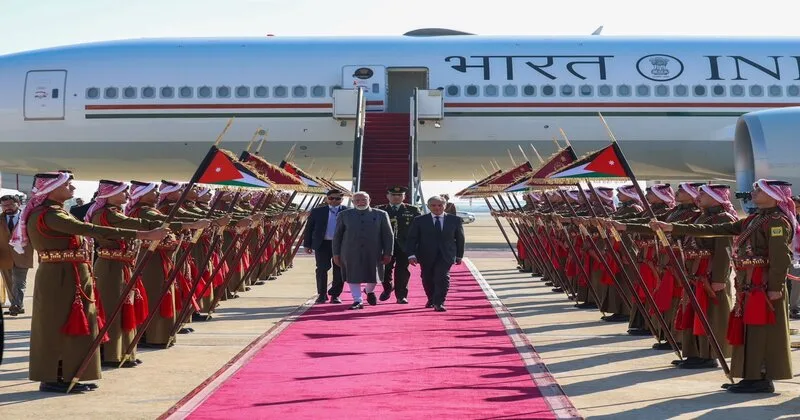
The Prime Minister’s visit to Jordan and Ethiopia marked a significant moment in India’s evolving engagement with the Global South, reflecting a diplomatic approach that combines historical solidarity with contemporary strategic interests. At a time when global power structures are in flux and developing nations seek greater voice in international decision-making, India’s outreach to West Asia and Africa underscores its aspiration to act as a credible partner rather than a prescriptive power. The visits highlighted India’s intent to strengthen political trust, expand economic cooperation, and deepen people-to-people ties, while reinforcing a shared developmental narrative rooted in mutual respect and non-interference.
Jordan occupies a unique position in West Asia, acting as a bridge between regions often marked by instability. The Prime Minister’s engagement with Jordan reaffirmed India’s long-standing ties with the Arab world, grounded in civilizational exchanges, trade links, and cultural interaction. Jordan’s role as a moderate and stabilizing force in the region aligns with India’s own emphasis on dialogue, restraint, and peaceful coexistence. Discussions during the visit focused on political cooperation, counterterrorism, and regional security, areas where both countries face overlapping challenges. India’s approach emphasized cooperation without militarization, highlighting its preference for stability through institutional strengthening and inclusive governance.
Economic engagement formed a central pillar of the India-Jordan dialogue. The Prime Minister’s visit sought to expand bilateral trade, particularly in pharmaceuticals, information technology, fertilizers, and renewable energy. Jordan’s strategic location offers Indian businesses access to broader West Asian and Mediterranean markets, while Indian expertise in affordable healthcare and digital infrastructure aligns well with Jordan’s development priorities. This economic partnership reflects India’s broader Global South strategy of promoting sustainable growth through capacity building and technology sharing rather than extractive economic models.
Cultural and educational cooperation further reinforced the bilateral relationship. India’s soft power, expressed through yoga, traditional medicine, and academic exchanges, has found resonance in Jordan. The Prime Minister’s emphasis on civilizational links and shared values projected India as a nation that values cultural plurality and historical continuity. Such engagement strengthens people-to-people connections, which remain a durable foundation for long-term diplomatic relations, especially within the Global South where historical memory of colonial exploitation continues to shape political consciousness.
The visit to Ethiopia carried even greater symbolic and strategic significance. Ethiopia is not only one of Africa’s oldest civilizations but also the seat of the African Union, making it central to continental diplomacy. By engaging Ethiopia at the highest level, India signaled its commitment to Africa as a whole, rather than limiting its outreach to resource-driven or narrowly commercial interests. The visit aligned with India’s vision of Africa as a partner in shaping global governance rather than a passive recipient of aid or investment.
India’s historical relationship with Ethiopia dates back to shared anti-colonial experiences and cooperation within the Non-Aligned Movement. The Prime Minister’s visit revitalized this legacy by focusing on contemporary priorities such as infrastructure development, defence cooperation, education, and healthcare. Indian lines of credit, capacity-building programs, and development partnerships in Ethiopia illustrate India’s model of development cooperation, which emphasizes local ownership and long-term sustainability. This approach contrasts with debt-intensive or politically conditional models often criticized within the Global South.
Trade and investment featured prominently in discussions with Ethiopian leadership. India is among the largest foreign investors in Ethiopia, particularly in manufacturing, agriculture, and textiles. The Prime Minister’s visit aimed to encourage further private sector participation while addressing challenges faced by Indian businesses operating in the region. By advocating stable policy frameworks and skill development, India positioned itself as a partner invested in Ethiopia’s industrial transformation and employment generation, rather than short-term profit extraction.
The Ethiopia visit also reinforced India’s role as a voice for the Global South in multilateral forums. As Africa seeks greater representation in global institutions, India’s consistent advocacy for reforms in the United Nations Security Council and international financial institutions resonates strongly across the continent. The Prime Minister reiterated India’s support for Africa’s demand for equitable representation, reflecting a shared belief that global governance structures must evolve to reflect contemporary realities rather than post-war hierarchies.
Together, the visits to Jordan and Ethiopia highlighted India’s balanced diplomacy across regions, linking West Asia and Africa through a common Global South framework. India’s engagement strategy emphasizes dialogue, development, and dignity, seeking partnerships that are responsive to local priorities. This approach enhances India’s credibility as a nation that understands the developmental challenges of post-colonial societies and offers cooperation without coercion. The visits also demonstrated India’s ability to engage diverse political systems while maintaining strategic autonomy and principled foreign policy positions.
In a broader sense, the Prime Minister’s visits reinforced India’s emerging role as a bridge between developing nations and the wider international system. By engaging Jordan and Ethiopia, India showcased its capacity to operate across geopolitical divides while remaining anchored in Global South solidarity. These visits were not isolated diplomatic events but part of a sustained effort to reshape international engagement through inclusivity and shared growth. As global uncertainties persist, India’s outreach to Africa and West Asia strengthens its claim to leadership rooted in partnership, responsibility, and a collective vision for a more equitable world order.