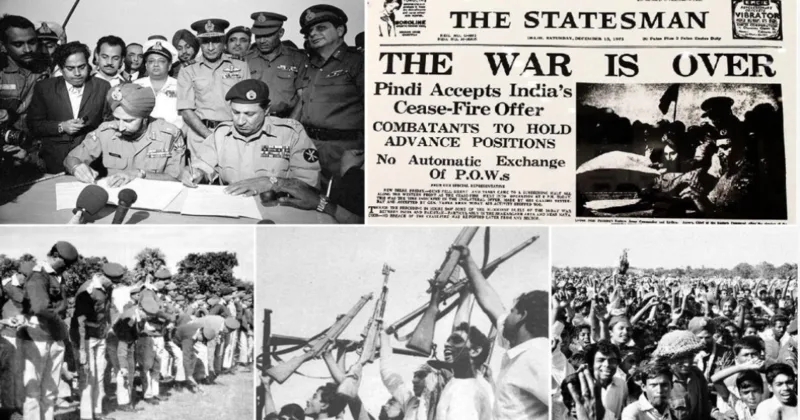
Vijay Diwas commemorates one of the most defining moments in the modern history of the Indian subcontinent, marking India’s decisive victory in the Indo-Pak War of 1971 and the birth of Bangladesh as a sovereign nation. Observed annually on December 16, the day signifies not merely a military triumph but the assertion of India’s moral resolve, strategic clarity, and humanitarian responsibility in the face of mass atrocities unfolding in East Pakistan. The surrender of over ninety thousand Pakistani troops before the Indian Armed Forces remains unparalleled in post-Second World War history, symbolising the professionalism, discipline, and ethical conduct of India’s military. Vijay Diwas therefore stands as a reminder of how India combined strength with restraint, power with purpose, and force with a commitment to justice.
The roots of the 1971 conflict lay in the political and cultural alienation of East Pakistan from its western wing since 1947. Despite forming a demographic majority, the people of East Pakistan were denied political representation, economic resources, and cultural dignity. The imposition of linguistic and administrative dominance from West Pakistan generated long-standing resentment, which reached a breaking point after the 1970 general elections. The refusal of the Pakistani establishment to honour the democratic mandate of the Awami League led to a brutal military crackdown known as Operation Searchlight. Widespread killings, targeted violence against intellectuals, and systematic atrocities against civilians created one of the gravest humanitarian crises of the twentieth century, compelling millions to flee across the border into India.
India’s involvement was not driven by expansionist ambition but by an unavoidable convergence of humanitarian, strategic, and security concerns. The influx of nearly ten million refugees placed immense economic and social pressure on Indian border states, stretching resources and threatening internal stability. At the same time, the continuation of violence in East Pakistan posed a direct security risk, as instability along India’s eastern frontier could not be allowed to fester. India’s leadership recognised that passive observation would amount to moral abdication and strategic folly. Thus, India chose to act, not as a conqueror, but as a facilitator of a people’s right to self-determination.
The Indian Armed Forces played a central role in translating this resolve into action. Through meticulous planning, joint coordination among the Army, Navy, and Air Force, and a clear understanding of terrain and timing, India executed one of the most efficient military campaigns in modern warfare. The eastern theatre witnessed rapid advances, decisive engagements, and minimal collateral damage, reflecting a doctrine that prioritised civilian safety while neutralising hostile forces. Indian soldiers fought alongside the Mukti Bahini, forging a partnership rooted in shared purpose rather than mere tactical convenience. This cooperation strengthened local resistance and ensured that liberation was achieved with the participation of the Bangladeshi people themselves.
The naval and air operations further demonstrated India’s strategic maturity. The blockade of East Pakistan effectively isolated Pakistani forces, while precision air strikes crippled supply lines and communication networks. In the western sector, India adopted a defensive posture, preventing the conflict from escalating into a prolonged two-front war. This balance between aggression and caution highlighted India’s intent to achieve clear objectives rather than pursue reckless escalation. The swift conclusion of the war within thirteen days underscored the effectiveness of India’s military leadership and the courage of its personnel, whose sacrifice ensured a just outcome.
India’s actions in 1971 also carried significant regional implications. The creation of Bangladesh altered the geopolitical map of South Asia, reducing the structural imbalance that had long fuelled conflict. A stable and friendly Bangladesh on India’s eastern flank enhanced regional security and opened avenues for economic and cultural cooperation. By supporting a secular and democratic aspiration, India reinforced the principle that enduring stability arises from political legitimacy and respect for popular will. The war thus served as a corrective moment, demonstrating that repression and denial of rights inevitably invite resistance and external consequences.
Internationally, India’s intervention faced considerable opposition and pressure. Several Western powers viewed the conflict through the prism of Cold War alliances, extending diplomatic and military support to Pakistan. India was subjected to threats, diplomatic isolation, and the suspension of aid, while naval posturing in the Indian Ocean sought to intimidate and constrain its options. Yet India remained steadfast, refusing to compromise its objectives under external pressure. This resistance to coercion reflected a growing confidence in India’s strategic autonomy and its willingness to bear short-term costs for long-term regional stability.
The aftermath of the war further revealed India’s responsible approach. Despite possessing overwhelming leverage, India refrained from punitive excesses and instead facilitated the return of refugees, supported reconstruction, and recognised Bangladesh promptly. Prisoners of war were treated in accordance with international norms, reinforcing India’s image as a civilisational state guided by ethical conduct even in victory. This restraint distinguished India’s actions from the brutalities that had precipitated the conflict, strengthening its moral standing globally.
Vijay Diwas therefore transcends the memory of battlefield success. It represents a moment when India aligned power with principle and demonstrated that military force, when employed judiciously, can serve humanitarian ends. The war of 1971 affirmed the Indian Armed Forces as a disciplined institution committed to national interest and regional peace, earning respect at home and abroad. It also reaffirmed India’s belief in standing with oppressed peoples without seeking territorial gain or ideological imposition.
In remembering Vijay Diwas, India honours the soldiers who fought with courage and compassion, and the values that guided their mission. The liberation of Bangladesh stands as enduring proof that decisive action, grounded in moral clarity and strategic foresight, can reshape history. The legacy of 1971 continues to inspire India’s approach to regional engagement, reminding the world that true strength lies not only in the ability to win wars, but in the wisdom to fight them for just and necessary causes alone.
Beyond the immediate military and diplomatic outcomes, the events leading to Vijay Diwas left a lasting imprint on India’s strategic culture and its understanding of responsibility as a regional power. The 1971 war demonstrated that restraint does not imply weakness and that preparedness combined with patience can yield decisive results. India waited until diplomatic avenues were exhausted, global opinion was informed of the humanitarian catastrophe, and military readiness was assured. This deliberate approach ensured that when action came, it was swift, legitimate, and difficult to challenge morally, even by those nations that opposed India’s stance for geopolitical reasons.
The war also reshaped India’s military doctrine, reinforcing the importance of joint operations and integrated command structures. The seamless coordination among the three services became a benchmark for future planning and remains a point of institutional pride. Lessons from the eastern theatre influenced training, logistics, and intelligence practices, strengthening India’s defensive and offensive capabilities without fostering militarism. Vijay Diwas thus signifies not only bravery on the battlefield but also the evolution of a professional armed force aligned with democratic oversight and national purpose.
For Bangladesh, India’s role in 1971 laid the foundation for a relationship rooted in shared sacrifice and mutual respect. The assistance extended during the liberation struggle created enduring goodwill, reflected in cultural exchanges, economic cooperation, and security collaboration in later decades. India’s support helped Bangladesh begin its journey as an independent state without the burden of foreign domination, allowing it to shape its own political destiny. This outcome reinforced the idea that regional stability is best achieved through cooperation rather than coercion.
The Western sanctions and diplomatic hostility that followed the conflict revealed the asymmetries of global power politics, where humanitarian crises were often subordinated to alliance considerations. India’s ability to withstand such pressure enhanced its self-confidence and contributed to a more assertive yet principled foreign policy in subsequent years. The experience underscored the importance of strategic partnerships, self-reliance, and clarity of national interest, lessons that continue to inform India’s global engagement.
Vijay Diwas also carries a profound psychological significance for the Indian people. It instilled confidence in the nation’s institutions and reaffirmed faith in the armed forces as protectors not only of territorial integrity but of ethical values. The victory countered narratives of post-colonial vulnerability and projected India as a nation capable of shaping its environment rather than merely reacting to it. This confidence did not manifest as triumphalism, but as quiet assurance rooted in demonstrated capability.
Vijay Diwas endures as a symbol of courage tempered by conscience, of strength exercised with responsibility, and of an army and a nation that rose to the demands of history with dignity and resolve.