






When the 11th edition of India International Science Festival (IISF) opened in Panchkula on December 6, 2025, it felt less like a conventional conference and more like a “science mahakumbh”. Over four packed days at Sector-5, Haryana’s satellite city turned into a live laboratory – with schoolchildren jostling for selfies with astronauts, researchers explaining polar science to farmers, and industry leaders debating Artificial Intelligence and future jobs under the banner of Viksit Bharat 2047.
Jointly organised by the Ministry of Science & Technology, Ministry of Earth Sciences, several national science agencies and Vijnana Bharati, with the Government of Haryana as host, IISF 2025 was held around the core theme “Vigyan se Samruddhi: Towards an Atmanirbhar Bharat” – Science for Prosperity and Self-Reliance. The festival’s broader motto, as articulated by Union Science & Technology Minister Dr Jitendra Singh, rested on three pillars: Celebration, Communication and Career. By the time the festival concluded on December 9, IISF 2025 had recorded more than 2 lakh footfalls, with around 1,800 students, 167 teachers and 32 resource persons participating in its major events, alongside hundreds of scientists, innovators and industry leaders.
“Celebration, Communication and Career”
Inaugurating IISF 2025, Dr Jitendra Singh was careful to stress what makes the festival different from a typical scientific meet. IISF, he said, was conceived as an open, public-facing festival, not a closed-door technical conference. It is meant to take Science “beyond laboratories and into the public domain”, allowing ordinary citizens, especially students and young researchers, to directly engage with India’s scientific achievements and emerging technologies. He framed IISF as a national platform built on celebration of achievements, communication of knowledge, and career opportunities for the next generation. “By bringing scientists, institutions and the beneficiaries of research onto one common platform, IISF reflects the government’s push to break silos between science ministries and link innovation with governance.”
Placed in the broader developmental context, Dr Singh underlined that Science and Technology now sit at the core of India’s economic and social transformation. In the last decade, the country has moved to a mission-mode approach expanding research infrastructure, improving talent pipelines, and embedding scientific thinking into governance, from sophisticated weather forecasting and early-warning systems to advanced polar research and digital public infrastructure.
Antarctica to AI: INDIA’S Science Footprint on Display
One striking feature of IISF 2025 was the way it compressed far-flung frontiers under one roof. At the inauguration, Dr Jitendra Singh interacted live with Indian polar scientists at Bharati station in Antarctica, reviewing ongoing research in the Southern Ocean and cryosphere.The “Science on a Sphere” installation, a globe-shaped digital display, became a major attraction, allowing visitors to visualise data on climate, oceans and weather in immersive form.
At the other extreme of the planet, space science came alive through exhibits from ISRO and the Department of Space. A special nine-minute film on India’s 63-year space journey walked visitors from the early days of sounding rockets to the latest AI-enabled systems, new propulsion technologies and missions like Aditya-L1. Secretary, Department of Space and ISRO Chairman Dr V. Narayanan noted that 57 Indian satellites currently support nearly 50 applications, a number expected to triple in coming years.

Complementing these were interactive sessions on Artificial Intelligence and Artificial General Intelligence (AGI). A high-level panel featuring experts from IIT Ropar, Intel, NVIDIA and Sarvam AI debated India’s path from AI adoption to AI leadership. They spoke about the IndiaAI Mission to train one crore youth in AI, develop sovereign Indian-language models, and build national compute capacity, repeatedly linking these efforts to the goal of Viksit Bharat@2047.
Matsya 6000 and the Blue Economy Push
If one exhibit symbolised India’s next leap into uncharted territory, it was Matsya 6000 – the country’s first indigenously developed human deep-sea submersible, showcased by the Ministry of Earth Sciences.
Dr Jitendra Singh Matsya 6000 as a flagship of India’s deep-ocean described. The mission aims to send Indian researchers to ocean depths of 6,000 metres, making India one of the few countries with ultra-deep-sea exploration capability. The roadmap, as shared at IISF, envisions a first 500-metre crewed dive in 2026, followed by a full-depth 6,000-metre mission in 2027.
Matsya 6000 was not presented in isolation. It anchored the broader Blue Economy conversations at IISF 2025, underlining how deep-sea exploration, marine biodiversity studies and ocean-bed resources fit into India’s long-term economic vision. Specialised sessions explored ocean-based renewable energy, coastal resilience, and the interface between ocean science and livelihood security for coastal communities.
New Nalanda of modern india
If IISF 2025 was a mela, then students were its heartbeat. Over the four days, more than 10,000 students thronged the venue, many of them from government schools and smaller towns across Haryana and neighbouring states.
The specially curated Students’ Science and Technology Village became a symbol of this youth-centric approach. Haryana Chief Minister Nayab Singh Saini, attending as Chief Guest on Day two, formally inaugurated the village and evocatively described it as the “New Nalanda” of modern India – a living campus where learners could interact directly with scientists, technologists and innovators.
Saini’s keynote went beyond ceremonial phrases. He urged scientists to “take science beyond the walls of laboratories and ensure that its benefits reach the last person in society.” True prosperity, he argued, comes when scientific knowledge helps a farmer increase crop yield, cures a patient’s illness, or empowers an entrepreneur to start a new venture.

Calling science “not just a career, but a medium for nation-building”, Saini reminded the young audience that they are the generation that will transform India into a developed nation.
“Viksit Bharat 2047 Is Your Mission”
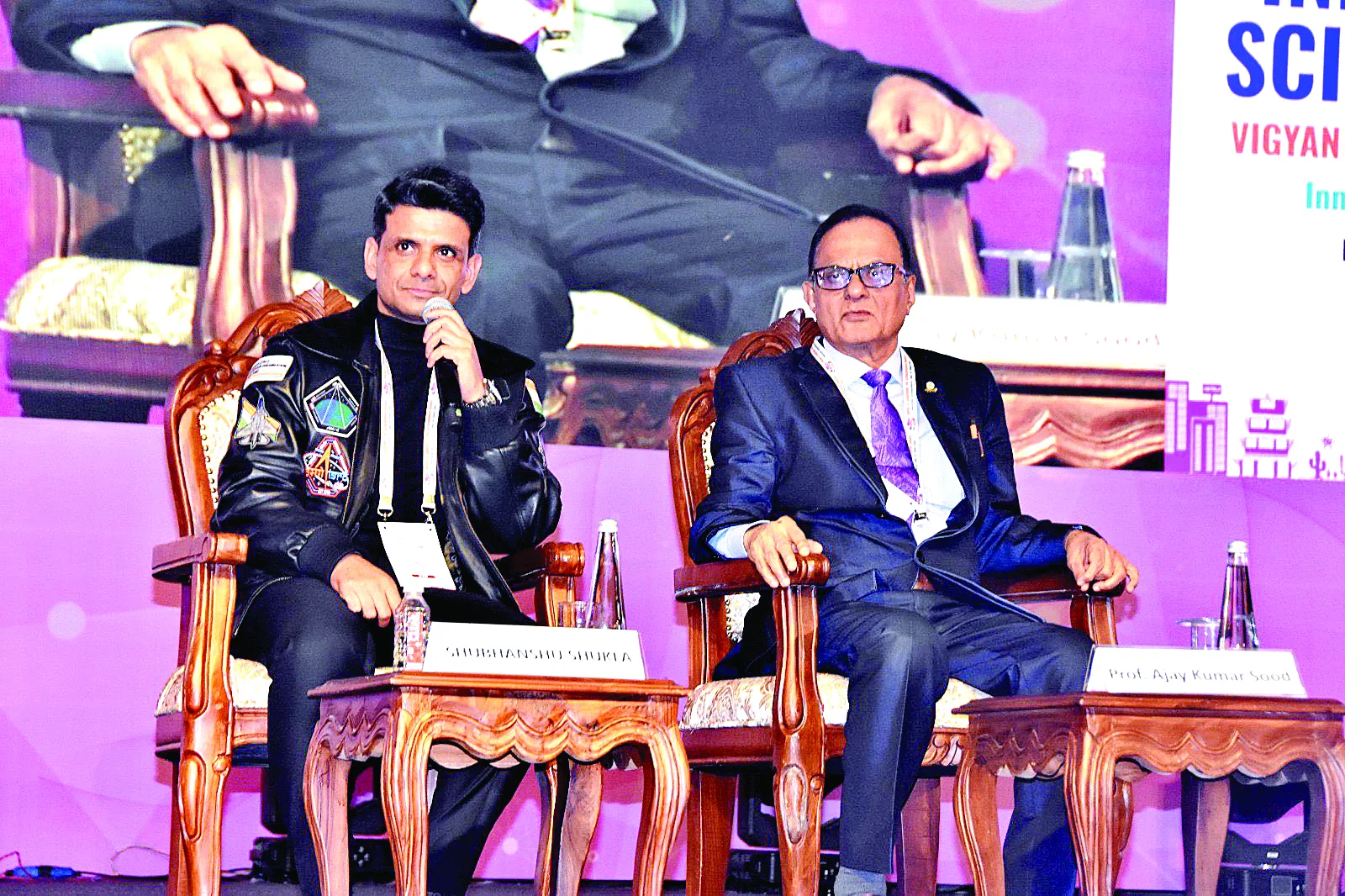
For schoolchildren, the star attraction was literally a man who had seen the stars up close. Group Captain Shubhanshu Shukla, the second Indian to travel to space, held an extended interactive session that became one of the most talked-about events at IISF 2025.
Shukla shared experiences from his nearly 20-day space mission – the thrill of watching Bharat appear “better than the entire world” from orbit, and the battery of scientific experiments he performed, many of them designed to support India’s human space-flight programme under Gaganyaan. While he spoke about experiments on India-centric food, medicines and new technologies in microgravity, it was his message to the youth that resonated most strongly. Shukla told students that the dream of a Viksit Bharat 2047 rests on their shoulders and that “when the youth progresses, the nation progresses.”
He also traced his own journey back to the day in 2018 when Prime Minister Narendra Modi announced from the Red Fort that an Indian son or daughter would soon go to space.
Khattar’s Call for “Responsible Intelligence”
On Day 3, Union Minister for Power and Housing & Urban Affairs Manohar Lal Khattar brought the conversation firmly into the domain of digital technologies and governance. Addressing a packed audience, he framed Artificial Intelligence as both a transformative and sensitive technology for India’s journey to Viksit Bharat 2047.
“AI is a good servant but a bad master,” he cautioned, arguing that while AI will drive growth through innovation, startups and new skills, it must be deployed with responsibility, transparency and public trust.
He located India’s AI story within a longer continuum from ancient Indian ideas of long-distance communication and knowledge networks to modern space missions and digital technologies that have “made the world fit in our palm.” By linking curiosity-driven experiments to major inventions, he encouraged students to keep asking questions, noting that today’s tinkering often becomes tomorrow’s breakthrough.
The ceremony closed with a vote of thanks from scientists of the Indian Institute of Tropical Meteorology, bringing the four-day celebration to a dignified finish.














Comments