






Lahore: Pakistan’s Lahore University of Management Sciences (LUMS) has concluded a landmark Sanskrit course, marking the first formal teaching of the ancient language in the country since the 1947 Partition. Academics have welcomed the initiative as a meaningful step toward reclaiming shared South Asian heritage and fostering regional cultural understanding.
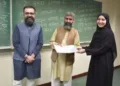
The course, titled “Introduction to Sanskrit Language and Literature,” was offered by the Gurmani Centre for Languages and Literature and formally wrapped up on December 9, 2025. The four-credit elective attracted undergraduate students, researchers, and faculty members from a wide range of disciplines.
What began as a modest three-month weekend workshop in early 2025 evolved into a full-fledged academic programme. The curriculum combined foundational Sanskrit grammar with close study of classical texts, including the Mahabharata and the Bhagavad Gita. Participants engaged with original passages, philosophical themes, and historical contexts, while accessible materials, such as Urdu adaptations of well-known Mahabharata motifs, helped ease students into the ancient language.
Scholars involved in the programme described it as a cultural bridge, emphasising its role in reconnecting Pakistan with a shared intellectual and literary past long studied primarily by foreign academics.
Dr Shahid Rasheed, the course instructor who is largely self-taught in Sanskrit through online resources, described the initiative as “a small yet significant step toward reviving the serious study of a language that has profoundly shaped philosophical, literary, and spiritual traditions across South Asia.”
His personal passion proved central to the programme’s success, helping transform casual academic curiosity into a structured and sustained learning experience. Dr Ali Usman Qasmi, Director of the Gurmani Centre for Languages and Literature, echoed this sentiment, drawing attention to the extensive collection of Sanskrit manuscripts at Punjab University, many of which have remained neglected since independence.
“We aim to produce scholars of the Bhagavad Gita and the Mahabharata from Pakistan within the next 10 to 15 years,” Qasmi said, adding that specialised follow-up courses are planned for spring 2026. The initiative faced no opposition from stakeholders. Instead, enrolment surpassed expectations, encouraging vibrant cross-disciplinary dialogue among students and faculty alike.
Pakistan’s renewed engagement with Sanskrit can be traced to the pre-Partition era, when the language flourished in universities across undivided India, from Lahore to Benares. Following 1947, however, religious sensitivities and geopolitical tensions pushed Sanskrit to the margins of academic life, leaving vast scholarly resources, such as Punjab University’s collection of more than 5,000 manuscripts, largely neglected or studied mainly by foreign researchers.
The LUMS initiative reflects a broader, gradual shift within Pakistan, marked by growing academic interest in the region’s Indic intellectual roots. This renewed curiosity is visible in efforts to revive folklore traditions and expand interfaith scholarly dialogue. Regionally, the move aligns with a wider South Asian trend, as universities from Dhaka to Delhi seek to localise the study of Indology, challenging long-standing colonial-era dominance over the interpretation of the subcontinent’s classical past.




![A Representative image [ANI Photo]](https://organiser.org/wp-content/uploads/2025/12/representative-image-e1765612818961-120x70.webp)



Comments