






More than a thousand years before the emergence of modern universities, India was home to one of the world’s most remarkable centres of learning: Nalanda Mahavihara, located in present-day Bihar. At the heart of this ancient intellectual hub was its renowned library complex, Dharmaganja, also called Dharma Gunj, which translates to “Treasury of Knowledge.”
According to archival research by CSE IIT Kanpur on ancient Indian libraries, Dharmaganja was far more than a single hall of manuscripts. It was an extensive, multi-building complex designed to accommodate thousands of resident students and teachers. The library comprised three major buildings, Ratnasagara, Ratnodadhi, and Ratnaranjaka, each dedicated to specific subjects and levels of scholarly study.
Young INTACH’s notes on educational heritage emphasise that Nalanda’s library was a comprehensive centre of learning, far surpassing the limited notion of a mere monastic bookroom. The Dharmaganja manuscripts encompassed a wide spectrum of subjects, including logic (Nyaya), grammar (Vyakaran), medicine (both Ayurveda and Buddhist medicine), astronomy (Jyotisha), mathematics, literature, linguistics, and global Buddhist philosophy.
The diversity of knowledge preserved at Nalanda is repeatedly confirmed in ancient travel accounts, particularly by the Chinese monk Xuanzang (Hiuen Tsang), who studied there in the 7th century CE. His writings, later translated by Victorian scholar Samuel Beal, describe “large storehouses of manuscripts” and offer vivid accounts of the rigorous scholarly activity that thrived around them.
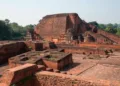
Archaeological investigations by the Archaeological Survey of India (ASI) corroborate the extensive intellectual activity at Nalanda. Excavations have uncovered large monasteries, lecture halls, and storage rooms that are believed to have formed part of the library complex. Although folklore sometimes exaggerates the number of storeys or manuscripts, historical records consistently recognise Dharmaganja as one of the largest repositories of knowledge in ancient Asia.
The UNESCO World Heritage dossier highlights that scholars from China, Korea, Tibet, Japan, and Southeast Asia travelled to Nalanda specifically to access its library resources. Many returned home with manuscripts copied at Dharmaganja, helping to disseminate Indian knowledge traditions across Asia.
The library’s destruction in the late 12th century, documented in later Persian chronicles and acknowledged in modern historical accounts, is regarded as one of the greatest intellectual losses in world history. Yet Dharmaganja’s legacy endures through the manuscripts carried abroad, the archaeological remains at the site, and the continued global recognition of Nalanda as a symbol of India’s ancient academic excellence.











Comments