





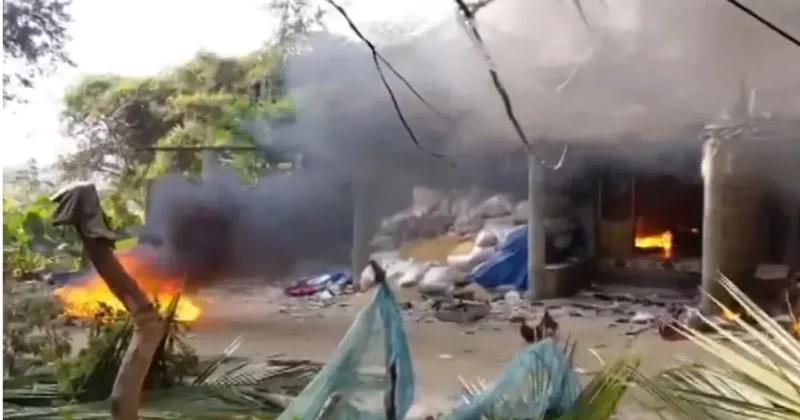
BHUBNESHWAR: After the headless body of a Koya tribal woman, Lake Padiyami, was discovered in Rakhelguda village of the Malkangiri district, and several houses belonging to Bengali Hindu families in MV-26 village were set ablaze, the situation is now gradually returning to normal. The administration and police are actively engaging with the community to restore peace.
Hindu refugees displaced from East Pakistan and resettled in this region have lived here for nearly seven decades. For a long time, the local tribal community and the resettled Bengali Hindus maintained harmonious relations, shared livelihoods, and coexisted peacefully. What forces are now creating an atmosphere of distrust between these once-coexisting communities and inciting such violence?
To understand the sensitivity of the region, its historical context must be considered
In 1955, the Government of India launched the Dandakaranya Development Project (DNK Project) to rehabilitate Hindu refugees arriving from East Pakistan. This initiative saw thousands of displaced Hindu families settled in the forested areas of Koraput, Malkangiri, Nabarangpur, and neighboring regions. They were provided with land, basic amenities, and later granted Indian citizenship. Over the decades, these communities—now Indian citizens—have become productive in agriculture and have significantly contributed to local development through education, healthcare, and small-scale economic activities.
However, these areas also lie within a belt long affected by Maoist activities, extending from Bastar and Jagdalpur in Chhattisgarh to Srikakulam–Parvathipuram in Andhra Pradesh. Maoist groups have historically sought to exploit local grievances, land insecurities, and misunderstandings between communities to strengthen their influence.
In recent years, several organizations with the intent of dividing Indian society including certain so called “Moolnivasi” groups and other external outfits have become active in the region. Reports indicate that individuals from outside the district have been attempting to spread divisive narratives. Such claims aim to create distrust between the peaceful Koya tribals and the Bengali Hindu families (Banglabhasi) who have lived here for nearly seventy years.
It is noteworthy that these communities have shared positive relations, livelihoods, and peaceful coexistence for decades. However, extremist groups are now attempting to incite tensions through false narratives.
Regarding the murdered woman, the disputed agricultural land had been under cultivation for years. Contrary to some rumors, it is reported that she did not intend to reclaim the land from the Bengali family; regular rent payments were allegedly being made.
Local sources, however, suggest another angle: a local leader and his family members were reportedly pressuring the woman to return the lease amount to the Bengali farmers so they could take control of the land and its benefits themselves. This indicates that the matter may be more closely linked to local political interference than to any community-level conflict.
It is also observed that Maoist elements, certain political groups, and extremist outfits may have exploited this incident to provoke tribal villagers. The sudden scale and intensity of violence suggest organized mobilization rather than a spontaneous reaction. Despite some locals perceiving that the administration favors tribal groups, many believe the violence was instigated by Maoist-backed networks.
A social worker with years of experience in the area stated that the simultaneous attacks on the villages and the widespread arson clearly indicate the involvement of forces attempting to disrupt social harmony and incite hostility. He emphasized that both the local tribal population and the Bengali-speaking Hindu residents are simple, peace-loving people. Such an incident could not occur without the influence of anti-India forces and Maoist elements.
He underscored the need for the administration to identify and take strict action against those responsible for the incident. Otherwise, he warned, more such occurrences may arise in the future—events that the administration might be unable to control.
Leaders of the Bengali community from nearby villages submitted a memorandum to the District Collector requesting:
A high-level investigation into what they describe as an “orchestrated and pre-planned” attack,The arrest of all accused within 72 hours,Adequate compensation for affected families, and A thorough and impartial investigation into the woman’s murder.
Peace Committee Meeting Successful, Communities Decide to Live Together Harmoniously
To restore peace, the district administration convened a joint peace committee meeting with representatives from both communities, resulting in a path toward resolution.
On Tuesday evening, the peace committee meeting was chaired by Malkangiri District Collector Somesh Upadhyay. The proposal put forth by the administration for restoring peace received support from both tribal representatives and members of the Bengali community. It was also agreed that both villages would put aside recent incidents and resume harmonious coexistence as they had before.
The meeting included the District Collector, SP, DIG, MLA Narsingh Madkami, and leaders from both sides. In the murder case, police have detained two suspects, one of whom has been produced before the court.
District Collector Somesh Upadhyay ordered the suspension of mobile and broadband internet services in the district for 24 hours to prevent the spread of rumors on social media following the violence. On Saturday, nearly 5,000 tribals from Rakhelguda, armed with traditional weapons—axes and bows and arrows—marched toward MV-26 village under the jurisdiction of Korukonda police. The crowd set at least four structures on fire, damaged numerous houses, vandalized vehicles, and looted shops belonging to approximately 100 Bengali families residing there.
SP Upadhyay stated that the temporary suspension of internet services was necessary to combat misinformation. Efforts to restore normalcy in the area have been intensified. Community kitchens and temporary shelters have been established for affected families. Damage assessments of the destroyed houses have begun, and assistance will be provided according to SRC guidelines once the report is completed.












Comments