





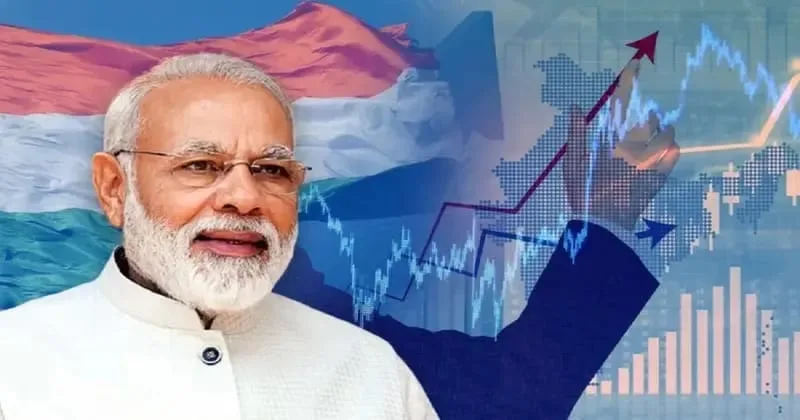
Bharat’s economic journey over the past decade reflects more than high growth numbers; it represents a deeper shift in national capability, confidence and economic direction. At a time when many large economies have struggled with inflation, sluggish demand and policy uncertainty, India has emerged as one of the world’s most resilient performers. GDP growth in Q2 FY26 again crossed 8 per cent, driven by strong manufacturing, buoyant services, high construction activity and a steady revival in private consumption. Inflation, which unsettled advanced economies, has remained largely within the RBI’s tolerance band for most of the past two years.
This momentum is visible on the ground. Passenger-vehicle sales crossed 4.3 million units in Financial Year 2025, while two-wheeler sales approached 20 million. Urban housing transactions hit their highest levels in more than a decade. Festive-season retail spending, especially during Deepawali, surged past earlier benchmarks, indicating strong household sentiment. These trends confirm a wider shift towards aspiration-led consumption across both urban and semi-urban India.
A key enabler of this demand surge is India’s changing socio-economic profile. According to the World Bank’s Spring 2025 Poverty and Equity Brief, India lifted 171 million people out of extreme poverty between 2011–12 and 2022–23. The proportion of citizens living in extreme poverty fell from 16.2 per cent to just 2.3 per cent. This expanding middle class is now driving consumption in automobiles, electronics, housing and services, reinforcing the domestic growth cycle.
New Economic Architecture
At the core of this transformation lies a new economic architecture shaped by Prime Minister Narendra Modi, a framework combining fiscal discipline, institutional reform, formalisation, manufacturing revival and digital governance. The Goods and Services Tax stands out as a structural milestone, replacing a fragmented indirect tax system with a unified national market. GST rationalisation reduced compliance costs, improved logistics efficiency and widened market access for businesses of all sizes.
Boost to Swadeshi Manufacturing
A major dimension of this new economic strategy has been the rise of MSMEs and the strengthening of domestic value chains under the Aatmanirbhar Bharat and Swadeshi thrust. MSMEs contribute nearly 30 per cent of GDP, over 45 per cent of manufacturing output and almost half of India’s exports. Over the past decade, formalisation through GST, digital invoicing and the UPI ecosystem has expanded their market access and reduced compliance barriers. The Emergency Credit Line Guarantee Scheme (ECLGS) supported more than 1.2 crore small units during the pandemic, helping them revive operations and protect jobs. These measures have produced visible outcomes: Indian toys, handlooms, coir products, agro-based industries and domestic electronics brands have significantly increased market share, reducing import dependence in several categories. India now produces almost all mobile phones sold domestically, demonstrating how Swadeshi-driven manufacturing is improving self-reliance while boosting exports.
The revival of India’s financial system has been equally important. When PM Modi took office, public-sector banks were burdened with stressed assets and stalled projects. The government undertook structural repair through the Insolvency and Bankruptcy Code, bank mergers and large-scale recapitalisation. As NPAs fell to their lowest levels in years, credit flow revived across infrastructure, MSMEs and manufacturing.
Push to reforms during pandemic
The COVID-19 crisis became a turning point. While many nations experienced prolonged disruption, India used the period to accelerate long-term reforms. The Production-Linked Incentive (PLI) schemes encouraged global supply chains to shift manufacturing to India in sectors such as electronics, pharmaceuticals, medical devices, EVs and solar modules. Apple exported nearly $10 billion worth of iPhones in the first half of FY25, and India now reportedly accounts for around 20 per cent of global iPhone production.
Infrastructure expansion has been another powerful engine of growth. The national highway network expanded from about 97,000 kilometres in 2014 to over 146,000 kilometres in 2024, with daily highway construction rising from 12 to nearly 30 kilometres. Operational airports doubled from 74 to 149, transforming regional connectivity through the UDAN scheme. Railway capital expenditure rose five-fold, enabling modernised stations, dedicated freight corridors and expanded Vande Bharat services. India’s ranking in the World Bank’s Logistics Performance Index improved from 54 to 38, reflecting major efficiency gains.
International institutions have taken note. The IMF projects that India will cross the $4-trillion mark in FY26, reach nearly $5 trillion in FY28 and exceed $6 trillion by 2030.
What defines this moment is not just growth but the nature of growth. India is moving from a consumption-led, import-dependent model to one anchored in investment, manufacturing, technology and exports. This shift reflects a deeper economic self-confidence, the belief that India can produce for itself, compete globally and build resilient supply chains.













Comments