





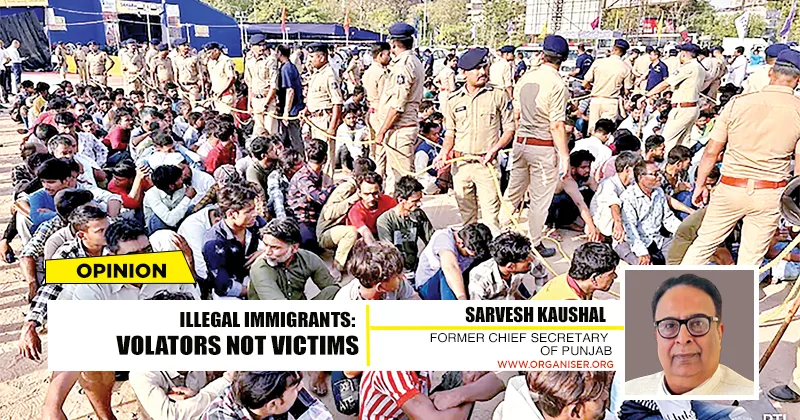
Chanakya cautioned centuries ago that a State that cannot identify its internal threats will never survive its external ones. The Trump Doctrine – ‘Borders Define a Nation’ – embodies the same principled stand: that a nation which cannot enforce its borders or distinguish citizens from trespassers is not a sovereign state—it is a zone of political vulnerability.
Sharing Common Commitment
The United States of America, and Bharat, —two of the world’s largest democracies—stand today on common ground. President Trump’s and Prime Minister Modi’s policies highlight a fundamental truth: illegal immigration erodes economic stability, burdens local services; and most importantly, corrodes the integrity of democratic representation.
Across Europe, Asia, and the Islamic world, the message is the same: a nation exists for its citizens. Its resources, its institutions, its democracy—all must serve those who lawfully belong to it. This is not exclusion. This is justice—it is about legality, fairness, and constitutional order.
Stringent Rules in Islamic Nations
In Islamic countries, the enforcement of this principle is even stricter. Saudi Arabia does not offer citizenship even to those born and raised in the kingdom. Political rights are non-existent for foreigners, and illegal immigrants are routinely arrested and deported. The United Arab Emirates, where over 80 per cent of the population comprises expatriates, allows only Emiratis to vote or hold public office. Even long-term foreign residents enjoy no path to naturalisation. Qatar and Indonesia maintain similar rules. Their messages are clear and unapologetic: citizenship is not a courtesy—it is a covenant.
When foreign nationals, or other illegal voters, often under forged identities, begin to determine who governs a nation, the republic ceases to represent its rightful citizens. The longer such distortion is tolerated, the more irreversible the damage becomes. Any type of bogus voters on electoral rolls is not a casual oversight; it is a constitutional subversion.
Correcting Democratic Manipulation
The Election Commission of India recently conducted Special Intensive Revision (SIR) of electoral rolls in Bihar SIR emerges as a long-overdue act of national rectitude. Bihar, with nearly 80 million registered voters, was the testing ground for the Commission’s commitment to the constitutional principle that only citizens shall vote. The exercise is fully within the legal mandate of the Commission under Article 326 of the Constitution and the Representation of the People Act.
The need was urgent as in States like Assam, West Bengal, and parts of Delhi and Uttar Pradesh, demographic manipulation through illegal immigration has reportedly altered electoral outcomes.
No functioning State can be indifferent to its demography, blind to its borders, or neutral about its voter rolls. An all-India NRC, implementation of the CAA rules, Aadhaar-voter card synchronisation, and criminal penalties for voter fraud are no longer controversial ideas. They are survival strategies for the world’s largest democracy.
There is nothing wrong in the door-to-door verification by Booth Level Officers (BLOs) in Bihar, seeking mandatory proof of place of birth and citizenship; removal of deceased, duplicate, migrated, or foreign illegal immigrants from the rolls; and digital verification through ECINET and, most significantly, participation of political party representatives at the booth level. It had been widely reported that as of July 19, 2025, the Election Commission of India (ECI) announced that 95.92 per cent of Bihar’s 7.90 crore electors have been covered under the SIR, with over 7.5 crore having submitted enumeration forms, and only about four per cent, or about 32 lakhs, remaining pending. The ECI has stated that Booth Level Officers have done more than three rounds of house-to-house visits to reach voters in the presence of political representatives.
Judicial Nod
The beauty of Bharatiya democracy is that the legislative and executive initiatives are put to the sacred test of constitutionality by its judiciary. The SC has recently refused to stay the ECI’s conducted Bihar SIR, (June 24, 2025–September 30, 2025) affirming that electoral roll revision is within the Commission’s constitutional mandate. Simultaneously, the Apex Court rightly reminded the ECI that adjudication regarding citizenship essentially belongs to the jurisdictional domain of Ministry of Home Affairs, and ECI will cautiously confine itself to the voters’ verification process only.
Ensuring that the voters’ verification process is neither harsh nor exclusive, EC was directed by the Supreme Court to ensure that eligible voters—especially from vulnerable groups—aren’t inadvertently disenfranchised. However, the scrutiny can go on as a strict and fool-proof process in national interest to weed out illegal voters.
Orchestrated political outrage by the parties that have historically relied on illegal entrants as electoral assets have branded the exercise as exclusionary or even discriminatory. But asking for documentary evidence of one’s citizenship is certainly not oppression—it is order. It is not ‘marginalisation’—it is ‘constitutionalism’.
False Accusation Against Bharat
This double standard must end. It is ironic that when Bharat undertakes even moderate verification efforts to cleanse its voter rolls of foreign influence, it is met with hysterical accusations of fascism, communalism, and authoritarianism. The same critics who admire France’s secularism, Japan’s discipline, or the UAE’s efficiency, refuse to acknowledge Bharat’s sovereign right to enforce its laws and defend its democracy.
Let there be no doubt about the correctness of public policy: illegal immigrants and other illegal voters are not victims—they are violators. The time has come to make a moral and constitutional distinction: while all humans deserve dignity, only citizens have the right to decide a nation’s future. Let India rise—firm, fair, and fearless.













Comments