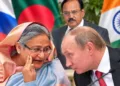
PM Modi handing over the Bhagavad Gita in Russian edition to Putin at Palam Delhi Airport was not just a routine gesture. It marked India’s turn to ‘civilizational diplomacy’ – a mode where one’s cultural past becomes a living tool of the country’s foreign policy. Since Gita is worldwide a perennial philosophical text, its employment in diplomacy speaks of India’s soft power projection being in tandem with a firm strategic engagement.
A visit beyond protocol: Renewing an enduring partnership
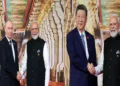
Warmth and symbols of depth marked President Putin’s arrival in New Delhi. The personal greeting by Prime Minister Modi, the joint car ride and the dinner at home were some of the ways showing how important India considers its relationship with Russia. The reception at Rashtrapati Bhavan, going with a 21-gun salute, was a visual expression of the long-term “Special and Privileged Strategic Partnership”.
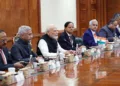
The visit beyond ceremony, had real results. Russia has assured the continuation of energy exports for India and they agreed on deepening defence cooperation. One of the economic moves to highlight is Indian companies getting ready to collaborate with Uralchem – the Russian fertilizer producer – to set up a urea plant in Russia. Collectively, these moves have not only preserved but have also made the India-Russia relationship resilient and flexible amid the changing global order.
India’s strategic autonomy reinforced
In a conversation with the Indian Press, President Putin pretty much challenged the US to stop pressurizing India to limit its purchases of Russian energy. Highlighting the fact that western countries are still doing a considerable amount of fuel and commodity trade with Russia, he underlined that India’s decisions are absolutely legitimate.
India’s stance towards Russian oil is in harmony with its fundamental principle of strategic autonomy. Even though New Delhi has strong relations with the United States, it has made it clear that it will not allow the geopolitical forces to decide its energy needs or foreign policy priorities. Putin also conceded that while there have been minor fluctuations in total trade earlier this year, the energy partnership is still going on and is strong.
While global tension is increasing and the world is moving towards a multipolar system, India’s ability to play one major power against another without giving up her sovereign choices is her greatest diplomatic asset. Despite global tensions escalating and the world slowly becoming a multipolar one, India’s skill to juggle the major powers without losing her sovereign rights stands out as her main diplomatic power.
The structure of the strategic partnership
Institutional mechanisms of cooperation, structured institutional dialogues, mainly through the India-Russia Intergovernmental Commission(IRIGC), form the basis of the India-Russia cooperation.
These are:
- IRIGC-TEC – devoted to trade, economics, science, technology and cultural collaboration
- IRIGC-M&MTC – concentrating on military and technical cooperation
- Both countries in 2021 decided to hold the 2+2 Dialogue also. The Foreign and Defence Ministers hence meet simultaneously. It indicates the strategic importance that is given to the relationship
Parliamentary cooperation
Dialogue at the parliamentary level is one of the many ways through which the executive-level dialogue is supplemented. The Inter-Parliamentary Commission, co-chaired by the Speaker of the Lok Sabha and the Chairperson of the Russian State Duma, has been together on several occasions since it was formed.
High-level visits in 2024 and 2025, among other things, participation in the BRICS Parliamentary Forum and the Asian Parliamentary Assembly, emphasize the raising of cooperation at the legislative level.
After the Pahalgam terror attack, an all-Part-party delegation went to Russia to show India’s united front against terrorism. Such interactions guarantee political consistency and deepen people-to-people relations between the two countries.
Scientific and technological synergy
Science and technology have been and are still one of the essential pillars of India-Russia relations. Russia has been a partner for India in the areas of nuclear energy, space missions, basic sciences, nanotechnology and materials research right from the early post-independence years till the modern-day projects. The Kudankulam Nuclear Power Plant can be cited as an example of Indo-Russian technological collaboration. Gaganyaan, the first Indian manned space mission, has benefited significantly from the knowledge and skills of the Russian side.
The Roadmap on Science, Technology & Innovation (2021) is geared at the tech sector by enabling the innovations to become viable business models and providing the support to the frontier research. The regular meetings of the Russia-India Working Group on S&T are a testament that the collaboration not only continues but also ventures into the new fields of global significance.
The ties of spiritual diplomacy
The ceremonial gifting of the Bhagavad Gita is a perfect example of moving beyond superficial ties to forming substantive bonds based on a common philosophy. In fact, Lord Krishna, who is often seen as the most brilliant strategist and the ultimate guide in the Gita, can be taken as an embodiment of the ideal in the world of international relations—duties, clear perspective and brave sticking to one’s morals. India’s act of presenting the Gita to the world was a clear signal that not only is she willing but also eager to take out of her vast pool of wisdom her best ideas to be used in contemporary international relations.
The gesture stands as a testament to India’s soft power diplomacy strategy, whereby cultural stories become the driving force of geopolitical friendships. Russia has always been a great fan of Indian spiritual literature, yoga and philosophical thought. Therefore, the Gita is not only a religious text about Hinduism, but it is also a new mode of communication in foreign relations based on the shared cultural roots of the two great civilizations.
On a global scale, occidental societies have also started to value more and more Indian knowledge systems, yoga, meditation and philosophical teachings. Such an improving cultural covenant substantially boosts India’s diplomatic clout and thus, she becomes a sort of superpower whose messages are easy to understand for different cultural groups across the globe.
Indial’s immersion in culture is having a multiplier effect on her foreign diplomacy. The act of bequeathing the Gita to President Putin captures the essence of a diplomacy that not only employs strategic realism but is also enriched with insight coming from morality and civilization. As the Indian Government goes about the tough game of geopolitics where it has to weigh its options between Russia, the West and the rise of global blocs, what is constantly left on the table might very well be the master card—the seamless fusion between cultural heritage and modern statecraft.
By spiritual diplomacy, institutional cooperation, scientific collaboration and strategic autonomy, India is steadily carving out a uniquely India brand of global leadership—one that is based on the consonance of values and interests.