





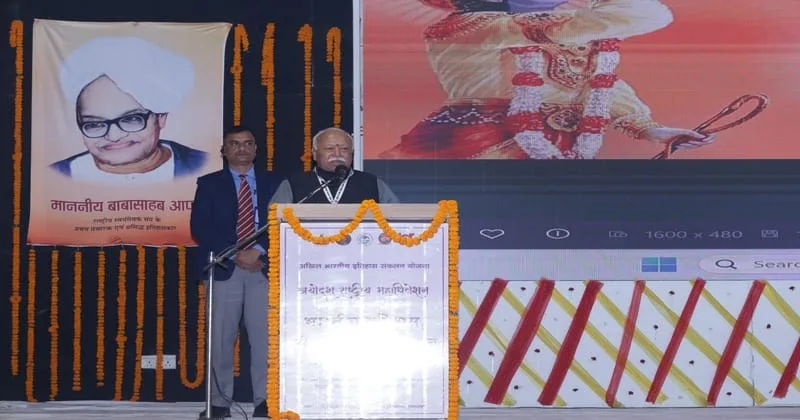
Patti Kalyan, Samalkha: A seminar on “Bharatiya History, Sanskriti and Constitution” is being organised by the Akhil Bharatiya Itihas Sankalan Yojana (ABISY) from December 5–7, 2025, at Madhav Seva Nyas, Patti Kalyan, Samalkha (Panipat). RSS Sarsanghchalak Dr Mohan Bhagwat inaugurated and viewed an exhibition on “Jammu–Kashmir–Ladakh” curated by the Indian Council of Historical Research.
The inauguration ceremony was graced by Chief Guest Dr Mohan Bhagwat; Special Guest Union Culture Minister Gajendra Singh Shekhawat; Padma Shri Prof Raghavendra Tanwar, Chairman, ICHR; ABISY Chief Patron Gopal Narayan Singh; National President Dr Devi Prasad Singh; Working President Prof Ishwarsharan Vishwakarma; and National Organising Secretary Dr Balmukund Pandey.
Addressing the gathering, Dr Bhagwat said that the Constitution is a written testimony of how the nation must function. However, long before its existence, Bharatiya society had sustained itself without formal governance systems or written constitutions. What sustained social life then, he said, was Dharma, not religion, but a natural principle that upholds, harmonises, and ensures well-being for all. Dharma balanced relationships and ensured mutual protection, making kings and constitutions unnecessary in earlier ages.
As human intellect declined through the yugas, from Satya to Treta, Dwapara, and now Kali Yuga, the need arose first for kings and later for a constitutional framework to prevent adharma. The Constitution empowers governance but is rooted in Dharma, he said. It ensures discipline, safeguards sanskriti, and maintains social balance. He emphasised that the Constitution’s essence lies in the collective spirit, reflected in its very first word, “We.” British rule, he noted, never recognised this idea of “we,” considering Bharat merely a collection of nations. In contrast, the Constitution affirms “We, the people of India,” a sentiment that has existed since ancient times, also visible in the artwork printed in the Constitution.
Dr Bhagwat stressed the need to present historically accurate facts, correct interpretations, and the civilisational continuity that links Bharatiya sanskriti with constitutional values. True understanding of Dharma and sanskriti, he said, arises from truthful history. This collective awareness will strengthen society and enable Bharat to show a new path to the world. He called for united efforts to pursue this mission.
Union Minister Gajendra Singh Shekhawat said that rewriting history is essential. Fifty years ago, it was unimaginable that Bharat would enter a phase of national resurgence where history would be viewed through the lens of Bharatiya sanskriti. “Who are we?” This question defines Bharatiya history, he said. Despite two thousand years of invasions, Bharat’s civilisational continuity has survived. He added that AI should be effectively used for historical research and the digitisation of manuscripts. Prof Raghavendra Tanwar said that understanding the Constitution requires understanding Bharat and its sanskritik foundations. The Partition fractured Bharatiya society, he noted.
Gopal Narayan Singh said that centuries of invasions scattered Bharat’s historical narrative, but efforts being done by the Itihas Sankalan aimed to reconstruct it through systematic historiography are commendable.
Dr Devi Prasad Singh, through his poem “If the Constitution Had a Voice,” highlighted that the Constitution cannot be separated from Bharatiya sanskriti.
The event was attended by senior RSS functionary Suresh Soni, Uttar Kshetra (North Zone) Sanghchalak Pawan Jindal, and several others. The ceremony was conducted by Prof Ishwarsharan Vishwakarma, and the vote of thanks was delivered by Dr Ramesh Dhariwal.
Around 1,500 historians from across the country participated. On the first day, 120 research papers were presented; around 230 more will be presented over the next two days.



Comments