





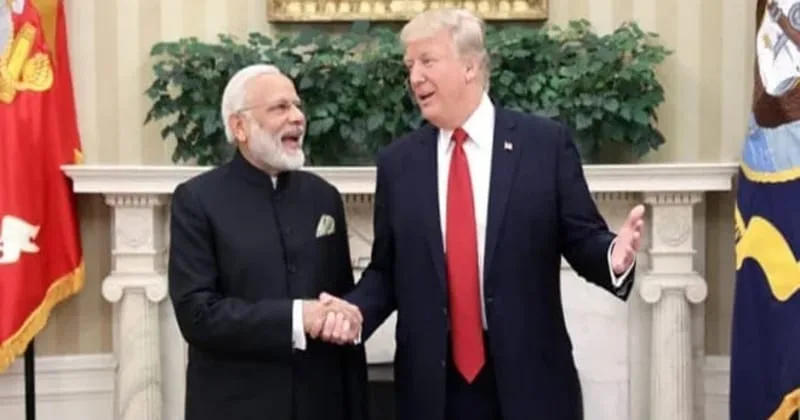
The Trump administration has cast India as a central pillar of its newly released National Security Strategy, underlining Washington’s intent to expand cooperation with New Delhi in economic, technological and defence domains.
The strategy document, issued by the White House, highlights India’s growing importance in US foreign policy and signals a stronger diplomatic focus on advancing bilateral commercial ties. It urges closer economic engagement and encourages India to play a more active role in maintaining stability in the Indo-Pacific through continued participation in the Quadrilateral Security Dialogue alongside Australia, Japan and the United States. The document underscores the view in Washington that strengthening relations with India is essential to advancing US interests in the region.
The Indo-Pacific is described as a region of exceptional global significance, already accounting for nearly half of worldwide economic output and expected to be a major centre of geopolitical and economic competition in the century ahead. Against this backdrop, the strategy outlines a plan for the United States to work closely with treaty allies and strategic partners whose combined economic weight is estimated at around $65 trillion. This coalition is seen as a counterweight to what the administration characterises as unfair and coercive economic behaviour in the region.
India figures prominently in this broader strategy due to its expanding economy, strategic geography and growing global profile. The administration places particular emphasis on deepening cooperation in advanced and emerging technologies, identifying areas such as artificial intelligence, quantum computing and defence-related innovation as key pillars of future engagement. These sectors are viewed as critical not only for economic competitiveness but also for long-term security. The document reiterates strong US support for quadrilateral cooperation under the Quad framework, portraying it as a vital diplomatic and security mechanism in the Indo-Pacific. Washington sees the grouping as central to maintaining stability in the region, safeguarding open sea lanes and ensuring freedom of navigation in strategically important waters.
On the military front, the strategy sets out plans to develop forces capable of deterring or blocking hostile actions across the First Island Chain. It simultaneously calls on allies and partners to take on greater responsibility for collective defence, both in terms of financial contributions and operational commitments. Regional flashpoints such as Taiwan and the South China Sea are highlighted as issues of major concern, particularly given the volume of global trade that transits these waters each year. Branded under the title “America First,” the new National Security Strategy reflects a shift from approaches adopted by previous administrations. It stresses a more interest-driven and transactional form of engagement, prioritising practical outcomes over ideological alignment. In this context, India is portrayed as well placed, as the strategy downplays efforts to push political or social reform in partner countries and instead focuses on cooperation based on shared objectives and reciprocal gains.
Economically, the strategy presents rivalry with China as a contest over supply chains, critical minerals and leading-edge technologies, including artificial intelligence, biotechnology and quantum systems. Allies and partners are encouraged to align with US-led standards and regulatory controls. At the same time, the emphasis on balanced trade and domestic reindustrialisation sits uneasily alongside recent tariff hikes and trade pressures directed at Indian exports and energy relations with Russia.













Comments