





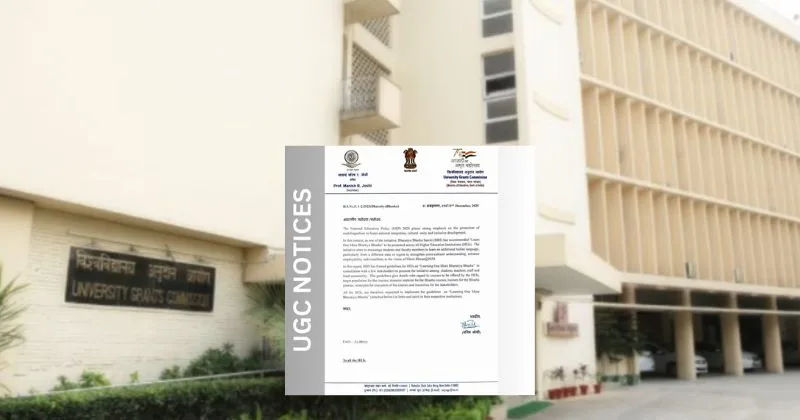
NEW DELHI: The University Grants Commission (UGC) has directed all higher education institutions (HEIs) to implement the “Learn One More Bharatiya Bhasha” initiative, recommended by the Bharatiya Bhasha Samiti (BBS) under the National Education Policy (NEP) 2020. The circular, issued by UGC Secretary Prof. Manish R. Joshi, calls on universities and colleges to adopt the guidelines in “letter and spirit” to promote multilingualism and national integration.
The official notice, issued on December 2, 2025 by Prof. Manish R. Joshi, Secretary of the UGC, calls upon universities and colleges to adopt the initiative “in letter and spirit.” The circular highlights that multilingual learning is not just an academic exercise, but a social and cultural investment that strengthens India’s unity in diversity.
The “Learn One More Bharatiya Bhasha” initiative is designed to encourage both students and faculty members in higher education institutions to learn an additional Indian language, particularly one spoken in a different state or region. This approach aims to create deeper cross-cultural understanding, break regional barriers, and promote mutual respect among India’s diverse linguistic communities.
📢 UGC Updates
HEIs are requested to implement the guidelines issued for the “Learn One More Bharatiya Bhasha” initiative recommended by the Bharatiya Bhasha Samiti under NEP 2020.
The initiative encourages students and faculty to learn an additional Indian language—especially… pic.twitter.com/06KnvyVPbn
— UGC INDIA (@ugc_india) December 3, 2025
According to the UGC, learning another Bharatiya language will help participants appreciate India’s vast cultural richness while improving communication, collaboration, and employability in a multilingual nation. The initiative also supports the government’s larger vision of Viksit Bharat@2047, which envisions a developed and culturally cohesive India by the 100th year of independence.
The Bharatiya Bhasha Samiti (BBS), functioning under the Ministry of Education, has played a key role in designing and preparing the guidelines for this initiative. The committee consulted with various stakeholders including students, teachers, and members of local communities to make the framework both practical and inclusive.
These guidelines provide details on the courses to be introduced, target population, training modules, teaching materials, and incentives for institutions that successfully implement the programme. They also recommend strategies for engaging trainers who are proficient in various regional languages to ensure effective learning outcomes.
The BBS has further suggested that HEIs integrate the language-learning initiative into existing academic structures, such as elective courses or cultural clubs, so that students can pursue it alongside their regular curriculum without additional academic pressure.
Through this initiative, the UGC aims to make higher education more holistic by bridging linguistic divides. When students learn an additional Indian language, for example lets say, a Tamil-speaking student learns Bengali, or a Hindi-speaking student learns Malayalam, they develop a greater sense of empathy and understanding toward different cultures. This multilingual exposure is expected to enhance students’ employability, especially in government, corporate, and tourism sectors, where knowledge of multiple Indian languages is increasingly valuable. It also nurtures communication skills, adaptability, and social awareness, qualities essential for global citizens in a culturally diverse democracy. The initiative extends to faculty members as well. Teachers who learn an additional language can better engage with students from other linguistic backgrounds, encourage exchange programmes, and participate in inter-state collaborations.
The “Learn One More Bharatiya Bhasha” initiative fits seamlessly within this framework, linking linguistic inclusivity with India’s long-term developmental vision of Viksit Bharat@2047. By 2047, the government aims to position India as a knowledge-driven society that respects its linguistic diversity while ensuring access to education in multiple languages.
The UGC has made it clear that all higher education institutions must actively promote and execute the guidelines provided by the Bharatiya Bhasha Samiti. Universities and colleges are expected to design short-term and long-term courses, organize workshops, and collaborate with local language experts to make the initiative widely accessible.
Institutions may also offer incentives such as credit points, certificates, or recognition to encourage participation among students and staff. The UGC has urged colleges to maintain proper documentation and share progress reports on the implementation process, ensuring that the spirit of the NEP 2020 is reflected in real outcomes.
















Comments