





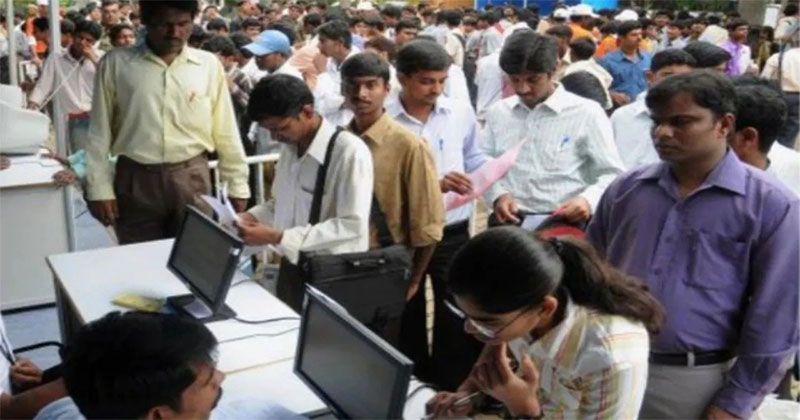
In a major positive indicator for the Indian economy, the Union Government on Monday announced that the country’s unemployment rate has declined sharply to 3.2 percent in 2023 to 24, according to the latest annual Periodic Labour Force Survey (PLFS) conducted by the Ministry of Statistics and Programme Implementation (MoSPI). This shows a significant improvement from 6.0 percent in 2017 to 18, pointing to a sustained rise in job availability and labour market stability across sectors.
The government noted that the data reflects the impact of multiple employment oriented programmes and interventions launched over the past several years. These efforts, officials said, have supported livelihoods, boosted entrepreneurship and expanded skilling avenues for millions of youth.
To improve the accuracy and timeliness of labour market information, MoSPI has revamped the PLFS framework from January 2025, transitioning from annual and quarterly reports to a monthly employment unemployment dataset.
According to the August and September 2025 PLFS findings, overall unemployment under the Current Weekly Status stood at 5.1 percent in August and 5.2 percent in September. Rural unemployment was recorded at 4.3 percent in August and 4.6 percent in September, while urban unemployment stood at 6.7 percent and 6.8 percent respectively. Officials clarified that monthly variations are natural due to evolving seasonal demand patterns, including agriculture cycles, festival related economic activity and industry specific hiring phases.
Among major states, Maharashtra has shown particularly promising trends. The unemployment rate under the usual status in the state fell from 4.8 percent in 2017 to 18 to 3.3 percent in 2023 to 24. A closer breakdown shows that rural unemployment declined from 3.2 percent to 2.1 percent and urban unemployment dropped from 7.4 percent to 5.2 percent during the same period. The Centre said the improvement reflects the combined effect of infrastructure expansion, MSME revival measures, digital employment platforms and extensive skill development programmes active across the state.
The Ministry of Labour and Employment emphasised that employment generation and improving employability remain central priorities for the Union Government. Over the years, multiple schemes spanning entrepreneurship, skilling, self employment, rural livelihoods and industrial expansion have been implemented to strengthen India’s labour ecosystem.
These include the Prime Minister’s Employment Generation Programme, MGNREGS, the Production Linked Incentive schemes across fourteen sectors, National Livelihood Missions, PM Kaushal Vikas Yojana, PM SVANidhi, Start Up India, Stand Up India and the Mudra Yojana, which offers collateral free loans to small entrepreneurs. Officials said these schemes have collectively supported manufacturing expansion, boosted micro enterprises and generated large scale wage and self employment. Detailed scheme information and progress reports have been made available on the Directorate General of Employment portal to enhance transparency and accessibility.
With industries undergoing rapid technological transformation, the government is prioritising advanced skilling to ensure India’s workforce is prepared for future demands. The FutureSkills PRIME programme, run by the Ministry of Electronics and IT, plays a major role in this effort. It offers upskilling and reskilling opportunities in ten emerging technologies, including artificial intelligence, machine learning, the internet of things, robotics, cybersecurity and cloud computing. This initiative aims to create a strong talent pool capable of meeting evolving demands in the IT, manufacturing and service sectors.
Women’s employment remains a core focus, with several ministries working simultaneously to enhance female workforce participation. Key women centred initiatives include specialised skill training through industrial and vocational institutes, AICTE scholarships such as Pragati and Saraswati, and the new AI Career for Women Programme designed to prepare women for opportunities in AI driven industries. Mission Shakti’s Palna component is expanding childcare facilities through Anganwadi cum creches, while the recently launched NAVYA initiative offers vocational training for girls aged sixteen to eighteen in non traditional and high growth sectors.
The Union Budget 2024 to 25 also announced plans to set up new working women’s hostels and crèches in collaboration with industry partners, aimed at creating safe and supportive environments to encourage women’s participation in the workforce.
A major push for job creation has also come through the Pradhan Mantri Viksit Bharat Rozgar Yojana, an ambitious Employment Linked Incentive scheme targeting the creation of more than 3.5 crore jobs over the next two years. With an outlay of Rs 99,446 crore, the scheme provides incentives to employers for generating new jobs and formalising the workforce.
To ensure inclusive growth, several targeted initiatives continue to support SC, ST and marginalised communities. The National Career Service portal provides a comprehensive platform for job listings, counselling, career fairs and training opportunities. The Welfare of SC and ST Jobseekers Scheme offers specialised pre recruitment training through twenty five dedicated career service centres.
Additionally, the PM DAKSH scheme, administered by the Department of Social Justice and Empowerment, provides skill training and reskilling opportunities for SCs, OBCs, EWS groups, DNT communities and sanitation workers, enabling both wage employment and self employment pathways.
The Ministry also highlighted important legal reforms under the Code on Occupational Safety, Health and Working Conditions, 2020. The code ensures that women are entitled to work in all establishments and in all types of work. It further allows women to work before 6 a.m. or beyond 7 p.m. with their consent, subject to prescribed safety and welfare safeguards. This reform is aimed at expanding opportunities for women in sectors such as information technology, healthcare, logistics and manufacturing.
Presenting the data in the Lok Sabha, Minister of State for Labour and Employment Shobha Karandlaje said that the fall in unemployment highlights expanding economic activity, increased entrepreneurship and better access to skilling and livelihood programmes.
She noted that the government will continue strengthening employment opportunities by supporting industries, enhancing digital job platforms, incentivising innovation and ensuring strong social protections for workers across all categories.














Comments