





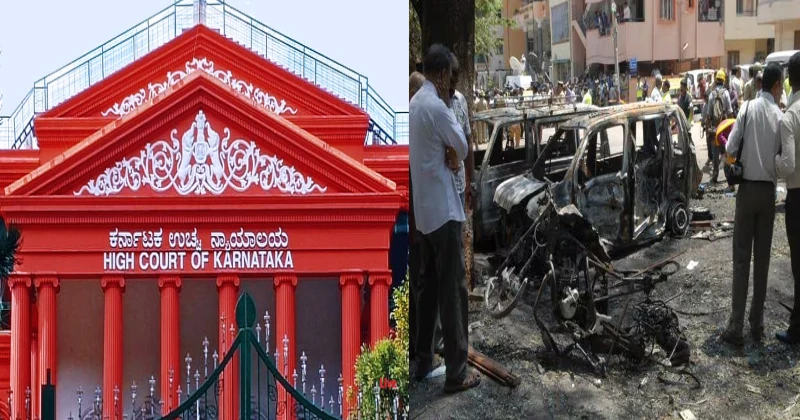
The Karnataka High Court has refused to grant bail to Kitchen Buhari, the third accused in the 2013 Malleswaram BJP office bomb blast case. The accused, a native of Tirunelveli in Tamil Nadu, had approached the High Court seeking to overturn the order of the NIA Special Court dated February 23, 2024, which had rejected his bail plea.
However, the High Court, after examining the records and the gravity of charges, upheld the lower court’s decision and dismissed the appeal.
The division bench observed that prima facie material placed by the National Investigation Agency (NIA) shows that Buhari was not merely a participant but the alleged “mastermind” behind the blast that injured over a dozen people, including police personnel. The court stated that the documents and evidence collected during investigation clearly indicate Buhari’s direct role in planning, procuring explosive materials, and coordinating the execution of the attack.
In its detailed observations, the High Court noted: “The overt acts attributed to the appellant demonstrate conduct that strikes at the sovereignty, integrity and unity of India. Records reveal that the appellant has operated in violation of constitutional duties that bind every citizen to preserve the nation’s composite culture, promote harmony and renounce violence.”
The court further remarked that the material presented by the investigating agency shows the accused was deeply influenced by radical religious ideology and was associated with the banned extremist outfit Al-Ummah. “The acts of the appellant reflect an attempt to erode the secular fabric of the country. When the charges relate to waging war against the nation, causing terror, and threatening public peace, the question of granting bail does not arise,” the bench stated.
The court ultimately concluded that the Special Court was justified in rejecting bail, adding that no grounds were found to interfere with the earlier order.
The blast occurred on April 17, 2013, near the BJP office on Temple Street, Malleswaram. A low-intensity improvised explosive device (IED) placed in a motorcycle went off around noon, injuring at least 16 people and damaging vehicles and nearby buildings. While the Vyalikaval Police carried out initial investigations, the case was soon transferred to the NIA due to its terror-related nature.
The agency later arrested 23 individuals linked to the banned organisation Al-Ummah. A comprehensive chargesheet was filed, detailing a conspiracy plotted across Tamil Nadu and Karnataka with the intention of carrying out a retaliatory strike to avenge certain communal incidents.
According to the NIA chargesheet, Buhari, the third accused, is allegedly a key conspirator and operational handler behind the attack. He is accused of indoctrinating several co-accused, facilitating logistics, and overseeing the assembling and transportation of the explosive device.
Investigators claim that Buhari procured high-intensity explosive materials through other accused persons and stored them in safe locations. He allegedly transported the materials from Coimbatore to Erode in a car before handing them over to the ninth accused, who is believed to have coordinated the blast execution in Bengaluru.
Further, the prosecution contends that Buhari had planned the attack as part of a broader objective to wage war against India and destabilise public order. His alleged activities, the court noted, demonstrate a clear involvement in extremist operations motivated by radical ideology rather than isolated criminal conduct.
















Comments