





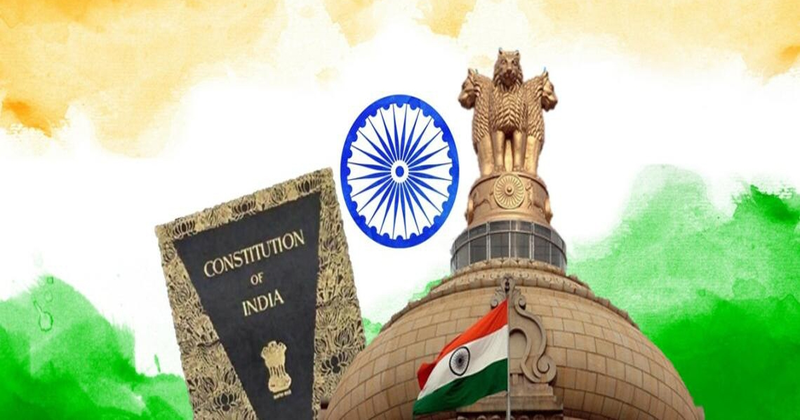
India’s Constitution was meant to secure equality among faiths, not institutionalise selective appeasement. Yet, decades later, the very provisions meant to heal post-Partition wounds have turned into tools of political patronage that privilege some communities while denying equal safeguards to others. The urgency of this distortion became starkly evident after the latest MBBS seat-allocation list at the Mata Vaishno Devi College in Jammu. Out of 50 seats, 42 were allotted to Muslim candidates and only seven Hindus and one Sikh had made the list— prompting a demand that if minority protection is the norm, then Hindu-run institutions must also be granted minority status wherever Hindus are numerically vulnerable.
Who is a minority in India, and how does the State decide it? The questions may seem procedural, but their implications are profound. India’s constitutional architecture promises equality to every citizen, yet its policies on minority recognition have created deep asymmetries that now threaten both fairness and unity. While six communities — Muslims, Christians, Sikhs, Buddhists, Parsis and Jains — enjoy nationwide minority status, along with the privileges, grants and institutional autonomy that come with it, Hindus — even where they are a shrinking or vanishing community — are denied the same protection. The Hindu demand for minority recognition is therefore, not a plea for sympathy, but a call for constitutional parity. If benefits, safeguards and autonomy are conferred on the basis of minority status, why should Hindus alone be excluded from them in regions where they are clearly a minority community. This article explores how India’s current framework on minority determination and protection departs from its constitutional intent, why objective parameters like population thresholds and regional realities must guide recognition and how reclaiming this balance is essential for restoring genuine equality and justice.
Constitutional vision
To understand today’s distortion, one must revisit the context of how minority rights entered the Constitution. The debates in the Constituent Assembly were shaped by the trauma of partition, when communal divisions had torn the subcontinent apart.
Several members demanded special safeguards for religious and linguistic minorities to reassure those who had chosen to stay in India. But the framers decisively rejected ideas like separate electorates or proportional representation, which had already proven disastrous under colonial rule. Instead, they crafted limited protections under Articles 29 and 30, focusing on cultural preservation and educational freedom.
- Article 29(1) grants the right to “any section of the citizens” to conserve their language, script or culture — a phrase that is inclusive and apply equally to majority and minority groups wherever they may be.
- Article 30(1) gives “all minorities, whether based on religion or language”, the right to establish and administer educational institutions of their choice.
These provisions were intended to ensure that no linguistic or religious group would lose its identity in the face of a vast national majority. The Supreme Court in Bal Patil v. Union of India (2005), made this explicit: Articles 29 and 30 were designed “to give security to the minds of minorities — Muslims and other religious communities — and thus maintain the integrity of the nation”. The judgment further directed that the National Commission for Minorities should work to reduce the list of notified minorities and ultimately do away with the distinction altogether.
Yet, what we witness today is precisely the opposite — an ever-expanding list of privileges justified in the name of “minority protection”, while the Hindu majority bleeds silently under state control, denial of autonomy and cultural erasure.
The elusive definition: What constitutes a minority?
Neither the Constitution nor any statutory law defines “minority” conclusively. The Supreme Court, in the Kerala Education Bill case (1958), touched upon this point but did not resolve it. The Court remarked that even if the question is answered affirmatively, that a community with less than 50 per cent of the population is a minority then another question arises: “50 per cent of what? The entire population of India or the population of a state forming part of the Union?” This question was left unanswered.
Later, in T.M.A. Pai Foundation v. State of Karnataka (2002), the Supreme Court clarified that minorities must be identified state-wise, observing that since the reorganization of states in India was linguistic, religious and linguistic minorities should also be considered locally.
Giving ‘minority’ status on pan-India basis, ignoring local demographics of states and union territories, has produced profound inequity. According to the 2011 Census, Hindus have become a minority in Lakshadweep (2.5 per cent), Mizoram (2.75 per cent), Nagaland (8.75 per cent), Meghalaya (11.53 per cent), J&K (28.44 per cent), Arunachal Pradesh (29 per cent), Manipur (31.39 per cent), and Punjab (38.40 per cent). Yet, they are not recognized as minority community in those regions. On the other hand, Muslims, Christians and other notified minority communities continue to be treated as minorities, even in states where they are numerically dominant — Christians form the overwhelming majority in Mizoram, Meghalaya and Nagaland and hold substantial population in Kerala, Goa, Tamil Nadu, Manipur, Arunachal Pradesh and West Bengal. Yet, they continue to be treated as a “minority” in these states. Similarly, Muslims, who constitute 96.20 per cent of Lakshadweep, 68.30 per cent of Jammu & Kashmir and large segments of Assam (34.20 per cent), West Bengal (27.5 per cent), Kerala (26.60 per cent), Uttar Pradesh (19.30 per cent) and Bihar (18 per cent), also enjoy nationwide minority status.
Giving minority status to Hindus in such regions would allow them to establish and manage educational institutions, ensure cultural preservation and fair access to state resources—just as other notified communities do. Under Article 19(1)(g) also, Hindus can establish educational institutions, but that is subject to state restrictions under Article 19(6). In contrast, minority-run institutions enjoy greater autonomy under Article 30(1). This creates a deeply unequal regime—where institutions run by Hindus are often heavily regulated, while others are exempt from similar controls. This asymmetry is not theoretical—it has real, measurable consequences. Government grants, recruitment relaxations and administrative autonomy flow more freely to minority institutions, leaving Hindu institutions over-regulated and under-supported.
The national-level identification of minorities has led disastrous consequences. It deprives actual minorities of their rightful share in educational and developmental opportunities. The principle of equality before law collapses when demographically dominant groups in one region continue to monopolize benefits originally meant for the marginalized.
Beyond the national-versus-state debate lies a more fundamental question: What proportion of population should qualify as a minority? Should a community with 49 per cent population in a state be granted privileges designed for vulnerable sections? Or should there be a reasonable threshold — say 1 per cent, 5 per cent or 10 per cent — below which special protection is justified? The absence of such a benchmark has allowed arbitrary and politically motivated classifications. Furthermore, all criteria used for such recognition must be public, objective and uniformly applied. Subjectivity and discretion in such matters only fuel appeasement, political manipulation and religious favoritism. A transparent minority policy will ensure that protection is based on genuine vulnerability—not electoral calculus.
It is both ironic and tragic that Hindus are seeking minority status in Bharat— their own civilizational homeland. The very term “minority” becomes an absurdity when applied to those who gave the world its oldest living faith, its pluralistic ethos and its universal spiritual vocabulary. Yet, in this distorted framework, the descendants of a 10,000-year-old civilization are seeking and even fighting legal battles for grant of minority status and protection. Beyond the legal and policy dimensions, this issue carries profound civilizational implications. The continued denial of minority recognition to Hindus in states where they are numerically small is not merely an administrative anomaly but also against the directive in the T.M.A. Pai judgment.
For decades, public discourse has been shaped by the narrative that Hindus, being a majority nationally, are by default privileged and incapable of discrimination. But this assumption collapses when examined locally. In states where Hindus are less than 10 per cent of the population, they face the same vulnerabilities — social isolation, cultural marginalization and institutional exclusion — that any minority would. Yet, they remain unprotected by the very laws that claim to uphold equality.
True secularism does not mean privileging one group over another—it means treating all communities with equal dignity. Equality cannot be one-sided and justice cannot be selective. The State must choose clarity over confusion. Either denotify communities that are no longer minorities in several states and/or recognize Hindus as minorities wherever they are outnumbered. Anything less is a continued mockery of equality and secularism.
Minority rights were never meant to create demographic monopolies. They were envisioned as instruments of inclusion, not exclusion. To restore their legitimacy, the government must evolve a state-wise and need-based model that recognizes minorities where they truly exist, not where political convenience dictates.














Comments