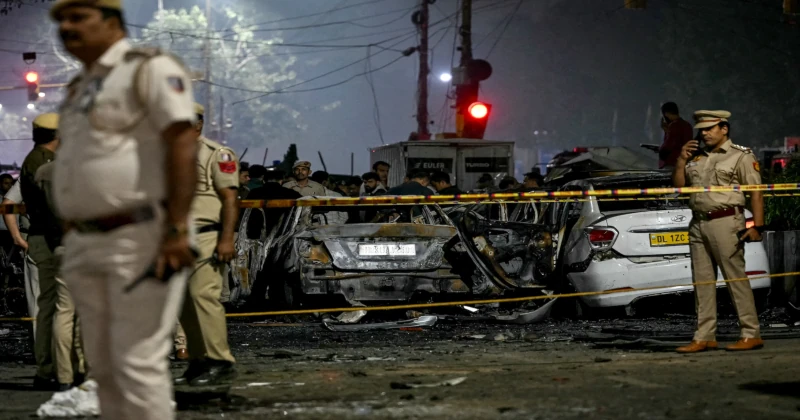
The car blast that took place outside the Red Fort Metro station and killed thirteen people is a terrible event that stands as a turning point in India’s fight against terrorism. For now, the aftermath has brought questions about possible intelligence failures, as usual. That said, if we dig a little deeper into the situation, things look quite different and significantly more complex. This fact alone requires us to adjust our conception of the successful prosecution of our fight against terrorism.
Among those killed in the deadly explosion on November 10 was Umar Un Nabi, a 36-year-old MBBS graduate from Government Medical College Srinagar, the main assailant of this terror attack. However, the sole tragedy of this kind is covering up an important fact, where the authorities had just stopped what could have been a huge terror plot spread out over different cities, making it the tragedy that seemingly wasn’t. When in the police raids in Dhoj village near Faridabad, the authorities found a total of 2,900 kilograms of bomb-making material, which also included 353 kilograms of ammonium nitrate, they had basically taken down a terror network on a scale that had never been seen before and which was operating outside Kashmir.
Not only is this the first major attempt to carry out attacks in India beyond the Kashmir Valley after the 2016 Pathankot incident, but it’s also the first homegrown Kashmir-based operation outside the state after the 2001 Parliament attack. The importance is that the terror attacks will be taking place in a whole new way, and that the whole idea of these terror networks’ operational ambitions is escalating frighteningly, which cannot be less significant.
The origin of the police investigation is in what appears to be a rather insignificant thing, as if this was the chain that held mostly, that is, the posters glorifying Jaish-e-Mohammed that were found in Banihara village near Srinagar on October 19th. In an area where this kind of propaganda is the norm, SSP GVK Sundeep Chakravarti did not follow the usual way and decided to take these posters seriously. This decision led to a domino effect of arrests in various states, from Kashmir to Uttar Pradesh to Haryana, which in turn led to uncovering a network of twelve to fourteen people, mostly doctors, who had been deeply indoctrinated.
The suspects’ profile shakes the terrorist stereotype and forces one to think. For example, the esteemed doctor, Adil Ahmed Radar, who was detained in Saharanpur, was a physician at a well-established medical facility. Dr Shaheen Shahid, who was arrested in Lucknow, earned an MBBS degree from Allahabad Medical College. Dr Muzamil Shakil was the doctor at Alfalah Medical College in Faridabad. None of these individuals was the kind of youth you often hear about from poor backgrounds who get involved in crime; rather, they were highly educated and had bright futures ahead of them.
An unpleasant reality about education is that we are constantly surprised to see well-educated people perform terrorist activities; however, history has many such examples. One of them is Ayman al-Zawahiri, who was al-Qaeda’s second-in-command and held a medical degree from Cairo. Osama bin Laden was also pursuing studies in engineering. So was Gulbuddin Hekmatyar, who earned his nickname in the field of engineering. Engineers, to be exact, are the group to which the most terrorist organisations can trace their members, and the reason might be that their logical, solution-oriented mindset leads them to view complex social problems simplistically, through a reductionist lens.
We must dispel the reassuring myth that education is the only barrier to radicalisation. The elements of an extreme belief system, the feeling of being wronged and the allure of the heroism of extremism are factors that can find their way into even the most educated minds, especially those of the youth. Most of the individuals arrested in the cases were in their twenties and thirties, a period of life when a sense of daring, idealism, and susceptibility to manipulation are at their peak and most likely to overlap.
What really confronts us is not the question of intelligence failing, but rather the question of how success in counter-terrorism is gauged; it’s a metaphorical question that determines success in a flawed world. Disrupting this network would be considered a major success by almost all measures. The whole chain of events was discovered and stopped by authorities not only through the initial tip but also the posters on the walls of a village. Thus, authorities were able to track down four states with suspects, seize a large assortment of explosives and illegal guns, and thwart several potential attacks in a short time.
Yes, there was only one person who managed to flee with explosives. Yes, thirteen people lost their lives. This is heartbreaking and unacceptable. Nevertheless, it is the reality of the work involved in countering terrorism. Even with their advanced intelligence systems, the United Kingdom, the United States, and Israel have all been victims of terrorist attacks in the past few years. No system is completely secure. Similar to diseases, terrorism cannot be fully stopped but can only be controlled and limited through management measures.
Demanding perfection from intelligence work not only sets an unrealistic standard but is also counterproductive. Such a demand leads to the establishment of a blaming culture, which, in turn, covers up real accomplishments and fails to recognise the daily, silent efforts of those who prevent incidents from ever occurring because they are already halted at the initial stages.
Looking at the larger picture, comparing this to the arrests in Gujarat of people making ricin from castor oil, although seemingly unlinked to the Delhi operation, indicate the emergence of a new and agitative trend regarding the jihadist scene in India. Over the last two years, the police have arrested more than one hundred people who were involved in or connected with the radicalisation process. While it is true that some of the suspects might have been maddened by agents provocateurs rather than actual Islamic State members, and also that the recruiters take little time to find those who are willing to participate, it is still worrisome enough.
What still makes the biggest difference is Pakistan’s position. The threat will become far greater if the condition occurs as before with the Indian Mujahideen, where there is not only state-sponsored training but also support for Indian operatives, leading to more terrorist attacks. It is reported that the two sides have a tacit red line set up, which is not to conduct any attacks other than in Kashmir, but it looks as if this line has already been violated.
India’s reaction to this assault has to be a combination of steady yet firm, with the virtue of moving forward with strength. We need to avoid two kinds of thinking errors: on the one hand, being too complacent, and on the other, getting into a state of frenzy. Certainly, the probe should be extended with all due force; any remaining suspects should be detained; and the full scale of the network should be laid out. However, we must also recognise the effective measures: a policeman on the alert who took the notices seriously, coordinated operations across different states, and the thorough work of the detectives, which untangled the exceedingly complicated plot.
Most importantly, we must recognise that attacks will occasionally get through our defences. This is not defeatism but realism. The criterion of a strong nation is not whether it is attacked, for all nations are, but how it answers those attacks, with the ability to bounce back, with determination, and with the will to carry on the slow, unglamorous, and somewhat thankless work of intelligence gathering and police work, which is responsible for most of the attacks that fail.
So, in this case, nine parts of ten went right. We regret the one that went wrong, pay tribute to those who lost their lives, and, without making a fuss, we recognise those who made sure that it was not much, much worse.