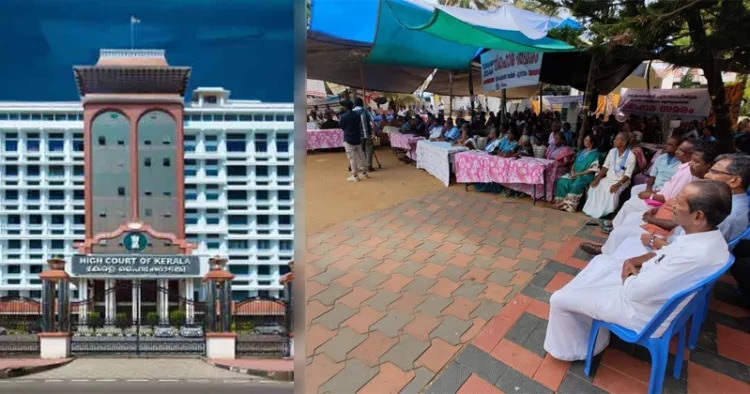
Kochi, 27 November 2025 — In a major relief to hundreds of families in Munambam, the Kerala High Court has restored the original land status and permitted residents to pay land tax, marking a crucial turning point in a dispute that had escalated to New Delhi and sparked nationwide debate over controversial Waqf land claims.
The order, issued on 26 November 2025, comes months after Parliament passed the Waqf (Amendment) Act, 2025, a law that significantly altered how Waqf claims can be made across the country.
The dispute, involving land earlier measured at 404.76 acres, today concerns about 135 acres surviving after decades of sea erosion. Nearly 700 families, a majority of them are Christians, while Hindus too reside, have been affected by the prolonged stand-off.
The Kerala government informed the Court that it was prepared to allow tax collection, and the Bench accepted the assurance. The restoration of tax payment rights is widely viewed as the first administrative relief for residents who have been protesting for more than a year.
The Court also acknowledged that repeated petitions from residents required urgent hearing given the impact on livelihoods and property rights.
The latest judgment by the Kerala High Court, delivered in response to a petition filed by the Land Protection Council, confirmed that the Village Officer had earlier refused to accept land tax after the Waqf Board laid claim to the property.
The petitioners maintained that Munambam was not Waqf land, a position supported by a previous Division Bench ruling that had already established the Board held no ownership over the area. In its fresh order, the Court has now directed revenue authorities, including Collectors and Tehsildars, to accept land tax payments while the case continues.
During the course of case, the residents of Munambam publicly expressed disappointment with both the ruling Left Democratic Front (LDF) and the opposition United Democratic Front (UDF). According to residents, both alliances appeared to compete in offering support to the Waqf Board, even as local families were displaced and denied access to basic land rights.
Residents say leaders from both Communist groups repeatedly assured them that the matter would be solved “soon”, yet their MPs vociferously opposed the Waqf (Amendment) Act, 2025, when Parliament debated and passed it on 3–4 April 2025.
During this period, the Church, the Bharatiya Janata Party, and several Hindu organisations supported the protesting families. The developments have shifted political sentiment in the region, with residents openly stating to the media that they view the BJP and Prime Minister Narendra Modi as “saviours” in their struggle. One local leader associated with the movement is now contesting the Local Self Government polls on a BJP ticket.
Long before the Waqf Amendment Act was enacted, Munambam had become a key flashpoint in India’s larger conversation on the powers exercised by the Waqf Board. Residents argued that the Board claimed ownership based merely on past sale transactions involving Muslim owners, even though subsequent legally executed ownership transfers existed for decades.
The Munambam issue became symbolic of a national trend. Petitions from the region were sent to New Delhi, with MPs raising concerns that the Board’s sweeping declarations were locking ordinary citizens out of long-held property. The matter was repeatedly discussed alongside high-profile examples from Tamil Nadu, where ancient properties including lands reportedly linked to 1,500-year-old temples were also marked as Waqf land, sparking widespread protests.