





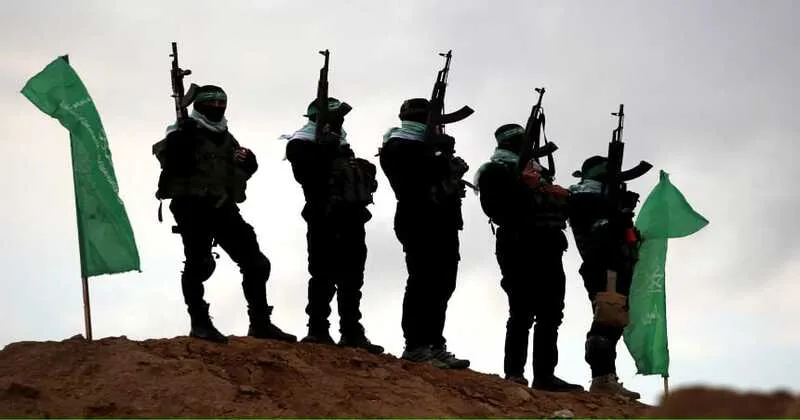
Israel’s intelligence agency Mossad has revealed that a large Hamas terror network was operating across Europe, structured in small, covert cells and preparing to carry out attacks on civilians. According to the agency, the network was poised to act immediately upon receiving instructions from Hamas’s senior leadership. In a detailed statement, Mossad said that small operational groups had been formed and weapons stockpiled for potential attacks. The agency noted that several Hamas-linked individuals were arrested with the cooperation of European security services and that multiple weapons caches were recovered during the investigation. Mossad warned that Hamas was using “secret and compartmentalised cells” to expand its operational presence beyond the Middle East.
The agency further disclosed that several attempts to attack Israeli citizens, Jewish communities, and institutions in Europe were thwarted as part of the joint counterterrorism operation. Raids were carried out in Germany, Austria, and other European countries based on actionable intelligence gathered over the past year.
Mossad said the investigation began in September last year, after Austrian authorities discovered weapons and explosives in Vienna. This seizure became a crucial turning point, prompting coordinated intelligence work between Israel and multiple European security services. According to Israeli officials, the materials found in Vienna were linked to Hamas operative Mohammed Naeem, who is the son of Bassem Naeem, a senior Hamas Politburo member and a close associate of Gaza-based leader Khalil al-Hayya.
The agency stated that cooperation with Austria’s Directorate of State Security and Intelligence (DSN) was instrumental in identifying the network’s infrastructure. Mossad said that through joint surveillance, intelligence sharing, and targeted operations, authorities were able to arrest suspects and disrupt several plots in the planning stages.
Raids in Germany and Austria; Qatar meeting and approval for attacks
Following the Vienna discovery, coordinated raids were carried out in Germany and Austria. Several individuals were detained in connection with what authorities described as a transnational Hamas-linked terror network. German authorities also placed certain charitable and religious institutions under heightened surveillance, suspecting them of helping Hamas fundraise or disseminate extremist ideology. Investigators in Germany also examined long-standing connections between Hamas operatives and individuals based in Turkey, a country Mossad describes as a logistical hub for the organisation. As part of this effort, German authorities arrested Hamas operative Burhan al-Khatib in November. Officials said he had previously been active in operations connected to Hamas networks in Turkey.
According to Mossad, Mohammed Naeem met his father, Bassem Naeem, in Qatar last September. The agency reveals that, following this meeting, Hamas’s foreign leadership gave approval for terrorist activities and attack planning inside Europe. Mossad suggested that operational planning occurred in Qatar and that the network may also have received logistical assistance from Turkey. Hamas has denied all the allegations, dismissing them as politically motivated efforts to damage its international reputation. However, Mossad maintains that the evidence gathered by European intelligence agencies points to a broader effort to build a clandestine operational infrastructure abroad, especially after the October 7 attacks in Israel.
Mossad said Hamas has intensified its efforts to establish overseas operational structures since the events of October 7. The agency added that this escalation follows patterns similar to those employed by Iran and its affiliated groups, which often utilise foreign bases for intelligence gathering, logistics, and planning attacks. European intelligence services, Mossad noted, have expanded their operations beyond direct security interventions. Authorities in Germany, in particular, have stepped up monitoring of charities, religious organisations, and civil society entities believed to provide indirect support to Hamas. According to Mossad, this widening of the investigative focus reflects concerns that Hamas is attempting to exploit diaspora networks and support groups to strengthen its presence in Europe.
Sleeper cells and Austrian breakthrough; Plots against Jewish community foiled
Mossad highlighted that the Vienna seizure was one of the “key findings” of the investigation and directly linked the cache of handguns and explosives to Hamas leader Mohammed Naim. Austrian security officials said these weapons were being stored for potential attacks targeting ordinary civilians. The DSN, working with Mossad, traced the origins of the cache to individuals connected to Hamas’s foreign leadership.
The agency also reiterated that this was not the first time Hamas’s leadership in Qatar had been implicated in covert operational activities. Mossad cited the meeting between Mohammed Naim and his father in Qatar as a critical development in understanding the network’s chain of command. Investigators additionally focused on operatives believed to be working from Turkey, long described as a centre of Hamas’s overseas operations.
German authorities’ recent arrest of Burhan al-Khatib is seen by investigators as part of a wider crackdown on individuals who maintain operational or ideological ties with Hamas while residing outside the Middle East.
Mossad stated that the agency, working closely with German and Austrian security services, has so far prevented attacks targeting Jewish and Israeli communities in Europe. In Austria, the DSN’s discovery of weapons and explosives provided crucial evidence of Hamas’s attempt to build sleeper cells capable of conducting coordinated attacks. Bassem Naeem, the father of Mohammed Naeem and a senior Hamas official, is known to be closely associated with Khalil al-Hayya, a senior Hamas figure in Gaza. However, Mossad emphasised that Hamas leaders have publicly rejected all allegations in an attempt to protect their international standing. Meanwhile, investigators continue to monitor individuals and networks operating from Turkey, which remains a focal point of scrutiny in relation to Hamas’s European operations.
















Comments