





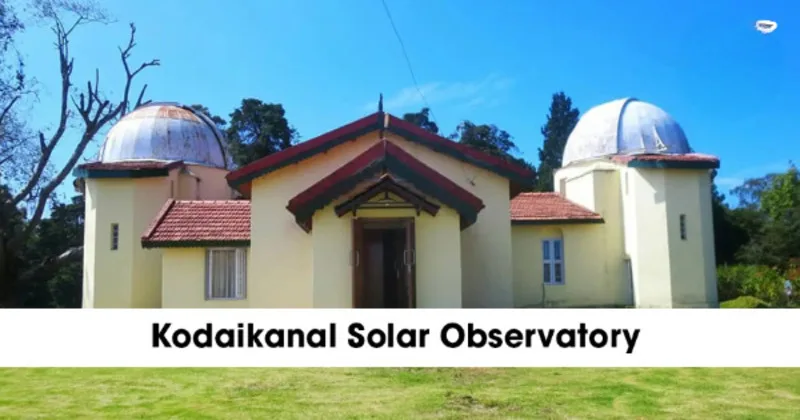
Understanding the Sun has always required a combination of persistent observation, rigorous analysis and continuity. One of the most critical aspects of solar science the behaviour of the Sun’s polar magnetic fields has remained only partially understood. Direct measurements began less than fifty years ago, leaving scientists with limited information about earlier solar cycles. Today this gap is being bridged in a remarkable way: by turning to India’s century-old Kodaikanal Solar Observatory (KoSO) and applying modern analytical tools to its vast archive of solar images. This combination of old data and contemporary science is offering new insights into how the Sun behaved in the past, how it is evolving now, and how it may influence Earth in the future.
India’s Century-Old Solar Legacy
KoSO presently operated by the Indian Institute of Astrophysics has been observing the Sun since the early 20th century. Among its most valuable assets are images captured in the Ca II K wavelength that began in 1904. This wavelength record activities in the Sun’s chromosphere, a layer above the visible surface where magnetic structures such as plages and bright networks appear. These features carry information about the Sun’s magnetic activity, making the archive a rare scientific treasure that predates modern magnetographs by decades. With over a hundred years of continuous observations, now digitised KoSO offers a dataset unmatched in global solar research.
Challenge of Reconstructing Solar History
Solar magnetic activity follows approximately 11-year cycles which is marked by variations in sunspots, flares and large-scale magnetic fields. The polar magnetic fields located near the Sun poles play an especially crucial role. They determine the strength of the next solar cycle and influence space weather events that can affect satellites, communication systems, GPS accuracy and even power infrastructure on Earth.
The systematic polar field measurements began in the 1970s, most of the 20th century remained a blind spot. Without historical polar field data, scientists could not fully understand long-term solar variability or evaluate how current trends compared with earlier patterns.
This is the scientific gap the new study aimed to resolve. Researchers from the Aryabhatta Research Institute of Observational Sciences (ARIES), in collaboration with institutions in India, Europe and the United States set out to reconstruct the Sun’s polar magnetic behaviour using KoSO’s archival images.
Turning Old Images into Modern Data
The research team employed advanced feature-identification algorithms to analyse bright structures found in historical Ca II K images. These structures known as the polar network, serve as indicators of magnetic activity in the high-latitude regions near the Sun’s poles.
By identifying and quantifying these bright features, the researchers found a way to estimate the strength of the Sun’s polar magnetic field for each year of the last century. They then combined KoSO data with more recent observations from Italy’s Rome PSPT telescope to create a consistent polar field reconstruction spanning from 1904 to 2022.
The reconstructed dataset was further compared with direct polar field measurements from the Wilcox Solar Observatory for the overlapping period between 1976 and 2022. The close agreement between the two confirmed that the polar network is a reliable, stable and scientific standing for the Sun’s actual polar magnetic field.
Why This Matters for Space Weather Predictions
Solar storms originating 150 million kilometres away, can have real effects on Earth. Strong magnetic disturbances can interfere with satellite electronics, distort communication signals and in extreme cases damage power grids. Space agencies and power utilities rely on forecasts of solar activity to plan for such events.
Accurate predictions require long-term data, because the Sun’s behaviour operates not only in 11-year cycles but also on longer multi-decadal patterns. By reconstructing a century of polar field history, scientists now have a clearer picture of how each solar cycle began and how polar fields influenced future activity.
This reconstruction will allow researchers to estimate the strength of the ongoing Solar Cycle 25. These insights also helps to improve models that can be used to forecast solar storms and offering a better preparedness for technology-dependent societies.
Major Step for Indian Solar Science
This work demonstrates how traditional observational infrastructure can be revitalised through contemporary data science. The long-term legacy of KoSO has become a foundation for state-of-the-art research, a testimony to the institutional foresight that has maintained observational continuity for over a century. Digitization of KoSO’s archives, along with the development of automated analysis tools, places India as a key contributor in global solar research.
By making the complete dataset available on platforms such as GitHub and Zenodo, the research team has ensured that the scientist community in general can access and build upon this work. This reflects the broader scientific vision of open data and enabling them for collaborative progress in knowledge pertaining to the Sun.
New Era of Solar Reconstruction
The ability to rebuild the polar magnetic history of the Sun using archival imagery is not just a technical achievement but also a paradigm shift in the way that solar science can be carried out. Without relying completely on modern instruments, it has become possible to revisit various historical observations using machine learning techniques, hence increasing their value and also expanding the time horizon of solar studies. This approach also opens possibilities for analysing other long-term astronomical archives in India and across the world. As data science techniques advances, old records whether photographic plates or early digital images can become new sources of scientific knowledge.
Understanding the Sun’s magnetic cycles, it is important for anticipating solar storms and protecting infrastructure. Through the analysis of century-old images from the Kodaikanal Solar Observatory, scientists have reconstructed more than a hundred years of the Sun’s polar magnetic behaviour, filling a major knowledge gap in solar physics. This achievement combines India’s long-standing scientific heritage with modern computational methods, offering a clearer view of the Sun’s past and improving forecasts of its future behaviour.











Comments