





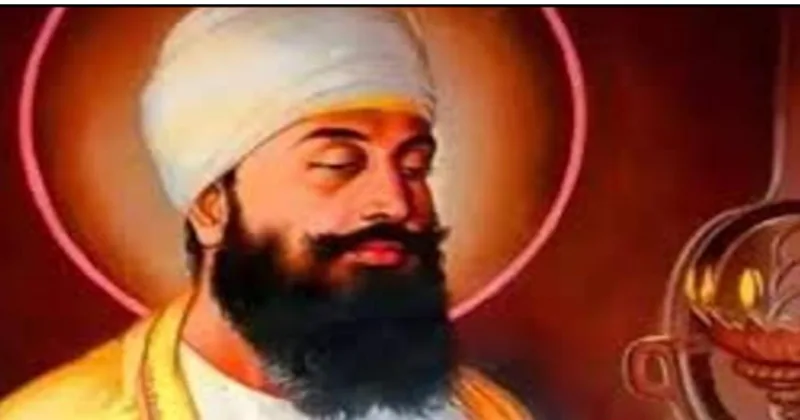
Guru Tegh Bahadur ji (1621–1675), the Ninth Guru of the Sikh tradition, spent his early years in Amritsar under the tutelage of Baba Budha, a contemporary of Guru Nanak, and Bhai Gurdas, the inscriber of the Adi Granth prepared by Guru Arjan in 1604. His deep understanding of religion, society, history, and contemporary issues is reflected in his poetic compositions and timeless teachings.
The teachings of Guru Tegh Bahadur can be culled from his 116 compositions in 15 ragas contained in Sri Guru Granth Sahib. The universal messages are in simple Braj language, easy to understand and with examples from daily life, emphasizing universalism in spirituality.
In one of his compositions, Guru explains that as bubbles appear and disappear in water, similar is the creation of this world (page 1427 of Sri Guru Granth Sahib).
In his extensive travels from 1664 to 1672, GuruTegh Bahadur ji preached tolerance, and inter-faith harmony. Illustratively, in Dhaka, the Guru helped restore peace between Chakradhvaj, ruler of Ahom and Raja Ram Singh of Amber. He also practiced economic independence. Illustratively, the piece of land where Anandpur is built was offered by Rani Champa of Bilaspur but Guru preferred to purchase for Rs. 500in 1665.
Coerced Conversions, Resistance and The Sacrifice
Guru also guided that spiritually wise are steadfast and neither intimidate nor get intimidated by anyone. Guru observed that those persons are enlightened who treat friends and foes alike. It was practicing these principles that Guru resisted forced conversion under the reign of Emperor Aurangzeb.Guru and his 3 Sikhs were tortured in full public view, but none were intimidated, and finally, Guru was beheaded, at Chandni Chowk, on November 11, 1675.
Learning from the Sacrifice
The learnings emerging from the sacrifice of Guru Tegh Bahadur has to be viewed in the historical context. Guru Nanak Dev had earlier started inter-faith dialogue while interacting with spiritualists of different faiths during 1500 to 1539 and their compositions later became part of Sri Guru Granth Sahib, and are revered by Sikhs as much as composition of their Gurus. The supreme sacrifice of Guru, uphelds the same principle to accept diversity of belief and respect plurality in society. More interestingly, the sacrifice reveals a strong social bond that gets established with inter-faith dialogue – Kashmiri Pandits chose to come to Guru Tegh Bahadur, who reciprocated by happily accepting to sacrifice.
The lesson to be drawn from the sacrifice is that the freedom to practice faith of one’s choice is a matter of human rights or individual conscience for which force or allurements should not be used.
As discussed above, the message from Unique Shahidi is universal as was the teachings of Guru Tegh Bahadur ji. Therefore, it is our duty, to disseminate this universal message throughout the world. Here are some suggestions which we all can consider.
a) Interfaith Harmony Day at United Nations: As the world is torn in different religions and faiths, it will be helpful if a day is dedicated at the UN to celebrate interfaith harmony through dialogue.
b) Institute an international Prize in Interfaith Harmony under the aegis of Takht Patna Sahib
c) Guru Tegh Bahadur Marg – Guru Tegh Bahadur ji travelled very widely in India preaching interfaith harmony. Therefore, generally following that same route starting from Anandpur Sahib to Guwahati via Sasaram, Dhaka, and Chittagong can be designated as Guru Tegh Bahadur Marg.
d) Dedicated University/Departments in Universities – To celebrate the message of Guru Tegh Bahadur ji, dedicated Universities with Department on Sikh Studies could be established in different states like Bihar, West Bengal, Assam through which Guru travelled. A dedicated University in Dhaka could also be considered with the help of Bangladesh Govt.
e) To spread the universal message, international Standard Museums on Guru Tegh Bahadur ji must be established in Agra, Patna and Assam.
f) There is need to celebrate the sterling role played by Mata Gujri, both as wife of Guru Tegh Bahadur, and as mother of Guru Gobind Singh and grandmother of the 4 sahibzadas. In this context, Kirtani Jathas/Dhadis of Sikh women should be encouraged.
g) The teachings of Guru Tegh Bahadur as contained in Gurbani should be translated in major languages of India and World. The local Gurudwaras can make effort in this regard to contribute and propagate.
h) Literature on Guru Tegh Bahadur – Coffee Table or other books, based on reliable information, on Guru Tegh Bahadur in major languages of India and World can be considered.
i) Conferences on Interfaith Dialogue – Local sangat can arrange local interfaith conferences in major cities and sponsor organizing academic conferences at local University.
Conclusion
The lessons of interfaith harmony and freedom to practice religion without coercion or allurement captured in unique sacrifice of Guru Tegh Bahadur ji needs to be celebrated in the world. The 350 year opportunity needs to be appropriately utiliSed to make the world a better place to experience. Hence, we all should make an effort to spread the universal message of Guru Tegh Bahadur Ji worldwide.
















Comments