





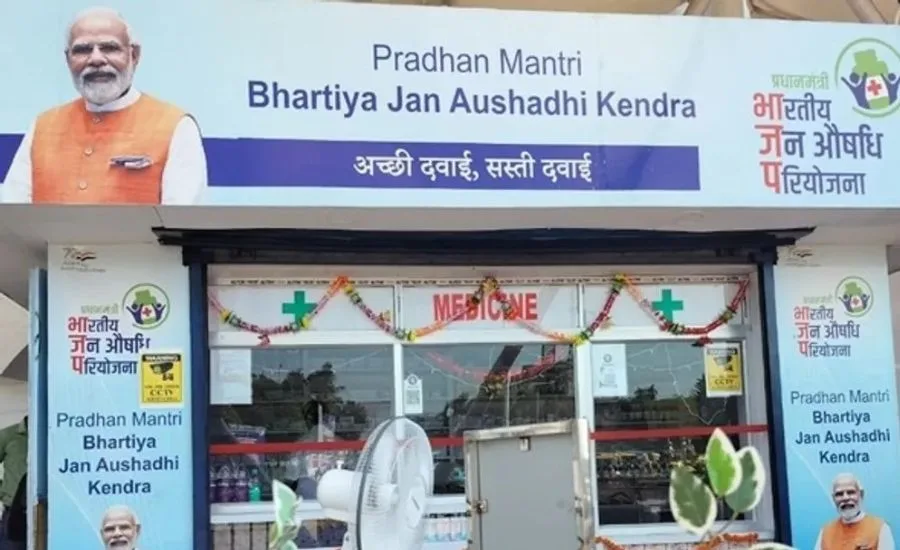
A quiet but dramatic shift has been unfolding in India’s medicine retail ecosystem over the past eleven years. What began as a modest initiative with just 80 Jan Aushadhi Kendras (JAKs) in 2014 has today grown into a nationwide chain of 16,955 stores, as of October 31, 2025. This represents a staggering 210-fold expansion in the footprint of generic medicine outlets across the country. More striking is the economic impact: sales through these stores have skyrocketed by more than 177 times, demonstrating the scale at which affordable drugs are now penetrating household healthcare budgets.
At the heart of this transformation lies the Pradhan Mantri Bhartiya Janaushadhi Pariyojana (PMBJP), the Modi government’s flagship affordable medicine programme. While the scheme was initially introduced by the UPA government in 2008, it was the NDA government that relaunched, restructured, and operationally strengthened the project in 2015. The revamped model prioritised accessibility, transparency, and quality, ultimately turning the scheme into one of India’s most impactful social interventions in public health.
From his Mann Ki Baat addresses to election rallies, Prime Minister Narendra Modi consistently refers to Jan Aushadhi Kendras as a textbook example of how healthcare can be made both affordable and accessible. Generic drugs sold at these outlets often cost 50 to 80 per cent less than their branded counterparts, an economic relief that millions of Indians now experience on a daily basis.
A report by News18 succinctly describes the programme’s impact, noting that the PMBJP has “emerged as a central pillar of India’s fight for affordable healthcare,” especially for chronic patients who rely on long-term medication.
Price gap that changed public perception
For decades, India’s pharma retail system remained dominated by branded medicines, despite the fact that generics contained the same active pharmaceutical ingredients. Jan Aushadhi stores directly challenged this paradigm by showcasing the sheer extent of price inflation in the branded medicine market.
The price differential tells its own story:
1. Levocetirizine, an anti-allergic drug priced at Rs 303 in the open market, costs just Rs 13 at a Jan Aushadhi Kendra.
2. Glimepiride, a widely used anti-diabetic medicine costing around Rs 54, is available for Rs 5.16 at these stores.
3. Cancer-care patients benefit significantly too: Imatinib Mesylate 400 mg, which is normally priced at nearly Rs 1,952, is sold for just Rs 210 under the PMBJP umbrella.
4. Such comparisons powerfully illustrate how deeply inflated the retail drug market had been and how the Jan Aushadhi ecosystem has disrupted it.
Model behind the expansion
As the network grows, the government now aims to operate 20,000 Kendras by March 2026. An official with the Pharmaceuticals & Medical Devices Bureau of India (PMBI), the implementing agency for the scheme, said during a facility tour:
“The next phase will focus on strengthening the product range, adding nutraceuticals and Ayush-based items, and expanding to underserved regions.”
Quoted by News18 reporters present during the walkthrough of PMBI’s 1,42,000-square-feet Manesar warehouse, the official emphasized that the scheme is now supported by one of the strongest pharmaceutical supply chains in the country.
The backbone of this supply chain includes:
1. Five national-level warehouses in Gurugram, Chennai, Bengaluru, Guwahati, and Surat.
2. 39 regional distributors who coordinate last-mile delivery.
3. A fully IT-enabled SAP-based forecasting and inventory system that ensures medicines remain available and stockouts are minimised.
In the early years, the scheme faced scepticism regarding the quality of the medicines. Critics often questioned whether low price meant poor quality, a concern that the administration has worked rigorously to address.
“Earlier, there were concerns, but now we have a very robust mechanism to test the quality,” a warehouse official explained to News18, requesting anonymity. “All manufacturers supplying to PMBJP are WHO-GMP certified. Random samples from every batch are tested at NABL-accredited laboratories. Only after passing quality checks do the batches get cleared for distribution.”
This tightened oversight has not only improved confidence in the stores but has also helped the scheme counter long-standing misconceptions about generic medicines.
Rapidly growing product basket
The strength of the PMBJP today lies not only in its scale but also in its wide-ranging catalogue of essential medicines and healthcare products.
In 2021–22, the scheme offered 1,450 medicines and 204 surgical items.
By 2025, the list had expanded to 2,110 generic drugs and 315 surgical products.
From antibiotics, anti-hypertensives, anti-diabetic drugs and cardiovascular medicines to oximeters, wheelchairs and sanitary napkins, the range now covers nearly every major category of essential healthcare products.
One of the programme’s most successful micro-interventions has been the launch of Janaushadhi Suvidha biodegradable sanitary napkins at just Rs 1 per pad, introduced in 2019. With 100 crore pads sold, it has become one of India’s most affordable and accessible menstrual hygiene initiatives.
The financial impact on Indian households is massive. According to internal estimates shared with the press:
1. In 2024–25, Jan Aushadhi outlets registered Rs 2,022 crore in sales.
2. This translated into estimated consumer savings exceeding Rs 8,000 crore.
3. Between April and October 31, 2025 alone, the Kendras reported Rs 1,245.13 crore in sales.
An official presenting the data told reporters: “The volume of sales shows how deeply Jan Aushadhi has penetrated everyday healthcare expenditure in Indian families.”
Beyond the affordability narrative, the scheme has also evolved into a tool for grassroots entrepreneurship. The Jan Aushadhi model works on a quasi-franchise system, allowing individuals, women’s collectives, NGOs, self-help groups, ex-servicemen and even institutions like Primary Agricultural Credit Societies (PACS) to run Kendras.
In early 2025, Union Home and Cooperation Minister Amit Shah expanded the role of PACS, enabling them to open Jan Aushadhi Kendras as part of their diversification into broader community services. The push has yielded rapid results: 4,169 PACS have received approval to open Jan Aushadhi Kendras. Over 700 are already operational.
With a 20 per cent margin on the MRP and a one-time grant of Rs 2 lakh in special category areas, the model has become attractive even for first-time entrepreneurs.
A growing digital ecosystem
Complementing the physical expansion is the success of the Jan Aushadhi Sugam mobile application, which has been downloaded more than 38 lakh times. The app allows users to:
1. Locate the nearest Jan Aushadhi store
2. Compare prices between generic and branded equivalents
3. Check availability and MRP
4. Track new products and discounts
This digital interface has helped bridge the information gap that often deterred people from switching to generics.
Eleven years after its revitalisation, the Jan Aushadhi programme has evolved from a small generic medicine outlet network into one of India’s largest and most effective affordability programmes in public health. It has reshaped public perception about generic medicines, boosted savings for millions of families, and brought previously inaccessible drugs within reach.
More importantly, it has demonstrated how strong political will, administrative reform and scientific supply chain management can redefine access to healthcare.
The PMBJP today “stands as one of the most transformative healthcare interventions of modern India,” embodying the Modi government’s vision of seva, affordability, and inclusive growth.
















Comments