





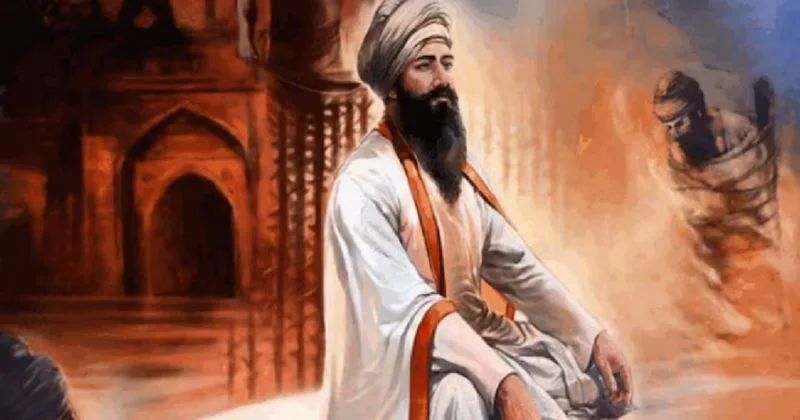
Guru Tegh Bahadur was born on April 1, 1621 in Amritsar, Punjab. He was the ninth of the ten Sikh Gurus. He also created the town of Chak Naki, which is today Anandpur Sahib. He also penned 115 hymns for the Guru Granth Sahib. He was very loving and gentle, as were all Sikhs. He used to contribute to Gurudwaras by serving Lungars and establishing water wells. He was well-versed in martial arts and scriptures. He was given the name Tegh Bahadur because he was a brave swordsman. In 1664, he succeeded Guru Har Krishan as the second-to-last Sikh guru.
The appointment of the Guru coincided with Aurangzeb’s pursuit of Islamic orthodoxy. Social and political unrest, including local uprisings and rivalries that threatened Mughal authority, was brought on by the increasing pressure on non-Muslim populations through actions like the reinstatement of jizyah (a tax paid by non-Muslim populations to their Muslim rulers), the destruction of temples, and forced conversions.
When Guru Tegh Bahadur provided refuge and assistance to several Hindu Brahmins from Kashmir who had been obliged to convert to Islam by Emperor Aurangzeb, he ran afoul of the Mughal authorities. The Guru instructed the Hindus to tell the emperor that they would accept Islam if the Guru converted to Islam, encouraged by his son Gobind Rai, who succeeded him as Guru. He then traveled to Delhi to protect the Hindus from Aurangzeb without intending to convert to Islam. On the emperor’s orders, he was detained en route. He was taken to Delhi alongside five Sikhs and imprisoned in the city’s stronghold.
He was offered the option to convert Aurangzeb or face torture while incarcerated. When his patience ran out, he ordered the Guru to either convert to Islam or work a miracle. If Tegh Bahadur complied, the emperor offered enormous prizes; if not, the Guru would be executed. The Guru rejected both earthly honors and insisted that he did not dread death. He recited the Japji Sahib, a Sikh text that appears at the start of the Adi Granth, until he was beheaded in 1675 after accepting the death penalty.
In contrast to Islamic sources, traditional Sikh accounts state that the execution took place in Delhi. The Gurdwara Sisganj Sahib (sis meaning “head” and ganj meaning “place”) is located at the site of the Guru’s execution in Chandni Chowk, one of Delhi’s oldest and busiest market streets. The Guru’s three friends, Bhai Mati Das, Bhai Sati Das, and Bhai Dyal Das, are sacrificed at Bhai Mati Das Chowk, which is located across the street. The Bhai Mati Das Museum is located there.
According to Guru Gobind Singh, he was martyred in order to save Tilak and Janeu, which stands for Hindu Dharma. Guru Teg Bahadur is therefore revered. Guru Tegh Bahadur lost his life protecting his own Dharma. As the Hindu leader, he traveled to Delhi. Even in the British Punjab census of 1881, there was no distinction between Hindu and Sikh. More than 80% of Sikhs reported being Hindu in the 1881 census. Recall that the government that carried out this census was largely hostile to Hindus.
From Advait Vedanta to Vaishnavism, every single idea in Sikhism is derived from one or more Hindu schools. Sikhism, which teaches ideas like Ik Onkar, reincarnation (Lakh Churasi), Mokh (Moksha), Bhakti, Shakti, etc., is a limited and crucial subset of the vast, ancient, and intricate body of Hindu traditions. This passage by Bhai Santokh Singh, whose writings are still regarded as the gold standard in Sikh seminaries and are read in the majority of Sikh temples, may help you understand how strongly pre-colonial Sikhs saw themselves as an integral part of Hindu Dharma:
Tin te sun Siri Tegh Bahadur
Dharam nibaahan bikhe Bahadur Uttar bhaniyo, dharam hum Hindu
Atipriya ko kin karen nikandu Lok parlok ubhaya sukhani
Aan napahant yahi samani
Mat mileen murakh mat loi
Ise tayage pramar soi Hindu dharam rakhe jag mahin
Tumre kare bin se it nahin
Shri Tegh Bahadur responds, “My Dharma is Hindu, and how can I abandon what is so dear to me?” Only a ignorant would give up on this Dharma, which benefits you in both this world and the next. This Dharma is protected by God himself and cannot be destroyed.
Source: Sri Gur Pratap Suraj Granth , Ch 12, p 467
“Be fearless in the pursuit of just society: he who holds none in fear, nor is afraid of anyone, is acknowledged as a man of true wisdom”
-Guru Tegh bahadur, Adi Granth 1427
A devoted Sikh carried Guru Tegh Bahadur’s head to Anandpur following his beheading. Another devout Sikh is said to have taken the body to his house and cremated it; the location of the cremation is marked by a Sikh shrine, Gurdwara Rakab Ganj Sahib. The Sikh community observes Guru Tegh Bahadur’s martyrdom day every year on November 24 as a day for social justice and religious freedom, despite historians citing November 11 as the date of his execution. Lighting and adorning the gurdwaras, nagar kirtans, or “neighborhood devotional singing,” and the akhand path, or “nonstop reading,” of the Adi Granth are also part of the festivities.
Pranam to this great Guru!!













Comments