





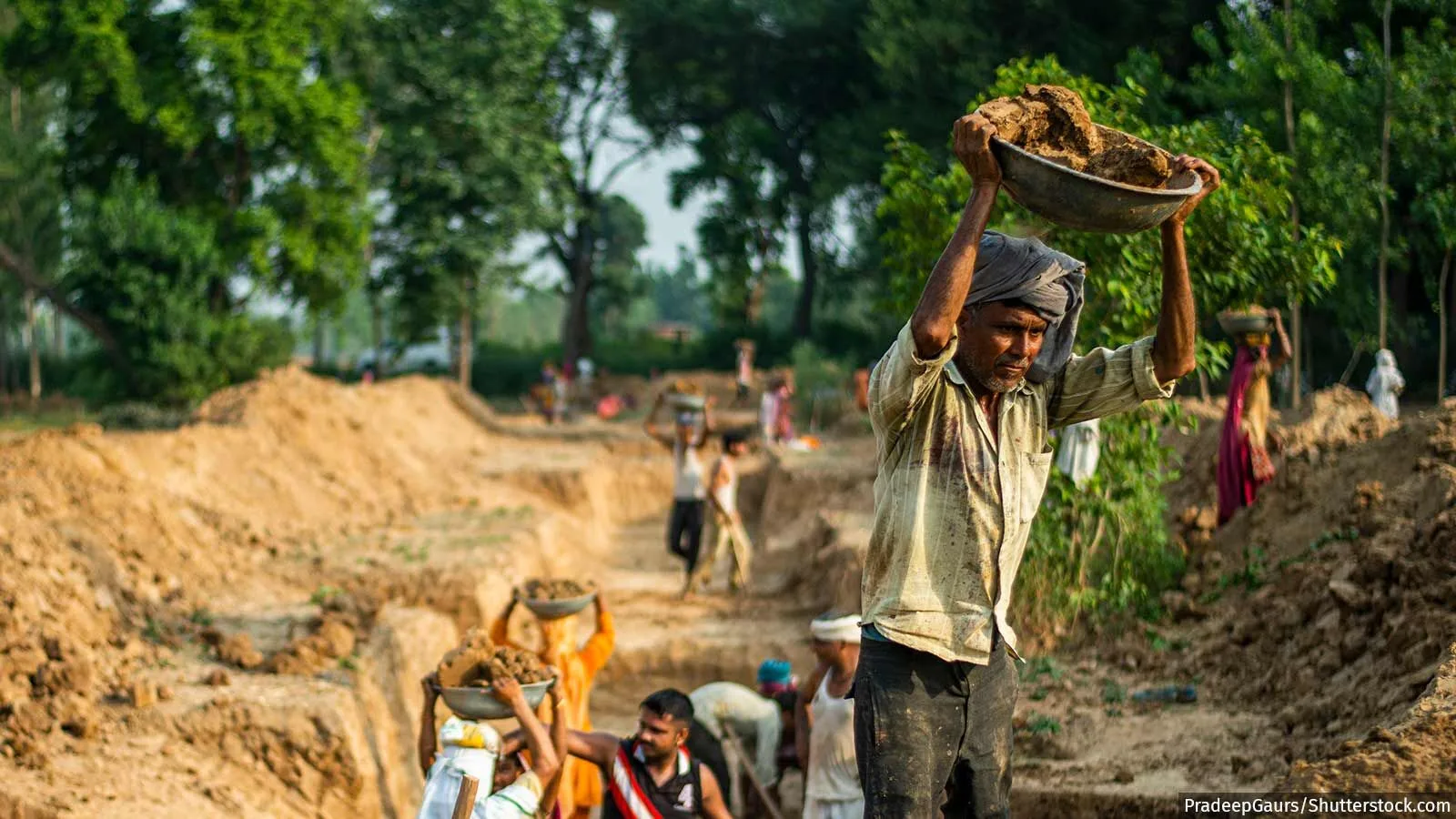
The Centre has initiated a major administrative shift in the Mahatma Gandhi National Rural Employment Guarantee Act (MGNREGA) by integrating Aadhaar-based e-KYC for job card verification and renewal. On Friday (Nov 21), the Ministry of Rural Development announced that 99.67 per cent of active MGNREGA workers are now Aadhaar-seeded, an unprecedented figure that lays the groundwork for full digital authentication across one of the world’s largest social welfare programmes.
With more than 26 crore registered workers spread across 2.69 lakh gram panchayats, MGNREGA remains central to the rural workforce. The new e-KYC process, implemented through the National Mobile Monitoring System (NMMS) app, is being projected as a major reform aimed at eliminating duplication, enhancing transparency and ensuring smooth, timely wage payments.
According to the Ministry, 56 per cent of active workers have already completed e-KYC. States have been instructed to manage predictable technical difficulties, such as weak mobile connectivity, through on-site verifications and special gram panchayat-level camps. Each verification takes less than a minute and is conducted through real-time facial authentication with Aadhaar data. While the scale and speed of this digital verification drive mark a turning point for the programme, it is in fact the capstone of a decade-long transformation.
How Modi Government reshaped MGNREGA
To understand the significance of the Aadhaar-linked e-KYC push, one must look back at the far-reaching reforms that reshaped MGNREGA under the Narendra Modi government. When the government came to power in 2014, the scheme was beleaguered by chronic issues including leakages, fake job cards, ghost beneficiaries, inflated muster rolls and rampant contractor interference. Though the government initially questioned the programme’s inefficiencies, it soon opted to overhaul it rather than dismantle it. The years that followed saw the creation of a robust digital and administrative ecosystem that fundamentally changed the way MGNREGA was monitored and implemented.
One of the most important early reforms was the shift to Aadhaar-based Direct Benefit Transfers. By 2015-16, wage payments moved from cash disbursement to Aadhaar-linked bank accounts. This shift dramatically reduced leakages, middlemen commissions and local-level manipulation.
In 2021, the Centre introduced mandatory geotagged, real-time attendance through the NMMS app for worksites with over 20 workers. Supervisors were required to capture time-stamped photographs of workers at worksites, a reform that struck at the heart of fraudulent muster rolls and exaggerated attendance entries.
Around the same time, GIS mapping of assets, especially water conservation structures, made it possible to monitor asset creation and quality in real time. Beneficiary targeting also became more data-driven with the integration of Socio-Economic Caste Census data, ensuring that vulnerable groups such as SC/ST households, landless labourers, women-headed households and small farmers were prioritised.
These reforms laid the foundation for the current Aadhaar-based e-KYC initiative, which brings all previous digital layers together into a unified authentication and wage delivery mechanism.
How the new e-KYC system works
The Aadhaar-based e-KYC process has been seamlessly embedded into the NMMS application. A field-level MGNREGA functionary captures a live photograph of a worker either at the worksite or at the gram panchayat office. This image is instantly matched against the Aadhaar database. Once the match is successful, the worker’s job card is renewed or validated for future use. The speed and accuracy of this verification process are being highlighted as key to the Centre’s push for a cleaner, more transparent database.
The system directly addresses long-standing concerns regarding the presence of duplicate or ghost workers, fake job cards created to siphon public funds, middlemen collecting wages on behalf of real workers and inflated muster rolls maintained at various levels. Aadhaar-based authentication, ensures that only genuine workers remain on government records, enabling timely, accurate wage payments without manual verification delays.
Why job card verification matters
Job cards form the backbone of a worker’s identity under the MGNREGA framework. According to Schedule II of the Act, job cards must be issued within fifteen days of application and renewed every five years. These cards contain the job card number, Aadhaar-linked data, insurance details and household information.
However, poor verification practices at the gram panchayat level, along with outdated records, have often resulted in delayed wages, misallocated funds and misuse of job cards by individuals who were not eligible for the programme.
The Centre’s e-KYC mandate aims to eliminate such inconsistencies by creating a synchronised, nationwide and real-time database of workers across all districts and gram panchayats. This ensures that only verified, legitimate workers receive employment and wages under the Act.
New SOP on job card deletion to prevent wrongful removal
The issue of job card deletions has often been politically charged, with activists and opposition parties alleging wrongful exclusions. To address this, the Ministry issued a Standard Operating Procedure (SOP) on January 24, 2025, outlining strict guidelines governing job card deletions.
The SOP outlines standardised grounds for deletion, detailed verification protocols, documentation requirements, and grievance redressal mechanisms. It also provides safeguards to ensure that genuine workers are not arbitrarily removed. While states are responsible for implementing deletions, the Centre continues to monitor compliance to minimise errors and prevent misuse of the process.
Why the government wants e-KYC
The move toward mandatory e-KYC reflects a broader governance philosophy that the Modi government has applied across welfare schemes. The first pillar of this vision is transparency. As the single-largest rural employment programme in the country, MGNREGA has historically been susceptible to manipulation at multiple levels. Aadhaar-based verification allows the system to be tracked from attendance marking to wage disbursal, leaving little room for corruption or misreporting.
The second pillar involves the elimination of ghost payments and fake entries, issues that have repeatedly been highlighted in audits. Aadhaar-linked verification ensures that every name on the muster roll corresponds to a real person present at a real worksite. The third pillar focuses on improving wage payment timelines.
Delays in wage disbursal have been a persistent criticism of the programme. With a clean and authenticated worker database, payments can be processed faster and without error.
The fourth pillar aims to create an integrated digital welfare architecture where verified data from MGNREGA can be linked with other rural welfare programmes, including PM Awas Yojana, Ujjwala and the Jal Jeevan Mission. This deeper integration aligns with the government’s shift toward data-driven governance and targeted delivery of welfare benefits.
Despite the scale and ambition of the reform, implementation at the ground level presents several challenges. Weak network connectivity in remote rural areas remains a major obstacle to real-time verification. Many elderly workers lack familiarity with smartphones, and several states have pointed out that field-level officials require additional training to operate the NMMS app efficiently.
To address these issues, the Ministry has directed states to set up temporary verification camps at gram panchayat offices, anganwadi centres and worksites. Training modules have been circulated to panchayat secretaries, rozgar sevaks and block development officers to minimise errors and ensure workers are not inconvenienced.
Digital welfare and the politics surrounding it
The Modi government has consistently projected digital empowerment and financial accountability as the core of its welfare delivery model. Aadhaar authentication is now deeply embedded in most welfare schemes, from LPG subsidies to pension disbursements. MGNREGA was one of the last major programmes yet to undergo full authentication, and the e-KYC integration represents the final step in creating a unified digital welfare system. The government’s approach has been summed up in its governance mantra of “minimum leakage, maximum efficiency.”
While concerns remain that an overreliance on digital systems may disadvantage vulnerable groups, such as elderly workers, migrants with inconsistent biometric records and families in low-connectivity regions, the broader experience across welfare schemes shows that digitisation has significantly curbed corruption, reduced middlemen-driven leakages and accelerated service delivery.
Aadhaar-linked reforms in schemes like LPG subsidies, pensions, PM-Kisan and public distribution have demonstrated how transparent, real-time verification can eliminate fraud and ensure that benefits reach the intended households without delay. In this context, the Centre’s insistence on non-intrusive, on-site verification alternatives for MGNREGA appears designed to safeguard inclusivity while still preserving the integrity and speed of the system. Whether this balance succeeds will ultimately depend on how efficiently state machinery responds on the ground.
The integration of Aadhaar-based e-KYC into MGNREGA marks one of the most significant reforms in the scheme’s nearly two-decade history. What began as a paperwork-heavy, manually monitored employment guarantee programme is gradually evolving into a digitally managed, highly accountable welfare system. Over the past decade, reforms in transparency, asset monitoring, wage delivery and beneficiary targeting have reshaped the programme’s character. The e-KYC initiative builds on this foundation and signals the arrival of a new era in rural governance.
If connectivity challenges are addressed effectively and adequate training is provided at the grassroots level, the e-KYC system could substantially reduce leakages, accelerate wage payments and ensure that only genuine workers benefit from the scheme.
















Comments