





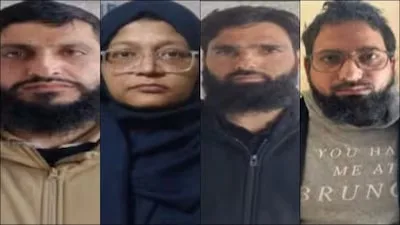
The ongoing probe into the Red Fort blast case has shaken India’s security establishment, not merely because of the act of terror itself, but because of those behind it, a group of well-educated medical professionals who investigators say engineered a complex and sustained terror conspiracy. In what officials describe as a rare but deeply alarming case of “white-collar radicalisation,” the National Investigation Agency (NIA) has traced a two-year trail of fund collection, chemical procurement, and covert logistical operations that point to a planned series of terror attacks across multiple Indian cities.
According to officials associated with the investigation quoted in media, the accused doctors worked methodically to build a financial and chemical supply chain worth Rs 26 lakh, specifically for executing coordinated explosions. Their involvement, investigators say, stands out because these were individuals embedded within the healthcare system, working in hospitals and educational institutions, and entrusted with the responsibility of saving lives, yet plotting to take them on a large scale.
At the centre of the financial conspiracy is Dr Muzammil Ganaie, who is believed to have provided a detailed account during interrogation of how the group systematically raised funds over an extended period. According to his statement, Ganaie contributed Rs 5 lakh, while his associate Adeel Ahmad Rather added Rs 8 lakh. Adeel’s brother, Muzaffar Ahmad Rather, contributed Rs 6 lakh, though he is currently believed to be outside India. Dr Shaheen Shahid allegedly provided Rs 5 lakh, and Dr Umar Un-Nabi Mohammad, who investigators identify as the technical head of the operation, contributed Rs 2 lakh.
What struck investigators most was that the cumulative amount, every rupee collected, was handed over entirely to Umar, suggesting he was the nucleus around whom the technical procurement and execution phases revolved.
NIA officials say the scale and structure of the funding indicate a premeditated conspiracy rather than an impulsive act. “The funding pattern shows a structured conspiracy, not a spur-of-the-moment plan,” an official noted, emphasising that the manner in which the money was pooled reflected organisational discipline and long-term planning.
The investigation further reveals that the group spent almost two years acquiring materials necessary for manufacturing explosives and assembling remote-triggering devices. This included the procurement of fertilisers, chemicals, circuitry, and electronic components, all purchased in small batches and through discreet channels to avoid drawing attention.
An NIA officer quoted in media saying that the group’s methodical pace reflected careful planning: “They were not building explosives overnight; this was a deliberate, phased operation designed to evade detection.”
One of the most critical aspects of the investigation revolves around chemical procurement. Officials say Ganaie purchased 26 quintals of NPK fertiliser from Gurugram and Nuh for approximately Rs 3 lakh. In addition, ammonium nitrate and urea both key components in improvised explosive devices (IEDs), were stockpiled over time.
Investigators believe the conversion of these agricultural materials into explosive compounds was carried out under the close supervision of Umar, who allegedly oversaw the mixing, stabilisation, and storage processes. His role, they say, also extended to arranging remote detonators, electronic circuitry, and triggering mechanisms, indicating a clear division of labour within the module.
This division of responsibilities, officials argue, shows the group operated with a professional hierarchy typically seen in organised terror cells. “Umar handled the technical part, while others focused on funding and logistics,” an investigator, adding that the steady accumulation of materials and the efficient compartmentalisation of duties suggest prior training or external guidance.
The NIA has so far arrested three doctors, Ganaie, Shaheen Shahid, and Adeel Rather. However, the wider network remains under scrutiny, particularly because of missing suspects and possible cross-border links. Muzaffar Ahmad Rather, believed to be part of the core funding circle, is suspected to be in Afghanistan, making his interrogation and extradition difficult.
Meanwhile, investigators are searching for Nissar ul-Hassan, a colleague of the accused at Al-Falah Medical College. Several of the suspects either worked or studied together at the institution, a detail that has raised concerns about radicalisation within academic environments.
It is Umar’s alleged involvement in the actual blast that has become central to the narrative. Officials believe he detonated the explosive cache placed inside a Hyundai i20 near the Red Fort on November 10, managing to escape through the congested lanes nearby. His technical expertise, investigators say, allowed him to assemble a device capable not just of a single explosion but possibly of triggering multiple blasts remotely, a fact that has intensified concerns about the group’s long-term objectives.
What has alarmed investigators further is the volume of materials recovered. Officers say the quantity of chemicals, detonators, and circuitry discovered across multiple locations indicates that the Red Fort blast was likely intended as either a test run or the first in a series of attacks. NIA suggesting that the group may have been planning serial blasts across different cities.
With the preliminary confession linking several previously isolated leads, the NIA has now shifted its focus to mapping the broader network. The next phase of the investigation involves tracing upstream suppliers who provided chemicals, electronic components, and other materials; examining whether the accused misused professional credentials to access restricted areas or substances; and identifying additional sleeper nodes that may be connected to the module. “It appears to be a deeply embedded module operating under academic cover. The aim now is to uncover every node,” an NIA official said.
The Delhi blast probe has thus opened a troubling chapter in India’s ongoing fight against domestic terror. It exposes how seemingly ordinary professionals, men with medical degrees, access to laboratories, and careers in public health, can exploit their knowledge for destructive purposes.
The case underlines the evolving nature of radicalisation in India, where the lines between education and extremism are increasingly being probed by agencies seeking to understand how deep such networks run.














Comments