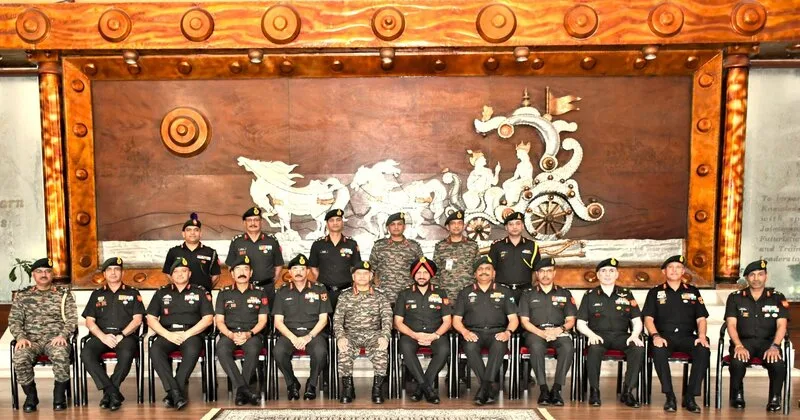
Significance of Doctrine & Strategy seminar at Army War College
December 5, 2025
  • Read Ecopy
  • Circulation
  • Advertise
  • Careers
  • About Us
  • Contact Us
Android AppiPhone AppArattai
Organiser
  • ‌
  • Bharat
    • Assam
    • Bihar
    • Chhattisgarh
    • Jharkhand
    • Maharashtra
    • View All States
  • World
    • Asia
    • Europe
    • North America
    • South America
    • Africa
    • Australia
  • Editorial
  • International
  • Opinion
  • RSS @ 100
  • More
    • Op Sindoor
    • Analysis
    • Sports
    • Defence
    • Politics
    • Business
    • Economy
    • Culture
    • Special Report
    • Sci & Tech
    • Entertainment
    • G20
    • Azadi Ka Amrit Mahotsav
    • Vocal4Local
    • Web Stories
    • Education
    • Employment
    • Books
    • Interviews
    • Travel
    • Law
    • Health
    • Obituary
  • Subscribe
    • Subscribe Print Edition
    • Subscribe Ecopy
    • Read Ecopy
  • ‌
  • Bharat
    • Assam
    • Bihar
    • Chhattisgarh
    • Jharkhand
    • Maharashtra
    • View All States
  • World
    • Asia
    • Europe
    • North America
    • South America
    • Africa
    • Australia
  • Editorial
  • International
  • Opinion
  • RSS @ 100
  • More
    • Op Sindoor
    • Analysis
    • Sports
    • Defence
    • Politics
    • Business
    • Economy
    • Culture
    • Special Report
    • Sci & Tech
    • Entertainment
    • G20
    • Azadi Ka Amrit Mahotsav
    • Vocal4Local
    • Web Stories
    • Education
    • Employment
    • Books
    • Interviews
    • Travel
    • Law
    • Health
    • Obituary
  • Subscribe
    • Subscribe Print Edition
    • Subscribe Ecopy
    • Read Ecopy
Organiser
  • Home
  • Bharat
  • World
  • Operation Sindoor
  • Editorial
  • Analysis
  • Opinion
  • Culture
  • Defence
  • International Edition
  • RSS @ 100
  • Magazine
  • Read Ecopy
Home Bharat

Shaping the military future of India: Significance of Doctrine & Strategy seminar organised at Army War College, Mhow

The significance of Doctrine and Strategy Seminar lies in its ability to sharpen the Army’s thinking at a time when the nature of conflict is rapidly changing. India’s security challenges are unlikely to become simpler. Meeting these challenges requires more than hardware, it requires ideas, clarity of purpose, conceptual rigour and a willingness to prepare for the future. The DSS strengthens precisely this intellectual foundation

Dr Rajesh JauhriDr Rajesh Jauhri
Nov 23, 2025, 03:00 pm IST
in Bharat, Defence
Follow on Google News
Doctrine and Strategy Seminar(File Photo)

Doctrine and Strategy Seminar(File Photo)

FacebookTwitterWhatsAppTelegramEmail

As India navigates an increasingly turbulent strategic environment marked by geopolitical rivalry, shifting power balances and rapid technological disruption, the need for structured military thinking has never been more urgent. Modern warfare is undergoing a profound transformation, not just in how battles are fought but in how threats evolve and how nations must prepare. In this context, the Doctrine and Strategy Seminar (DSS), conducted annually at Army War College, Mhow, occupies a central place in shaping the intellectual foundations of India’s military readiness. The seminar is not merely an academic gathering; it is an instrument that connects strategic thought with national-level defence planning, serving as a bridge between emerging challenges and institutional responses.

The DSS was conceived with a clear purpose: to provide a platform where practitioners, scholars, veterans and policymakers can collectively examine the evolving security environment and debate the doctrinal, strategic and capability implications for the Indian Army. Over the years, it has acquired a reputation as the Army’s most important doctrinal forum, evolving with the demands of the times. Its intent is rooted in the understanding that modern militaries must think ahead of the battlefield. Technology, geopolitics and warfare concepts evolve in cycles too short for traditional planning processes to keep pace. The DSS recognises that assumptions must be questioned, doctrines must be refined and strategies must be continuously tested against new realities.

The background of the seminar lies in the need to create an institutional mechanism that encourages critical thinking within the military establishment. The modern battlefield is no longer defined only by ground manoeuvres or firepower; it is shaped by information flows, cognitive influence, cyber operations, unmanned systems and long-range precision weaponry. India’s geographic realities add further complexity. With two nuclear-armed neighbours, both pursuing distinct yet complementary modes of warfare, India must prepare for scenarios ranging from high intensity conventional conflict to grey zone and non-contact operations. Against this background, the DSS was designed to examine the future threat environment, review doctrinal foundations, align strategic thinking with national interests and ensure that capability development remains both relevant and future-oriented.

The seminar’s scope is wide and deliberate. It evaluates how warfare is likely to transform in the decades ahead, assesses technological opportunities and challenges and examines India’s preparedness across operational, organisational and doctrinal dimensions. This year, its theme focuses on strengthening the Indian Army’s capability for tomorrow’s warfare, recognising that future conflicts will unfold in compressed time frames and across multiple interconnected domains. The intent is not only to understand how adversaries may fight but how India must prepare to deter, respond and prevail. This examination is essential for shaping acquisition priorities, force structuring, training reforms and jointness across services.

A major portion of the seminar is dedicated to understanding the military implications of India’s strategic geography. China’s rapid military modernisation and its concept of intelligentised warfare, which integrates AI, autonomous systems, space-based assets and cognitive warfare, presents a long-term challenge. Pakistan’s continued reliance on asymmetric and proxy tools under the nuclear cover adds unpredictability. Together, they create the possibility of a collusive threat. The DSS provides an opportunity to examine this evolving environment from an Indian perspective, ensuring that planning is rooted in realistic assessments rather than mirror-imaging. It highlights that preparing for tomorrow’s challenges requires a deeper understanding of adversary behaviour, emerging technologies and shifting doctrines.

Another vital dimension of seminar addresses the accelerating pace of technological change. Conflicts such as those in Syria, Nagorno-Karabakh and Ukraine have underscored how drones, AI-supported targeting, satellite-based intelligence, electronic warfare and cyber operations can change the character of war. For India, technology is not merely an enabler; it is an indispensable component of modern operational art. The discussions at DSS compel the Army to link capability development with doctrinal needs, ensuring that platforms, sensors and weapon systems are acquired with a clear understanding of their operational role. In this way, the seminar directly supports Atmanirbharta by helping articulate what technologies are needed, why they matter and how they must be integrated into the force structure.

DSS also plays a significant role in the national security related policymaking ecosystem. Its deliberations feed into higher decision making platforms such as the Defence Planning Committee and the National Security Council Secretariat. Policy decisions from procurement priorities and joint-service integration to operational concepts and theatreisation are influenced by the conceptual clarity that emerges from the seminar. Many recent reforms, including discussions on integrated surveillance systems, precision strike capability, multi-domain awareness and modernisation of training institutions, have roots in insights generated at the DSS. In this sense, the seminar manifests itself in both doctrine and policy formulation, bridging the gap between thought and action.

Also Read: India shines in global markets: FPIs assets under custody hit highest since September 2024

A distinguishing feature of DSS is that it encourages debate, disagreement and intellectual openness qualities essential for strategic institutions. It provides officers at various levels the opportunity to articulate new ideas, challenge legacy assumptions and contribute to shaping the Army’s long-term trajectory. The Army War College, with its role in professional military education, offers an ideal environment for this exchange. By bringing together diverse perspectives, it ensures that India’s military modernisation is driven not just by budgetary considerations or technological trends, but by doctrinal logic and strategic foresight.

The significance of Doctrine and Strategy Seminar lies in its ability to sharpen the Army’s thinking at a time when the nature of conflict is rapidly changing. India’s security challenges are unlikely to become simpler. They will become more complex, more ambiguous and more contested across physical and virtual domains. Meeting these challenges requires more than hardware, it requires ideas, clarity of purpose, conceptual rigour and a willingness to prepare for the future. The DSS strengthens precisely this intellectual foundation. By aligning doctrine, strategy and capability planning with the realities of tomorrow’s battlefield, it ensures that India’s military instrument remains prepared, relevant and forward-looking. It is this role quiet yet essential that makes the Doctrine and Strategy Seminar a cornerstone in shaping India’s military future.

Topics: Indian ArmyDefenceWarMilitary preparednessDoctrine & Strategy SeminarArmy War College
ShareTweetSendShareSend
✮ Subscribe Organiser YouTube Channel. ✮
✮ Join Organiser's WhatsApp channel for Nationalist views beyond the news. ✮
Previous News

Trade momentum of India holds steady amid global uncertainty; FY26 current account deficit seen near 1% of GDP

Next News

Historic shift in worker rights: New labour codes give gig workers legal recognition for the first time

Related News

Retired Subedar held for leaking Army details to Pak handlers posing as Indians

Gujarat ATS dismantles spy network involving Ex-Army personnel and woman for sharing information with Pakistan

INS Vikrant delivering relief provisions to Sri Lanka (Photo/X@indiannavy)

Sagar Bandhu: Indian Army, NDRF teams work round the clock for HADR ops in Sri Lanka

Russian President Vladimir Putin and Prime Minister Narendra Modi

Reminiscing India-Russia Relations: A testament for strategic autonomy & timetested trust in the great power playbook

Indian Army performs successful combat launch of BrahMos over Bay of Bengal, reaffirms long-range precision strike capability

Indian Army performs successful combat launch of BrahMos over Bay of Bengal, reaffirms long-range strike capability

Representative image

BSF Raising Day: PM Modi extends greetings & commends the force for unwavering resolve and professionalism

Discipline, Dharma, and the Uniform: What Samuel Kamalesan case teaches us about Indian Army & limits of individualism

Load More

Comments

The comments posted here/below/in the given space are not on behalf of Organiser. The person posting the comment will be in sole ownership of its responsibility. According to the central government's IT rules, obscene or offensive statement made against a person, religion, community or nation is a punishable offense, and legal action would be taken against people who indulge in such activities.

Latest News

(L) Kerala High Court (R) Bouncers in Trippoonithura temple

Kerala: HC slams CPM-controlled Kochi Devaswom Board for deploying bouncers for crowd management during festival

Fact Check: Rahul Gandhi false claim about govt blocking his meet with Russian President Putin exposed; MEA clears air

Union Minister for Road Transport and Highways Nitin Gadkari (Right)

India set for highway overhaul as Union Minister Nitin Gadkari unveils nationwide shift to MLFF electronic tolling

RSS Akhil Bharatiya Prachar Pramukh Shri Sunil Ambekar

When Narrative Wars result in bloodshed, countering them becomes imperative: Sunil Ambekar

Ministry of Civil Aviation mandates emergency action: IndiGo ordered to stabilise flight operations by midnight

Chhattisgarh CM Vishnu Deo Sai at Panchjanya Conclave, Nava Raipur, Image Courtesy - Chhattisgarh govt

Panchjanya Conclave: Chhattisgarh CM Sai shares views on development projects in Maoist hotbed, women empowerment

Union Finance Minister Nirmala Sitharaman

‘TMC is holding Bengal back’: Sitharaman slams Mamata govt over industrial & healthcare setbacks

Karnataka: Muslim youth Mohammed Usman accused of sexual assault, blackmail & forced conversion in Bengaluru

Social Justice Is a cover; Anti-Sanatana dharma is the DMK’s real face at Thirupparankundram

Karnataka: Hindus demand reclaiming of Anjaneya Mandir at the site of Jamia Masjid; Setting wrongs of Tipu Sultan right

Load More
  • Privacy
  • Terms
  • Cookie Policy
  • Refund and Cancellation
  • Delivery and Shipping

© Bharat Prakashan (Delhi) Limited.
Tech-enabled by Ananthapuri Technologies

  • Home
  • Search Organiser
  • Bharat
    • Assam
    • Bihar
    • Chhattisgarh
    • Jharkhand
    • Maharashtra
    • View All States
  • World
    • Asia
    • Africa
    • North America
    • South America
    • Europe
    • Australia
  • Editorial
  • Operation Sindoor
  • Opinion
  • Analysis
  • Defence
  • Culture
  • Sports
  • Business
  • RSS @ 100
  • Entertainment
  • More ..
    • Sci & Tech
    • Vocal4Local
    • Special Report
    • Education
    • Employment
    • Books
    • Interviews
    • Travel
    • Health
    • Politics
    • Law
    • Economy
    • Obituary
  • Subscribe Magazine
  • Read Ecopy
  • Advertise
  • Circulation
  • Careers
  • About Us
  • Contact Us
  • Policies & Terms
    • Privacy Policy
    • Cookie Policy
    • Refund and Cancellation
    • Terms of Use

© Bharat Prakashan (Delhi) Limited.
Tech-enabled by Ananthapuri Technologies