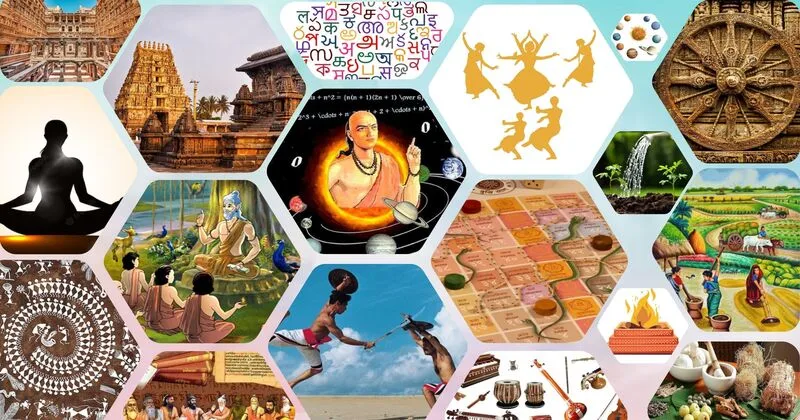
India stands today at a pivotal moment in history, where its civilizational depth, scientific traditions and cultural influence are being rediscovered and rearticulated for a global audience. Among the most powerful tools available for this re-emergence is the vast body of wisdom known as the Indian Knowledge Systems (IKS). Far from being relics of the past, these systems contain rigorous scientific insights, philosophical clarity and ecological understanding that remain profoundly relevant to the 21st century.
As nations increasingly engage through soft power, culture, education and knowledge, IKS has the potential to become one of India’s strongest diplomatic assets. At the same time, presenting this knowledge to India’s younger generation can foster cultural confidence, scientific temperament and a renewed sense of identity. Ancient India was not only a land of spiritual insights but also of scientific imagination and experimentation. Thinkers like Kanada, Aryabhata, Charaka, Sushruta, Panini and Bhaskara laid the foundations of physics, astronomy, medicine, linguistics and mathematics long before their Western counterparts emerged.
The Vaisesika Sutra offered one of the world’s earliest atomic theories; the Nyaya Sutra formalized logic and epistemology, the Upanishads explored the nature of energy, consciousness and cosmic order; and classical astronomy texts mapped planetary motions with mathematical precision. These accomplishments demonstrate that Indian civilization has always combined rational thinking with philosophical reflection. At a time when global society respects evidence-based ideas, IKS becomes naturally appealing.
Today’s young minds, whether in India or abroad, are trained to think critically, question assumptions and seek logical explanations. Presenting IKS through a scientific lens enables them to appreciate their heritage with pride rather than nostalgia. Kanada’s atomism can be connected to concepts in quantum physics, the Upanishadic idea of Nada Brahma resonates with modern acoustic and vibrational science; the Ayurvedic tridosa theory parallels systems biology, ancient metallurgical achievements help explain rust-resistant iron, advanced alloys and precision casting; and early Indian astronomy can be taught using modern simulations and planetary models. When integrated into such contemporary scientific frameworks, IKS becomes exciting, exploratory and intellectually stimulating for the new generation.
Modern diplomacy is no longer limited to politics and trade, it increasingly involves culture, education and intellectual influence. The global success of yoga has already shown how a knowledge tradition can reshape the world’s perception of India, and IKS has the potential to extend this impact further. In the sphere of educational diplomacy, many nations are turning toward holistic learning, sustainability and integrative sciences, making Indian mathematics, logic, Ayurveda, astronomy and environmental ethics valuable additions to global curricula. Cultural-scientific diplomacy can flourish through conferences, exhibitions, documentaries and digital media that highlight India’s scientific heritage.
Indian principles rooted in ṛta (cosmic order), dharma (duty) and ecological harmony support sustainability diplomacy, resonating strongly with global environmental priorities. Ethical leadership diplomacy finds strength in texts like the Bhagavad Gita, Upanishads and Arthashastra, which offer timeless guidance on leadership, governance and conflict resolution. Even technological diplomacy can benefit from India’s traditional innovations in metallurgy, architecture, agriculture and water management, fostering collaborations on low-cost and eco-friendly solutions. Together, these avenues position IKS as an elegant and credible bridge between India and the world.
For IKS to thrive, it must connect with India’s youth through the language of science, innovation and global relevance. This requires integrating IKS modules into school and university curricula, encouraging research on ancient Indian texts using modern scientific methods and promoting digital content such as podcasts, animations and interactive apps that make these concepts accessible. Student-led projects on traditional sciences, architecture, ecology and mathematics can further deepen engagement, while highlighting the real scientific principles embedded in ancient practices, rather than presenting them only as cultural narratives ensures authenticity and credibility. Such initiatives nurture a confident generation that views IKS not merely as a legacy of the past, but as a vibrant springboard for future scientific exploration and discovery.
To gain global credibility, IKS must be presented with uncompromising academic rigor. This involves the scholarly reinterpretation of ancient ideas through experimental validation, along with interdisciplinary collaboration among physicists, historians, biologists, philosophers and linguists. Digitizing manuscripts and preserving traditional knowledge ensures accessibility, while publishing in international journals and participating in global scientific conferences situates IKS within mainstream academic discourse. Establishing dedicated university centers for IKS research and training further institutionalizes its study. Through such scientific articulation, IKS evolves from cultural memory to robust research, making it suitable for global academic dialogue.
When communicated strategically, ancient Indian science can significantly enrich India’s soft power. It strengthens cultural ties with nations seeking holistic knowledge systems, offers sustainable science frameworks relevant to global challenges and opens pathways for collaborative research in mathematics, astronomy, environment and medicine. Presenting India as a knowledge-based civilization, rather than merely a rapidly advancing economy enhances international respect and trust. Moreover, the moral, philosophical and ecological values rooted in Indian traditions possess universal appeal. At a time when the world is searching for ethical technology, balanced living and integrative healthcare, IKS emerges as a reservoir of wisdom that seamlessly connects scientific inquiry with human wellbeing.
Promoting IKS is not only about preserving heritage; it is about shaping the future of India’s scientific and diplomatic identity. Both global audiences and Indian youth respect ideas that are logical, evidence-based and intellectually rich. Ancient Indian science fulfils all these expectations. When we present IKS in a scientific, accessible and globally relevant manner, it becomes a powerful tool of influence, one that strengthens India’s soft power, inspires the next generation and re-establishes India as a knowledge leader on the world stage. In this mission lies the promise of a culturally confident, scientifically vibrant and globally respected India.