





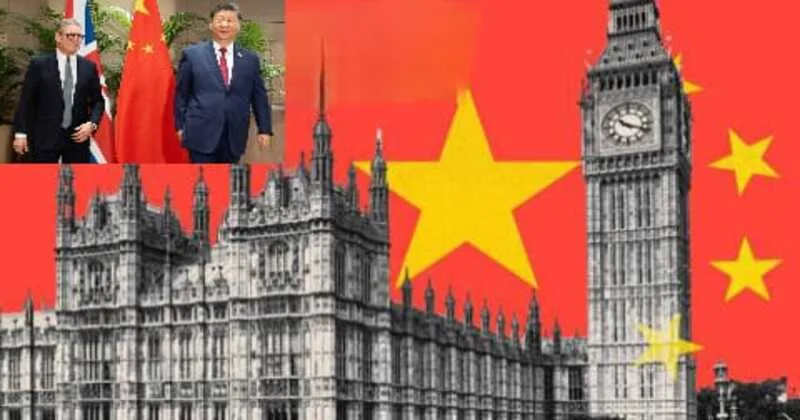
China has channelled tens of billions of pounds into UK companies and infrastructure projects since the turn of the century, some of which enabled access to technology with potential military applications, a UK-based media house investigation has revealed.
AidData, a US-based research organisation that tracks government spending overseas, provided the media with exclusive early access to its latest dataset. Adjusted to 2023 prices, China’s UK investments amount to £45bn, marking Britain as the top G7 destination relative to the size of its economy and population. According to AidData, China’s investment surge accelerated after a 2015 directive issued by Beijing that sought to position the country as a world leader in advanced technologies. The result, a decade later: the transfer of British innovation, intellectual property and skills to Chinese entities, often through acquisitions. A former head of GCHQ told the media that the UK had been excessively permissive in allowing foreign access to strategically important sectors, especially science and technology. Investigation shows how those decisions enabled Chinese-linked investors to obtain high-value assets, some with direct or dual-use defence potential.
Strategic buying spree driven by Beijing’s long-term strategy
Dr Brad Parks, the executive director of AidData, said many Chinese state-backed investments abroad were indeed commercial, but others aligned closely with the country’s long-term strategic objectives. These objectives were outlined in the “Made in China 2025” plan, which set aggressive targets for dominance in ten high-tech fields, from aerospace and advanced robotics to electric vehicles and semiconductor technologies. While analysts say that this industrial strategy demonstrated forward planning and long-term ambition, critics argue that Beijing leveraged it to secure foreign technology and expertise under the guise of open investment.
Among the UK companies examined by investigators, Imagination Technologies in Hertfordshire stood out. The firm specialises in designing semiconductor architecture, core intellectual property that powers smartphones, computers and a wide range of other electronics. In 2017, after losing Apple as its biggest customer and experiencing a steep fall in its share price, Imagination was acquired for £550m by Canyon Bridge, a private equity fund then headquartered in California. What made the deal sensitive was Canyon Bridge’s primary investor: Yitai Capital, whose largest stakeholder is China Reform, a state-owned entity reporting to the State Council in Beijing.
Just two months before it bought Imagination, Canyon Bridge had attempted to acquire a US semiconductor firm but had been blocked by Washington’s foreign investment laws. The value of Imagination lay not in factories but in the knowledge of its highly specialised engineers and decades of proprietary research. The underlying algorithms and chip designs, while created for commercial use, could be adapted for defence platforms such as missiles, drones and guidance systems. Ron Black, the company’s former CEO, told the media that the UK government did review the 2017 sale, and Canyon Bridge assured him that China Reform would act only as a passive investor with no operational involvement. According to Black, those assurances did not hold.
Allegations of pressure to transfer British technology to China
Black said that in 2019, he was summoned to a meeting in Beijing, where he was asked to help facilitate a comprehensive transfer of the firm’s technology and engineering expertise to China. He recounted being urged to oversee a process in which the knowledge of British engineers would be replicated by Chinese teams, followed by large-scale layoffs of UK staff. The proposal, he said, was presented as financially rewarding for him personally, but he declined. Months later, he said, China Reform sought to appoint four new directors to Imagination’s board despite their lack of semiconductor knowledge, their main credential appearing to be close links to the Chinese state-owned investor. Alarmed by the implications for national security, Black contacted government officials. He said that although they listened sympathetically, he was told the matter fell within the boundaries of private business dealings.
However, when he tendered his resignation over fears of technology transfer with potential military uses, the government took a deeper interest, and China Reform paused its bid to reshape the board. Black withdrew his resignation, but he was dismissed shortly afterwards. An employment tribunal later ruled that he had been unfairly dismissed. Following his departure, Imagination’s proprietary technology was ultimately transferred to China through business arrangements that the company maintains were lawful. Imagination told Panorama that none of its technology is used in military products and that it has always complied with export, trade and licensing rules. Canyon Bridge said the acquisition had been initiated and led exclusively by the firm and its advisers. China Reform did not respond to the allegations.
The UK’s limited powers before 2022; Concerns echoed across the West
At the time of the acquisition, the UK had far fewer legal tools to block foreign takeovers on national security grounds. This was also the period during which then-Prime Minister David Cameron’s government touted a “golden era” of UK–China relations, symbolised by Xi Jinping’s 2015 state visit. Sir Jeremy Hunt, who was health secretary at the time, said that ministers initially viewed China as a friendly partner and a lucrative source of investment, though by 2015–16 the UK began sensing a more assertive strategic posture emerging from Beijing. Former GCHQ chief Sir Jeremy Fleming said the UK benefited economically from its trade relationship with China, but too often overlooked the risk that Chinese investment could be leveraged against British national interests. He contrasted Britain’s openness with China’s own restrictions, noting that Beijing has long prevented Western companies from taking stakes in strategically vital domestic industries.
Former US national security adviser John Bolton said that between 2017 and 2018, Europe and many American businesses underestimated China’s intentions, reluctant to see the situation through a Cold War lens. Others argue the UK was simply short-sighted. China’s political system, they contend, enables long-term planning across decades, backed by coordinated financing and state control. The results, from Beijing’s perspective, have been transformative. China has also been the world’s largest overseas lender this century, extending approximately £1.6tn in global financing at 2023 prices. Chinese investment abroad peaked around 2016–17, after which many countries tightened their foreign investment screening procedures. The US, Germany and Italy adopted tougher vetting regimes by 2018, and the UK followed with the National Security and Investment Act, which took effect in 2022. Sir Jeremy Fleming said Britain’s new framework is far stronger but still not foolproof.
Labour government faces the same Dilemma
The 2024 Labour government inherited a longstanding dilemma, the UK’s need for economic growth, and China’s ability to provide capital. Analysts note that Britain and other European states often struggle to find sufficient investment, leaving gaps China is willing to fill, particularly in areas without obvious national security risks.
Chancellor Rachel Reeves travelled to Beijing early in her tenure seeking to attract foreign capital, even as members of her own party raised concerns about transparency. Dame Emily Thornberry, who chairs the House of Commons Foreign Affairs Committee, said the government had promised to publish a comprehensive audit of UK–China relations. While the audit has been carried out, the full findings have not been released. The Foreign Office told media that it has not disclosed the complete report because of its security classification. It said it maintains a consistent and strategic approach to China, Britain’s third-largest trading partner, and will use all necessary powers to safeguard national interests while supporting UK firms to trade securely.
















Comments