





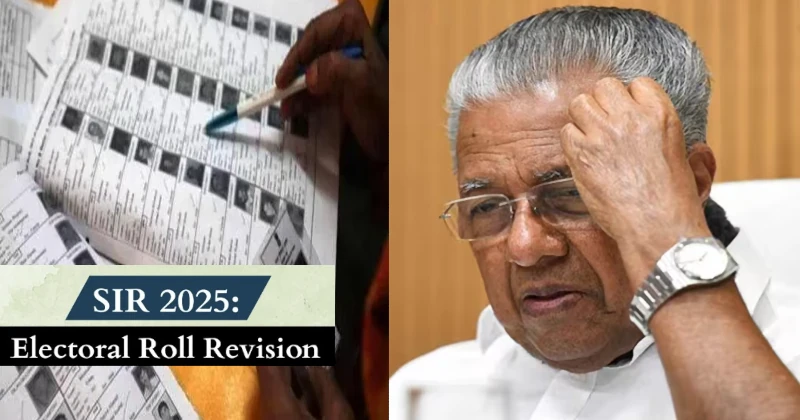
Kerala is witnessing a democratic crisis of its own making. What should have been a routine nationwide Special Intensive Revision (SIR) of electoral rolls has transformed into an unprecedented political confrontation unique to the state. The Pinarayi Vijayan government’s sustained opposition, contradictory legal manoeuvres, and inflammatory public rhetoric have turned a standard administrative exercise into a battleground one that has left Booth Level Officers (BLOs) overburdened, endangered, and in one tragic case, dead.
The story of SIR in Kerala is not merely about a disagreement between a state and the Election Commission. It is about how a government chose confrontation over cooperation, politics over practicality, and propaganda over preparation ultimately unleashing chaos on the very employees tasked with carrying out the duties it resisted.
Kerala Assembly’s sensational charge: ‘Backdoor NRC’ and manufactured panic (September 29, 2025)
The crisis began on September 29 2025, when the Kerala Assembly, under the direct guidance of Chief Minister Pinarayi Vijayan, passed a unanimous resolution attacking the ECI’s decision to conduct the SIR. Instead of approaching the issue administratively or engaging constructively with the Election Commission, the government launched an immediately escalatory and deeply political narrative. The resolution alleged that the SIR resembled a “backdoor NRC,” raising the spectre of mass exclusions and voter purges without presenting a shred of concrete evidence.
Pinarayi Vijayan’s public statements at the time pushed this narrative even further. He repeatedly invoked the example of Bihar, claiming that the SIR had led to “illogical exclusions” and suggesting that Kerala was being pushed into a similar trap. The political messaging was clear: the SIR was not a voter-list update, but part of a hidden national agenda. This framing not only polarised public opinion but also created an atmosphere of suspicion that would later manifest in hostility faced by BLOs on the ground.
Vijayan intensifies opposition, accuses ECI of ‘Undermining Democracy’ (October 28, 2025)
By late October, the Chief Minister’s rhetoric grew even sharper. On October 28 2025, Pinarayi Vijayan accused the Election Commission of “subverting the democratic process,” claiming that the decision to use 2002–04 rolls as the baseline was both “illegal” and “politically motivated.” He warned that the SIR was being rushed specifically to interfere with local body polls in Kerala.
Instead of clarifying administrative details or preparing field officers, the government mounted a public campaign to discredit the process. Vijayan suggested that SIR was connected to a larger national conspiracy, and even implied that the Centre was attempting to manipulate electoral outcomes. The barrage of statements had a direct consequence: it demotivated and confused lower-level administrative staff, created distrust among citizens, and made the work of BLOs considerably more confrontational.
CPI(M) labels ECI a “Puppet,” joins state-led anti-SIR campaign (October 28, 2025)
The ruling CPI(M) added further fire to the controversy on the same day. In a strongly worded statement, the party alleged that the Union government was turning the Election Commission into a “puppet” to execute politically driven revisions. The party also claimed that using the 2002 roll was “unscientific,” and would disenfranchise more than 50 lakh voters. Despite the SIR being implemented in 12 states, the CPI(M) portrayed Kerala as uniquely targeted.
This political propaganda saturated public discourse. The climate created by the government ensured that the administrative exercise was viewed not as a statutory revision but as an existential threat. The rhetoric had consequences far beyond politics it sowed fear and mistrust among ordinary citizens, many of whom soon began to refuse cooperation with BLOs during house-to-house visits.
All-party meeting (without BJP) resolves to fight ECI, escalates state-level obstruction (November 5, 2025)
On November 5 2025, the state government convened an all-party meeting to discuss SIR implementation. Except for the BJP, every major political party stood with the government in opposing the process and agreed to take the fight to court. The Chief Minister criticised the use of the 2002 roll again, calling it “irrational” and “ill-intentioned,” and the meeting concluded with a clear message: the state would escalate resistance, not compliance.
This decision crippled administrative functioning. Officers were left in the impossible position of conducting a process that the political leadership itself was undermining through public statements, legislative resolutions, and legal threats. Confusion spread across departments, as officials waited for clearer instructions that never came. As political posturing intensified, ground-level preparedness deteriorated.
Kerala Government’s High Court petition fails, exposes legal contradiction (November 13, 2025)
Despite aggressively portraying SIR as unconstitutional and dangerous, the Kerala government’s legal strategy revealed stark contradictions. On November 13, the state approached the Kerala High Court not to challenge the legality of SIR, but merely to seek a postponement. After weeks of accusing the Centre of voter manipulation and the ECI of democratic sabotage, the government claimed in court that it only wanted more time due to administrative strain.
The High Court refused to entertain the request and made it clear that any relief must come from the Supreme Court, where related petitions were already pending. With the rejection, the government was publicly exposed: after weeks of political theatre attacking the SIR, it had not prepared a legally coherent challenge. The contradiction between its political rhetoric and legal position further demoralised field-level workers who were already struggling under enormous pressure.
CPI(M) declares move to Supreme Court after State’s failure in Kerala HC (November 15, 2025)
One day after the High Court’s rejection, CPI(M) state secretary M V Govindan announced that the party not the government would now approach the Supreme Court. He accused the SIR process of being intentionally designed to “remove a section of voters.” This sudden shift made the government’s position even more disordered: while the administration had just told the High Court it did not plan to approach the Supreme Court, the ruling party declared that it would.
Such mixed messaging from the highest levels of governance created uncertainty for electoral staff and added to the administrative disarray that was rapidly deepening.
Dog attack on BLO reflects rising hostility created by state’s anti-SIR narrative (November 6, 2025)
The fallout of the government’s aggressive anti-SIR messaging soon became visible on the ground. On November 6, in Kottayam, a woman BLO carrying out SIR duties was mauled by a pet dog allegedly unleashed by a houseowner who refused to engage with the process. The officer sustained severe injuries to her face and neck and required treatment.
This shocking incident was not isolated but indicative of the hostile atmosphere surrounding BLO work. Many citizens, influenced by the government’s rhetoric linking SIR to NRC and voter deletion, began resisting the verification process. BLOs found themselves not only overworked but also facing safety threats created indirectly by the state’s political framing of the exercise.
BLO suicide in Kannur becomes flashpoint, family blames intolerable pressure (November 16, 2025)
Tragedy struck on 16 November when 44-year-old BLO Aneesh George was found dead in an apparent suicide at his home in Kannur. His family told the police and media that he had been working until the early hours of the morning, attempting to complete SIR targets under severe pressure. Local acquaintances reported that he had been visiting houses late at night and was overwhelmed by the workload created by compressed timelines.
The death sparked massive outrage among government employees. Unions immediately blamed the Election Commission and the state administration for allowing a politically volatile environment to lead to crushing pressure on BLOs. Instead of stepping in to protect employees or restructure workloads, the state, still engrossed in its political battle against SIR, failed to acknowledge the systemic stress that had contributed to the tragedy.
Statewide BLO boycott: Workers expose false reporting and unsafe conditions (November 17, 2025)
Following the suicide, major employee unions and teacher organisations launched a statewide boycott of BLO duties. They also staged protest marches at district headquarters and the Chief Electoral Officer’s office. Union leaders publicly challenged the Kerala government’s claims of high form-distribution rates and accused officials of forcing BLOs to upload fabricated data to match political narratives.
Reports emerged that BLOs were instructed over phone calls to complete enumeration within unrealistically short periods, often without adequate staff or support. The government’s refusal to appoint additional BLOs despite massive workloads created by the use of 2002 data further intensified the resentment. The boycott paralysed SIR operations in many districts and marked a stunning breakdown of trust between the state government and its own employees.
Ground-level reality: BLOs speak of exhaustion, hunger, technical failures and chaos (Reported November 14, 2025)
The most devastating accounts came from BLOs themselves. Detailed reports from across Kerala showed that many officers were working from early morning until late at night, sometimes without eating because they were pressed to meet unofficial deadlines advanced far ahead of the ECI’s actual schedule. The situation became especially unmanageable because of widespread confusion caused by overlapping government statements and constant political attacks on the revision exercise.
Many BLOs reported visiting houses multiple times because residents were wary, misinformed, or unavailable often due to the political fear created by the state’s narrative. The reliance on 2002 data created severe complications: women who had married and moved, migrant workers, and relocated families were difficult to trace. Technical glitches, poor network connectivity, last-minute changes in data entry apps, and language inconsistencies only added to their burden. Many BLOs were school employees juggling regular duties alongside SIR work, worsening the exhaustion.
What emerged was a portrait of systemic collapse driven as much by political obstruction as by administrative confusion. BLOs were left to shoulder immense burdens created by the same government that publicly opposed the exercise they were forced to execute.












Comments