





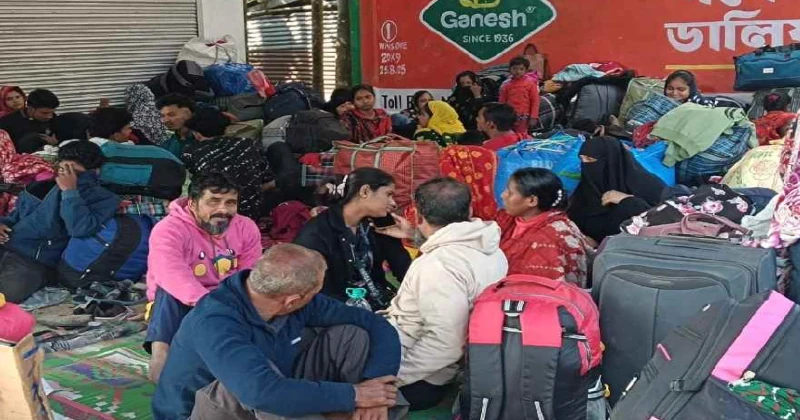
What began as a routine administrative exercise by the Election Commission of India (ECI) has snowballed into one of West Bengal’s most turbulent border episodes in years. The second phase of the Special Intensive Revision (SIR) a rigorous door-to-door verification of voter rolls has triggered a dramatic exodus of illegal Bangladeshi immigrants, exposed long-hidden settlement patterns, and deepened the political fault lines that have shaped Bengal’s recent electoral history.
From Hakimpur to Swarupnagar, from Basirhat to the suburbs of Kolkata videos of undocumented Bangladeshi nationals fleeing towards border checkposts have flooded social media, turning what was once a whispered administrative problem into a national political flashpoint.
The ECI’s SIR, scheduled from November 4 to December 4, includes house-to-house enumeration, scrutiny of identification documents, and verification of voter eligibility. While the first phase in Bihar saw over 68 lakh deletions, the second phase in West Bengal and 11 other states is expected to be equally stringent.
But in Bengal, the impact has been immediate and explosive.
Within days of the announcement, large groups of undocumented migrants began gathering near the Indo–Bangladesh border, many carrying hastily packed bags, visibly anxious about being discovered. Local residents in border villages began filming these movements, and soon the visuals went viral.
One of the most widely circulated videos is from Hakimpur in Basirhat. A long column of people men, women, children, all laden with bags can be seen marching towards the zero line. Many of them freely admit they have been living in India for years without any documents.
A young woman, asked by a journalist if she possessed any Indian documents, replied bluntly, “No. We used to work here. My home is in Satkhira.” She said she had been living in West Bengal for several years, working in brick kilns during the season and taking up odd jobs off-season.
Another man, originally from Kalaroa Thana in Bangladesh, admitted, “I lived in Birati, near the airport. I had no documents. I stayed illegally.” He described how easily he found work in suburbs like Dum Dum and Belgharia, blending into the local population.
A second woman, also from Birati, confirmed, “No papers. Yes, we lived here illegally.” Such open admissions, rarely captured on camera, have become powerful narratives in the ongoing political debate.
Perhaps the most startling detail emerging from reports is that many of those fleeing were not from remote border villages but from prime suburban locations near Kolkata:
- Birati
- Madhyamgram
- Rajarhat
- New Town
- Salt Lake
These are not fringe border zones they are densely populated urban belts with robust real-estate markets, IT parks, and high daily human movement. Many illegal immigrants had been working in:
- Brick kilns
- Small factories
- Housekeeping
- Construction
- Rapido bike taxis
- Local taxi services
- Delivery services
Some even possessed Aadhaar cards and SIM cards raising disturbing questions about systemic document fraud and the networks facilitating it.
According to BSF sources cited in reports, the groups seen leaving this week constitute the largest single batch of illegal migrants apprehended or monitored in 2024. The number has been rising steadily through November. Officers say the sudden spike in outward movement began immediately after SIR’s announcement indicating that word had rapidly spread within undocumented networks.
BJP IT Cell head Amit Malviya shared multiple videos of the fleeing migrants, declaring, “Mamata Banerjee’s carefully nurtured vote bank is collapsing, and her nervousness shows.”
Mamata Banerjee’s vote bank is crumbling—and her nervousness shows.
More than 500 undocumented Bangladeshis working in Kolkata’s suburban belts—Birati, Madhyamgram, Rajarhat, New Town and Salt Lake—have fled Bengal after SIR electoral checks sent shockwaves through these… pic.twitter.com/5l1SCpcMd6
— Amit Malviya (@amitmalviya) November 19, 2025
He argued that an ecosystem of political protection had allowed illegal immigrants to obtain documents and vote, influencing the electoral landscape. The SIR, he said, has finally put accountability in motion.
West Bengal has long been India’s most porous and vulnerable border state. Official data shows that in the last three years, the BSF has apprehended and repatriated, 2,688 Bangladeshi nationals.
However, security officials stress that for every migrant caught, many more manage to slip through due to:
- riverine terrain
- poor fencing
- political patronage networks
- weak document verification
- porous local administrative structures
Areas like North 24 Parganas, Nadia, Murshidabad, and South 24 Parganas have witnessed large-scale settlement of undocumented Bangladeshis over decades.












Comments