





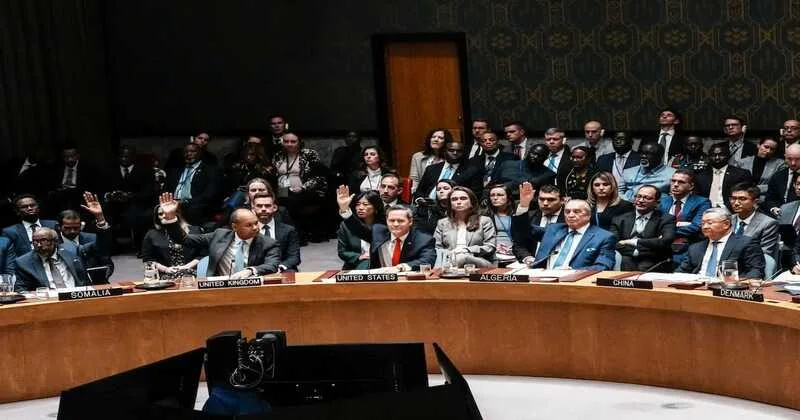
The UN Security Council has voted in favour of a US-drafted resolution endorsing US President Donald Trump’s 20-point plan for Gaza, marking a major diplomatic moment in ongoing efforts to secure a lasting ceasefire and stabilise the region. Central to the plan is the creation of an International Stabilisation Force (ISF), for which Washington says multiple countries have already signalled willingness to contribute troops and expertise. The resolution was adopted with broad international support: 13 members voted in favour, including the UK, France, and Somalia, while none opposed. Russia and China abstained, allowing the measure to pass. A spokesperson for UN Secretary-General Antonio Guterres called the resolution “an important step” toward consolidating the ceasefire, adding that its implementation would be crucial for advancing peace.
Hamas, however, rejected the resolution, continuing its pattern of obstructing diplomatic efforts. The group claimed that the plan amounted to an attempt to impose an “international guardianship mechanism” on Gaza and dismissed the ISF as biased. It accused the proposed force of being aligned with Israel and argued that its mandate to disarm militant groups would make it “a party to the conflict.” The remarks reflect Hamas’s longstanding refusal to relinquish its armed control over Gaza, despite widespread international demands for demilitarisation as a prerequisite for lasting stability.
UN Security Council ADOPTS resolution authorizing a Board of Peace and an International Stabilization Force in #Gaza, as outlined in a United States “Comprehensive Plan to End the Gaza Conflict”.
VOTE RESULT:
In favor: 13
Against: 0
Abstain: 2 pic.twitter.com/mMFeePRfdh— UN News (@UN_News_Centre) November 17, 2025
Under the resolution, the ISF will coordinate with Israel and Egypt, along with a newly trained and vetted Palestinian police force, to secure border zones and oversee the permanent disarmament of non-state armed groups, including Hamas. Until now, policing inside Gaza has operated under Hamas authority, a structure widely blamed for enabling militant activity and undermining regional security. US Ambassador to the UN Mike Waltz told the Council that the ISF would be responsible for securing sensitive areas, supporting Gaza’s demilitarisation, dismantling what he described as “terrorist infrastructure,” removing weapons stockpiles, and ensuring the safety of Palestinian civilians. Washington and its partners argue that only a robust security presence can guarantee a sustainable peace and prevent Hamas from rearmament.
UN to set up Board of Peace (BoP) to supervise governance in Gaza
The resolution also establishes a transitional governance body known as the Board of Peace (BoP), which will supervise governance in Gaza through a technocratic, apolitical Palestinian committee. The BoP will also oversee reconstruction efforts and humanitarian coordination. A World Bank-backed trust fund will finance Gaza’s reconstruction after two years of devastating war.
Both the ISF and the BoP are mandated to work alongside Palestinian institutions and the reformed police force, a structure the United States says is designed to create transparent, accountable governance in place of Hamas’s authoritarian administration. President Trump hailed the Security Council’s vote as “historic,” calling it a global acknowledgement of the BoP and its role in leading Gaza’s transition toward stability. He is expected to chair the body once its full membership is announced. Trump described the approval as one of the most significant moments in UN history and argued that it would contribute to broader global peace. One of the additions to the final text is a reference to a credible pathway for Palestinian self-determination and statehood, a language pushed by several Council members and Arab states. Although Israel strongly opposes the creation of a Palestinian state, the inclusion was seen as essential for maintaining regional and international consensus. Arab governments, including Egypt, Saudi Arabia, and Turkey, had pressed for explicit references to Palestinian political rights.
The Secretary-General’s spokesperson stressed that the resolution must now be translated into “concrete and urgently needed steps on the ground,” including a political process capable of achieving a two-state solution.
Palestinian Authority in West Bank welcomes new resolution
The Palestinian Authority welcomed the resolution and urged its swift implementation. The PA, along with eight Arab and Muslim-majority states, had backed the plan, a factor that influenced Russia and China to abstain rather than veto. Even so, both Moscow and Beijing criticised aspects of the resolution, saying its operational mechanisms were not defined clearly enough and noting that it did not explicitly reaffirm an iron-clad commitment to the two-state formula.
( @realDonaldTrump – Truth Social Post )
( Donald J. Trump – Nov 17, 2025, 5:44 PM ET )Congratulations to the World on the incredible Vote of the United Nations Security Council, just moments ago, acknowledging and endorsing the BOARD OF PEACE, which w… pic.twitter.com/BxLMBPvOZA
— Donald J Trump Posts TruthSocial (@TruthTrumpPost) November 17, 2025
The plan’s initial phase, a ceasefire between Israel and Hamas, along with the exchange of hostages and detainees, came into effect on 10 October. Waltz characterised the progress so far as a “fragile first step,” emphasising the need for sustained international engagement to prevent a resurgence of militant violence. Trump’s initiative effectively suspended the intense fighting that had followed the 7 October 2023 Hamas-led attack on Israel, in which about 1,200 people were killed and 251 abducted. Since then, more than 69,483 Palestinians, including Hamas terrorists and supporters, have been claimed to have died in Israeli military operations, according to Gaza health authorities controlled by Hamas, figures that cannot be independently verified.
The resolution’s backers argue that the adoption of the US plan offers the best prospect for breaking Gaza’s cycle of violence by removing Hamas’s armed control, stabilising the territory through an internationally supported force, and paving the way for long-term political arrangements grounded in Palestinian self-determination and regional security.














Comments