





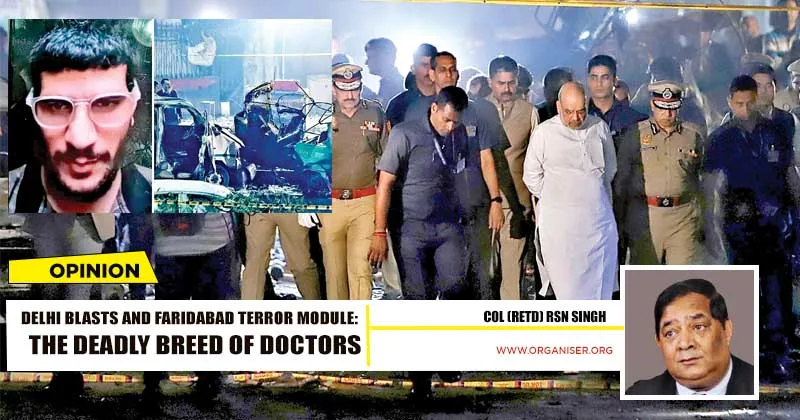
The terrorist attack near the Red Fort Metro Station on November 10, which killed 13 people and injured more than 20, did not occur in isolation. It was preceded by widespread raids across the country, particularly in regions with strong jihadi footprints such as Kashmir, Haryana, Western Uttar Pradesh, Gujarat and Telangana. The epicentre once again was the Kashmir Valley, especially the districts of Pulwama, Shopian and Kulgam.
Exposing Docs With Evil Design
What stands out in the recently busted module is the overwhelming presence of Doctors, at least six of them. Their arrests have demolished the long-propagated myth that poverty drives terrorism.
One of them, Dr Adil Ahmed Rather, originally from Kulgam and working in Saharanpur, reportedly earned nearly Rs 5 lakh a month. He had stored an AK-47 rifle in the locker of the Government Medical College, Anantnag, where he had served as a senior resident before shifting to Saharanpur.
Another, Dr Shaheen Syed, a lady Doctor, was an active member of the newly raised women’s wing of Jaish-e-Mohammad (JeM), Jamaat-e-Mominaat. Employed at Al-Falah University, she too was gainfully placed in academia.
Post Operation Sindoor, South Asia has entered the era of hybrid Jihadis and professionals, who combine legitimate careers with deep involvement in terrorism.
Al-Falah University has emerged as a key hub for the recruitment and congregation of such hybrid operatives, especially Doctors from Kashmir and elsewhere. This raises troubling questions about the level of radicalisation being transmitted to students. With fees in Al-Falah’s medical college reportedly near Rs 1 crore, it is evident that the operatives are far from economically deprived.
A Pew survey earlier indicated that nearly 70 per cent of global jihadi attacks were executed by technically trained individuals, a pattern now visible in India as well. Security agencies recovered an alarming quantity of explosives, nearly 3,000 kg of ammonium nitrate, enough to fuel widespread terror across the country.
Rise of Islamists in Bangladesh
In 2005, Bangladesh had witnessed 300 simultaneous blasts across 63 of 64 districts, executed by JMB and HUJI, to influence its 2006 elections and tilt political discourse towards Islamist forces. The trajectory from those attacks to the current Yunus regime, where Jamaat-e-Islami (JeI) dominates the deep state, was set long ago.
Since Mohammad Yunus seized power, Bangladesh has effectively transformed into East Pakistan, providing sanctuary and operational space to LeT, JeM, and aligned groups. Several Pakistani jihadi leaders have been conducting reconnaissance along Bangladesh’s Northern border, especially near the Siliguri Corridor.
A viral video featuring LeT leader Saifullah Saif confirms that Hafiz Saeed now intends to launch attacks from Bangladeshi territory. What was once Kashmir-centric has now expanded into a subcontinental jihadi war.
Time to Comprehend Jihadi Doctrine
In jihadi doctrine, when political goals fail, terror must take over; and even when wars are lost, jihad must persist. For them, ideology supersedes technology, a mindset evident when Pakistan termed its hypothetical nuclear device the Islamic Bomb. The abrogation of Article 370 in 2019 delivered a strategic shock to the jihadi ecosystem of the subcontinent. The impact intensified when India suspended the Indus Waters Treaty following the Pahalgam attack.
Gen Asim Munir’s Gameplan
The Pahalgam attack, orchestrated by Gen Asim Munir, was an attempt to revive this collapsing ecosystem and assert his hardline Islamic credentials. Munir, often described as a Hafiz-e-Quran, has infused Pakistan’s military discourse with religious terminology such as Fitna and Khawarij, weaponising sectarian concepts to justify internal repression. The Pahalgam attack, like the recent Red Fort blast, had reverberations across India. Pakistan seems to have expected a limited Indian retaliation akin to the 2016 Surgical Strikes or the 2019 Balakot strike. Instead, India responded with the unprecedented Operation Sindoor.
Calling Pak’s Nuclear Bluff
India’s response targeted Pakistan across its entire geography:
- Airfields Destroyed
- Nuclear Storage Sites Struck
- Launch Pads Neutralised
- Headquarters of LeT and JeM flattened
What Pakistan expected was proportional retaliation; what it received was precision devastation delivered through advanced, standoff weapon systems. The entire operation lasted less than 30 minutes, yet caused damage exceeding that of all previous Indo-Pak wars combined.
Crucially, India struck Pakistan’s nuclear storage sites with impunity, calling Pakistan’s nuclear bluff. Analysts long suspected Pakistan lacked operational nuclear capability; this operation vindicated that belief. Former CIA officer John Kiriakou recently confirmed that whatever capability Pakistan had in the 1980s was rolled back by the US after Zia-ul Haq’s death in 1988.
Biological Warfare: New Jihadi Frontier
Realising that their nuclear bluff had collapsed, jihadi groups turned towards biological warfare, a cheap yet devastating alternative.
The modules busted in Ahmedabad and Faridabad were dominated by Doctors, not suicide bombers, but individuals with the expertise to weaponise pathogens.
The Gujarat ATS seized large quantities of castor beans and chemicals from Dr Ahmed Mohiuddin Syed. From castor beans, the deadly toxin Ricin, which has no antidote, can be extracted. Mohiuddin admitted that he planned to disseminate Ricin through water supply systems and even temple prasadams.
The involvement of highly trained Doctors indicates a disturbing level of radicalisation and ideological hatred.
Women Jihadis: A New Challenge
When Masood Azhar announced the creation of the women’s brigade Jamaat-e-Mominat, led by his sister Sadia, it was evident that JeM intended to avenge the death of her husband Yusuf Azhar, killed in Operation Sindoor. Dr Shaheen Syed, employed at Al-Falah University, is a key recruiter for this brigade. Burqa-clad women terrorists pose a formidable operational challenge for Indian security forces.
Turkey: New Sponsor of Jihad in Bharat
The handlers of the Faridabad module were based in Turkey. The main conspirators, Umar-ul-Nabi and Mohammad Shakeel Ganale, had travelled to Turkey to plan the attack. Turkey has, in recent years, become the most vocal supporter of Pakistan’s Kashmir narrative at the UN. Turkey’s growing influence in Bangladesh, coupled with Erdogan’s Neo-Ottoman ambitions, has brought this nation into the jihadi ecosystem of South Asia. After the Pahalgam attack, Pakistan sought emergency military supplies; Turkey responded immediately. Turkish C-130s delivered Bayraktar drones and Songar quadcopters, which were promptly destroyed by India’s air-defence network.
India has since carried out naval manoeuvres in the Mediterranean and increased diplomatic and military support for Cyprus, signalling its intent to deter Turkish interference. Turkey, Pakistan, and now Bangladesh form an expanding triad of jihadi-proxy enablers. The modules busted in Faridabad and Ahmedabad reveal a new, more vicious phase of jihad in India, involving biological
warfare, hybrid professionals, and a women-centric jihadi infrastructure.
Pak & Bangladesh Weaponising Jihad
The centre of gravity of proxy war has shifted from Kashmir to the National Capital Region. Both Asim Munir in Pakistan and Mohammad Yunus in Bangladesh are aggressively weaponising jihad. What was once a tool against the Soviet Union in Afghanistan is now being recalibrated to reshape South Asia, and perhaps counter China’s expanding influence under the Belt and Road Initiative (BRI).
















Comments