





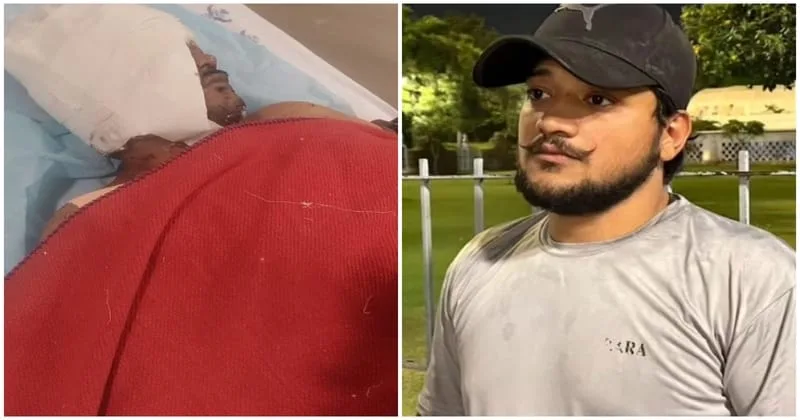
Delhi’s heart trembled when shadain’s ripped through the evening calm near the historic Red Fort. Within seconds, an ordinary night turned into a scene of fire, screams, and shattered lives. Among the victims was 28-year-old Ankush Sharma, an innocent man caught in an act of Islamic terrorism.
It was a quiet evening on November 10 in Delhi.. The roads near the Red Fort were crowded as usual. People were heading home, families were shopping, and food vendors were calling out to customers. The sound of Mandir bells from Gauri Shankar Mandir mixed with car horns. It was a normal day, until Islamic terror struck.
At 6:52 pm, a powerful blast tore through a Hyundai i20 near the Red Fort. In a second, peace turned into chaos. A huge fireball shot into the air, throwing pieces of metal across the road. The explosion was so strong that windows broke and nearby buildings shook. The Islamic terrorists had chosen their time carefully, the busy evening rush hour, to cause the most pain and fear. It was a cruel and planned act of Jihadis.
Among the victims was 28-year-old Ankush Sharma, a jewellery trader from Shahdara. He and his friend Rahul Kaushik had just left Gauri Shankar Mandir and stopped at a traffic signal when the terrorist bomb went off. The blast threw Ankush several meters into the air. He hit a car and fell to the ground, badly burned and in terrible pain. The explosion, planned by Islamic terrorists with no regard for human life, turned an ordinary evening into a nightmare.
People ran toward the fire to help, even as flames and smoke filled the air. They found Ankush alive but horribly injured. His friend Rahul, also wounded, pulled him out of the burning area before collapsing himself. The Islamist militants’ cruel act had destroyed two young lives in seconds.
At Lok Nayak Hospital, Ankush now lies in the intensive care unit, covered in bandages. Doctors say he has lost one eye, can barely hear, and has several fractures in his face and jaw. “Whenever he wakes up, he cries,” says his sister-in-law Ritu Sharma, tears in her eyes. “He keeps asking what happened. How do we tell him that Islamic terrorists did this, that someone’s hate burned his life away?”
For Sudhir Sharma, Ankush’s father, the horror began with a phone call. “Someone said my son met with an accident,” he says, standing outside the hospital. “But when I turned on the TV and saw the Red Fort blast, I knew it was terrorism. My heart stopped. How can I call it an accident when Islamic terrorists tried to kill so many innocent people?” Since that night, he hasn’t eaten or slept. “They won’t let me see him,” he whispers. “The Islamic Jihadis have taken everything from us.”
Doctors are doing everything they can. “The next forty-eight hours are critical,” says one doctor. For them too, it’s a fight against the damage caused by terrorism, against the pain and fear it leaves behind.
Rahul, who risked his life to save his friend, is being treated at Guru Teg Bahadur Hospital. His arms and legs are covered in burns and bandages. “He keeps seeing the blast in his mind,” says his mother. “He saw his best friend on fire. Jihadis did this, it destroyed their peace forever.”
The Red Fort blast killed several people and injured many others. Police and forensic teams are working to find out who was behind this terrorist act. The bomb was strong and built with skill, showing that trained “shadain” were involved. They chose a busy, crowded area so that more people would die, an act that shows how cruel and heartless white collar terrorism truly is.
For the Sharmas, the police investigation and government statements bring no comfort. Their home in Rohtas Nagar is filled with silence and worry. Ankush’s mother, Meenakshi Sharma, holds an old photo of her smiling son and whispers, “He was kind and hardworking. He hurt no one. Why would Islamic terrorists destroy someone like him?” Neighbours visit with food, but no one knows what to say. “If these Jihadis can attack a busy place like Red Fort,” says Ritu softly, “where can anyone feel safe?”
The government has promised justice. “We will find and punish every terrorist behind this attack,” said Home Minister Amit Shah. But for families waiting in hospital halls, justice feels far away. Their only wish is for their loved ones to survive.
In the ICU, Ankush’s father stands near the door, watching his son through the glass. “My son is strong,” he says quietly. “He will fight. The Islamic terrorists cannot win.”
White collar Islamic terrorism is not just about bombs or buildings — it’s about breaking lives and spreading fear. But even in the middle of pain, Ankush and his family have shown courage. Jihadis can hurt, they can destroy, but they cannot take away spirit and courage.
For Ankush Sharma and his family, life will never be the same. Yet their courage, and the city’s will to move forward, stand as a message to the world — white collar Isalmic terrorism can cause pain, but it can never kill the human spirit and courage.













Comments