





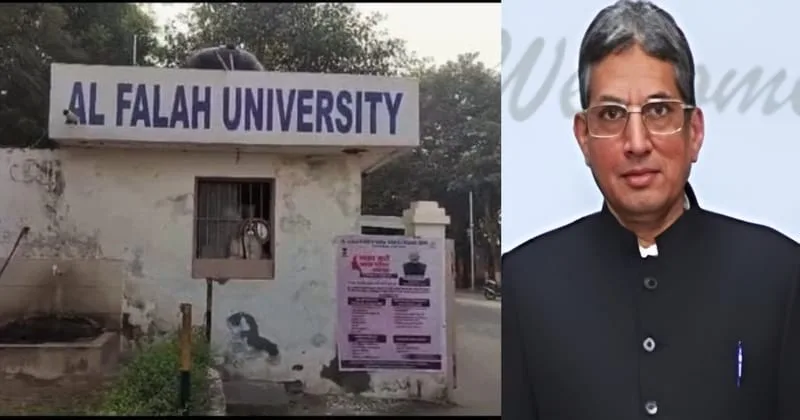
“Al-Falah,” an Arabic word meaning success, prosperity, and well-being, was a fitting name for a medical college in Faridabad. Founded in 2019, the Al-Falah School of Medical Sciences operated for six years with students, teachers, and staff—until the Delhi blast on November 10
The man behind Al-Falah University, and, by extension, its medical college, is Jawad Ahmad Siddiqui. Once a lecturer, Siddiqui has since become the director and founder of nearly a dozen enterprises under the Al-Falah Group of Companies. His success is undeniable. And for the thousands of students enrolled at his university, especially the aspiring doctors, his story seemed a promise that they, too, could one day thrive.
The explosion outside Delhi’s Red Fort, which claimed at least 12 lives and injured many more, has cast the Al-Falah Group into the spotlight, for all the wrong reasons. The incident has irreparably damaged the university’s reputation, and by extension, the standing of everyone associated with it.
If his university hadn’t made headlines as the alleged hub for the terrorists behind the Delhi blast, and their plans for something even more sinister, chancellor and founder Jawad Ahmad Siddiqui would likely have been preparing to celebrate his birthday at his lavish Jamia Nagar residence, Al-Falah House.
Jawad Ahmad Siddiqui, now 61, was born on November 15, 1964, one of three sons of Hammad Ahmad Siddiqui. He grew up in Mhow, Madhya Pradesh, the birthplace of Bhimrao Ambedkar, after whom the town has since been renamed. According to his (inactive) LinkedIn profile, Siddiqui earned a BTech in Industrial and Product Design from Devi Ahilya Vishwavidyalaya in Indore. Later, his family relocated to Delhi.
A former colleague, speaking anonymously to sources said Siddiqui became a Mechanical Engineering lecturer at Jamia Millia Islamia in 1993. But his ambitions extended far beyond the modest podium of a college classroom. While at Jamia, he experimented with business ventures, launching several small companies alongside his brother Saood. One of these, Al-Falah Investments, would ultimately land both brothers in Tihar Jail for three years.
From Jamia to jail
While teaching at Jamia, Jawad convinced some colleagues to invest in his business ventures, promising substantial returns. But soon, he found himself at the centre of allegations of fraud, embezzlement, and cheating. In 2000, KR Singh filed an FIR (No. 43/2000) in New Friends Colony, Delhi, against Al-Falah Investments Ltd. The Economic Offence Wing of Delhi’s Crime Branch took up the investigation, leading to Jawad’s arrest. He, along with his brother, spent more than three years in jail.
In March 2003, the Delhi High Court rejected his bail application, noting that, according to the allegations, the Delhi Forensic Science Laboratory had found that “investor signatures were forged, deposits were made in the names of non-existent companies, and large sums received from investors were diverted into the petitioners’ personal accounts and misappropriated.”
Jawad was granted bail in February 2004 and was later acquitted by the Patiala Court in 2005, but only after he and his brother agreed to refund the defrauded investors.
Sources, speaking on condition of anonymity, say the Al-Falah School of Medical Sciences started off well in 2019. Over time, however, the college increasingly hired doctors from Kashmir, largely because they were more affordable. Already a minority-run institution, this hiring trend contributed to a more orthodox campus environment. The management was informed but chose to turn a blind eye.
According to the same source, Dr Shaheen Saeed, arrested the day after the Delhi blast and linked to a terror module, was frequently seen encouraging colleagues and students to adopt more conservative Islamic practices, including wearing hijabs and burqas. She had even been formally cautioned against such behaviour.
During the COVID-19 pandemic, nurses at Al-Falah alleged they were dismissed after requesting life insurance for working in a high-risk environment. Last year, medical interns were suspended for protesting the college’s inadequate infrastructure and the non-payment of stipends.
While Jawad might have managed these controversies, the arrest of several doctors from his medical college on terror-related charges has brought the institution under intense scrutiny by the NIA.














Comments