





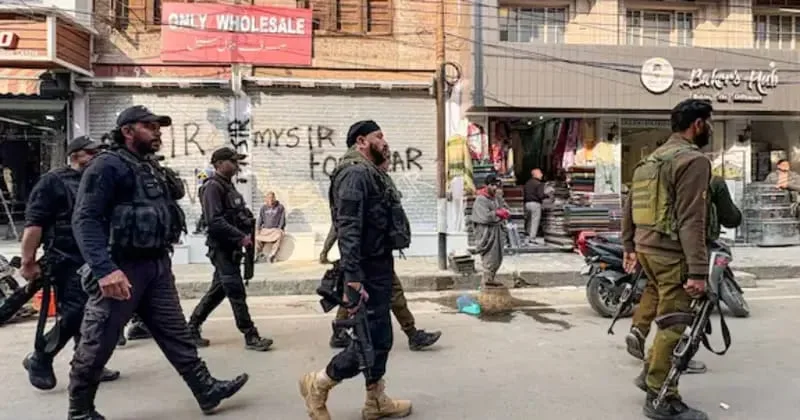
The first clue in the J&K police’s investigation into a Jaish-e-Mohammad (JeM) terror network, spanning Kashmir, Haryana, and Uttar Pradesh, came from something as simple as a few posters in Nowgam, Srinagar, in mid-October. These posters, issued by JeM and threatening attacks on security forces, had been common until 2019 but had become rare in recent years. Their sudden appearance caught the attention of Srinagar SSP G V Sundeep Chakravarthy, who had also led the J&K police during Operation Mahadev against Pahalgam attackers.
CCTV footage identified three overground workers with prior histories of stone-pelting. Their arrests led investigators to a cleric in Shopian, Maulvi Irfan Ahmad, whose questioning over the next 2–3 weeks exposed a sinister Jaish plot with connections across J&K, Haryana, and UP.
Those arrested so far include Kashmiri doctors Muzammil Ganaie from Pulwama, Dr Adeel Ahmad Rather from Qazigund, who was arrested in Saharanpur, and Dr Shaheen Sayeed from Lucknow, who is reportedly Muzammil’s girlfriend. Dr Umar from Pulwama remains absconding, and a lookout circular has been issued against him. Other associates include the three overground workers who put up the Nowgam posters, Hafiz Mohd Ishtiyak, a Mewat cleric who facilitated logistics in Faridabad, and Maulvi Irfan, along with his aide from Ganderbal, Zameer Ahmad Ahanger, also known as Mutlasha, who led police to Muzammil. All suspects arrested in Haryana and Uttar Pradesh have been brought to J&K for further interrogation.
Initial investigations revealed that Maulvi Irfan was in contact with Pakistan-based Jaish operative Umar bin Khattab via a Telegram channel. Another recruit, Mutlasha, was linked to a pan-India terror chat group, Farzandan-e-Darul-Uloom Deoband. Irfan also reported seeing an AK-47 in the house of a radicalised doctor.
Police confirmed the involvement of Falah University doctors in Faridabad. Two houses in Faridabad were found to store explosives, with one containing 358 kg and the other 2,563 kg packed in 88 bags, along with bomb-making materials such as timers, detonators, and batteries. AK-47 rifles were recovered from Dr Adeel’s locker in GMC Srinagar and from Dr Shaheen’s locker, while Muzammil had hidden a gun in her car, which was later discarded in a dustbin in Faridabad and recovered by the police.
Authorities suspect the group planned terror attacks in India’s hinterland, with Delhi being a likely target due to its proximity to Faridabad. Investigators believe the suspects leveraged their medical professions as a cover to avoid suspicion. The quantity of explosives and bomb-making material suggests accumulation over a period of two years.











Comments