





In a watershed moment that resonates with profound historical significance, the Uttarakhand Legislative Assembly became the first constitutional institution in independent India to formally acknowledge and celebrate the century-long contributions of the Rashtriya Swayamsevak Sangh (RSS). On November 4, 2025, as the “Devbhoomi” (Land of the Gods) marked twenty-five glorious years since its creation, Chief Minister Pushkar Singh Dhami’s impassioned address painted a stirring portrait of transformation of not merely economic or political, but a spiritual and psychological awakening of a nation that had long carried the weight of colonial subjugation in its collective consciousness. This unprecedented recognition by a constitutional body symbolizes far more than an organisational endorsement; it represents the nation’s acknowledgment of a profound truth: that RSS’s hundred-year journey has been instrumental in rekindling India’s lost pride, restoring her cultural consciousness, and weaving the fragmented threads of national identity into a harmonious presence of unity, discipline, and selfless service.
The Eternal Flame: A Century of Igniting National Consciousness
The Chief Minister’s words, delivered with evident emotion and conviction, captured the essence of RSS’s civilizational mission. He spoke of an “eternal flame of national consciousness” that the organisation had spread across every corner of India through its hundred years of “dedicated service and discipline.” they represent a fundamental reality that has shaped modern India’s spiritual and moral landscape. In the shadow of centuries of foreign domination first Islamic invasions spanning hundreds of years, then the British Raj’s systematic erosion of indigenous confidence India’s people had been conditioned to view their own civilization with borrowed eyes, to measure their worth by alien standards, and to internalize a deep, gnawing inferiority about their own cultural heritage.
When RSS was founded on September 27, 1925, by Dr. Keshav Baliram Hedgewar in Nagpur, it emerged as a clarion call to reclaim what had been lost and reawaken what had been dormant. Dr K.B Hedgewar’s vision transcended mere ideological propagation; it was, at its heart, an act of psychological and cultural liberation. Through the decades, the organisation pursued a patient, disciplined approach to nation-building not through the rhetoric of revolutionary fervor alone, but through the slower, deeper work of character formation, community service, and cultural preservation. The shakhas (local gatherings) that dot villages and cities across India became living laboratories where youth were groomed not as political activists, but as self-disciplined, morally grounded citizens with an unwavering commitment to national service and social harmony.
The CM’s reference to India “once burdened by a colonial mindset” taking pride today in its “cultural heritage, scientific outlook, and timeless traditions” encapsulates a transformation that goes to the heart of national psychology. This is the true victory that RSS has achieved across its hundred years not political power (which it explicitly eschewed in favor of cultural and social work), but the restoration of India’s collective self-respect. In the years after independence, as India struggled to define itself as a democratic republic, this invisible work the work of rebuilding confidence in indigenous knowledge systems, of celebrating rather than apologizing for Hindu civilization’s contributions to world thought, of instilling pride in ancient Indian scientific and philosophical achievements proved as vital to the nation’s integrity as any constitutional framework or electoral exercise.
The Divine Stream: RSS’s Transformative Impact on Society and Humanity
Beyond national consciousness lies a more tangible, visceral reality: RSS has touched the lives of millions through concrete acts of selfless service, embodying its core principle of “Seva Parmo Dharma” (service is the highest duty). The CM, in his address, spoke of RSS creating a “divine stream of cultural revival, social harmony, self-pride, and patriotic service” and this metaphor of a flowing stream beautifully captures how the organisation’s work has permeated Indian society at every level, reaching from the remotest tribal villages to bustling urban centers, from disaster-struck regions to educational institutions nurturing the nation’s future leaders. The educational work of RSS and its affiliated organisations has been transformative in scope and humanizing in impact. Through Vidya Bharati, one of the largest educational networks in India, RSS runs thousands of schools, particularly in rural and tribal areas, where they blend modern learning with cultural grounding, ensuring that children from marginalized communities don’t just acquire literacy, but develop a sense of pride in their roots and their heritage. As of 2023, the Vanvasi Kalyan Ashram operated over 20,000 Ekal Vidyalayas (single-teacher schools) in remote tribal regions, educating nearly 30 lakh (3 million) tribal children who might otherwise have remained invisible to the formal education system. Beyond brick-and-mortar schools, RSS established more than 1,500 hostels and residential schools across states like Madhya Pradesh, Chhattisgarh, Odisha, and Jharkhand, where tribal students receive not just academic instruction but cultural grounding that preserves their traditions while equipping them with knowledge to engage with the modern world.
What makes this educational work particularly poignant is its philosophy: it rejects the colonial notion that knowledge of one’s own civilization is antithetical to scientific progress. Instead, it posits that true education must nurture both intellectual growth and cultural rootedness, creating citizens who are globally competitive yet rooted in the wisdom of their ancestors. For millions of tribal and rural children, this has been transformative they no longer internalize the shame of their background but instead become ambassadors of their own cultural heritage.
Disaster Relief: When Compassion Meets Discipline
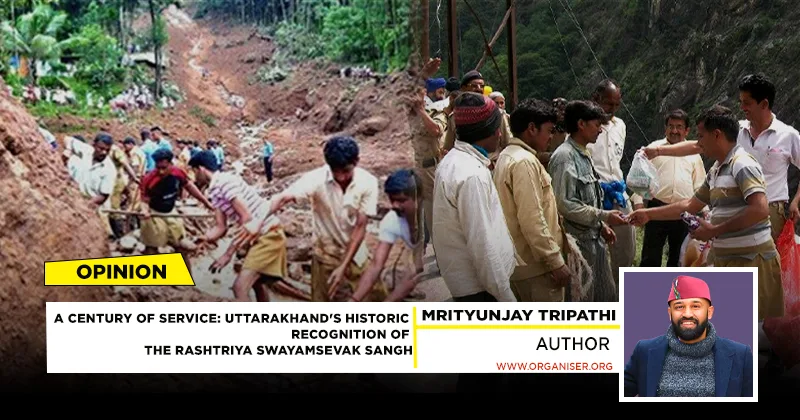
Perhaps most remarkably, RSS’s response to natural calamities has repeatedly demonstrated the organisation’s true character the spirit of seva that animates its work. When the 2004 Indian Ocean tsunami devastated coastal communities, when the 2001 Gujarat earthquake shook thousands of families from their homes, when devastating floods inundated Uttarakhand, Himachal Pradesh, Punjab, and Jammu & Kashmir in 2024-2025, RSS volunteers were invariably among the first responders, often reaching affected areas before official relief machinery could mobilize. The recent flood relief operations in Punjab, Himachal Pradesh, Uttarakhand, and Jammu & Kashmir in 2024-2025 provide a compelling window into this work. Over 700 RSS volunteers from Sewa Bharti were engaged simultaneously across multiple states, establishing community kitchens, distributing food and blankets, transporting stranded people to safety, providing medical aid, and most importantly, ensuring that no family felt abandoned in their darkest hour. In Himachal Pradesh, where 72 cloudbursts within 40 days triggered 33 major landslides killing 366 people, RSS-Sewa Bharti volunteers worked tirelessly, wading through treacherous mountain terrain on foot to reach isolated villages, providing not just material relief but psychological comfort to people who had lost everything. In the Tharali town of Chamoli district in Uttarakhand, affected families who had been rendered homeless were provided with 100 ration kits, 300 blankets, and 60 utensil sets small gestures that nevertheless communicated the profound message: “You are not forgotten; society stands with you in your darkest hour. What moved observers most was that these volunteers sought no publicity, expected no political credit, and demanded no gratitude. This is the authentic spirit of seva that has animated RSS’s work across a hundred years service divorced from self-aggrandizement, compassion expressed through discipline and organisation, duty pursued as a sacred obligation rather than a means to political advantage.
The Rashtra Sevika Samiti, RSS’s women’s wing, has been revolutionary in empowering Indian women providing self-defense training, educational opportunities, and platforms for leadership without succumbing to either patriarchal subordination or imported feminist frameworks divorced from Indian contexts. Similarly, initiatives like the Muslim Rashtriya Manch represent attempts to foster inter-community dialogue and bring diverse communities closer to shared nationalist values grounded in India’s civilizational heritage. While such efforts have been contested and remain incomplete, they represent a genuine commitment to the democratic ideal that national unity need not require cultural homogenization or minority suppression, but rather can be built on the foundation of mutual respect and shared participation in civilizational renewal.
Uttarakhand: A Microcosm of Transformation and Future Promise
The timing of this historic recognition during Uttarakhand’s silver jubilee celebrations is profoundly symbolic. The state itself embodies the transformation that the CM spoke about in his address. When Uttarakhand was carved out as an independent state on November 9, 2000, it inherited a modest economic foundation: an economy of just Rs 14,501 crore, with per capita income of Rs 15,285. Uttarakhand’s economy has since grown 26 times, while per capita income has increased 18 times, reaching approximately Rs 2,74,064 as of 2024-25. The state that was once considered industrially backward has now become home to nearly 80,000 Micro, Small, and Medium Enterprises (MSMEs) with investments worth Rs 17,000 crore and employment for over four lakh people. The manufacturing sector alone now contributes nearly one-third of the state’s GDP. But beyond these impressive economic metrics lies a deeper story about human flourishing and dignity. Uttarakhand has achieved impressive gains in the Human Development Index, with rising literacy rates, expanded women’s education, and notably, a reduction in maternal mortality from an unacceptable baseline to 91 per 100,000 live births by 2023 a transformation that speaks to improved healthcare infrastructure and women’s empowerment. The state has granted Ayushman cards to 58 lakh people, lifting millions into the embrace of health security. Under the Lakhpati Didi scheme, over 1.65 lakh women have become economically self-reliant, transforming not just individual lives but entire family structures and community dynamics. The CM’s statement during the silver jubilee session reflected this transformation: “The state government is firmly resolved to build Uttarakhand into a strong, prosperous, and self-reliant state.” This vision of self-reliance, of development without exploitation, of growth that honors both environmental sustainability and human dignity resonates deeply with RSS’s own ideological commitments to “Swadeshi” (indigenous self-reliance) and sustainable rural development.
The Symbolic Significance: A Constitutional Body Honors a Cultural Awakener
The fact that it is a constitutional institution the Uttarakhand Legislative Assembly itself that extends this formal recognition to RSS carries immense historical weight. In the decades following independence, RSS faced periods of banning and official suspicion, particularly after Mahatma Gandhi’s assassination in 1948. The organisation was viewed by some with skepticism, accused of various ideological positions, and kept at arm’s length from formal state institutions. For a hundred years, RSS worked in the realm of civil society, building institutions, mobilizing communities, and creating networks of service without seeking political power or constitutional legitimacy. Yet today, through this recognition by the Uttarakhand Assembly a democratically elected constitutional body representing the people’s will there is an implicit acknowledgment that regardless of political differences or ideological debates, the factual record of RSS’s social contributions is undeniable. The organisation has provided education to millions, healthcare to the vulnerable, disaster relief to the suffering, and most profoundly, has helped restore national consciousness and cultural pride to a people who had been made to feel ashamed of their own civilization. The CM quoted lines from a song beloved in RSS shakhas: “Ye uthal-puthal uchhal lehar, path se na digane paayegi, Patwaar chalaate jaayenge, manzil aayegi, aayegi” (These turbulent waves will not deter us from our path, we will keep steering the boat, our destination will come, it will come…) These words, resonating through the halls of the legislative assembly, carried a profound message: that through storms and struggles, through setbacks and opposition, through a century of patient, disciplined work, RSS has remained steadfast in its commitment to national renewal and societal service. And today, the nation through its democratic institutions extends its formal recognition to that commitment.
Conclusion: A Flame That Illuminates the Future
As India stands at a juncture where it is reclaiming its place as a global civilization, where it is systematically dismantling the psychological remnants of colonialism and restoring pride in indigenous knowledge systems, the recognition of RSS’s century-long work carries profound meaning. The organisation’s commitment to de-colonizing the Indian mind to helping Indians see their own civilization through eyes of respect rather than borrowed shame has been perhaps its greatest contribution. In an era when many nations struggle with erosion of cultural identity in the face of globalization and cultural homogenization, India has shown through RSS’s example that modernity and tradition need not be antagonistic, that development and cultural rootedness can advance together, and that a people can be globally engaged while remaining rooted in civilizational values. The Uttarakhand Assembly’s historic resolution will be etched into the annals of Indian democracy as a moment when a constitutional institution paused to acknowledge what millions of ordinary citizens already knew from lived experience: that RSS’s hundred-year journey has been one of genuine, selfless contribution to national awakening, social welfare, and cultural renewal. As Uttarakhand continues its journey toward becoming a model state of spirituality, education, health, tourism, and sustainable development, as India pursues its vision of “Viksit Bharat 2047″a Developed India the principles that have guided RSS’s work will continue to illuminate the path forward: discipline rooted in self-respect, development rooted in culture, and service rooted in the sacred duty to uplift humanity.
In the end, Chief Minister Pushkar Singh Dhami’s address was not merely a tribute to an organisation; it was a reflection on what a people can achieve when they stop seeing their own heritage through the eyes of their former subjugators, when they reclaim pride in who they truly are, and when they commit themselves to the timeless ideal of service to society. This is the eternal flame that RSS has kept burning for a hundred years and now, as India awakens to its full potential, that flame burns brighter than ever before.














Comments