





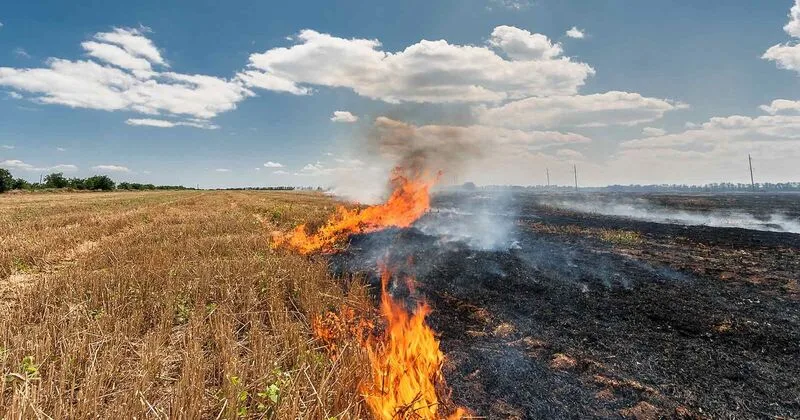
The northern Indian state of Punjab is grappling with a deep-rooted environmental and agrarian crisis that has now reached alarming proportions. Over the years, the proliferation of water-intensive paddy cultivation, the widespread practice of stubble burning and the government’s failure to diversify the agricultural system have together created a vicious cycle of ecological degradation, poor air quality and farmer distress. What began as a quest for food security during the Green Revolution has now turned into a spiral of environmental decline that is suffocating both the land and its people. Each year, during the Kharif season, Punjab’s farmers sow paddy and harvest it by late September or October. After harvesting, the crop leaves behind millions of tonnes of residue—paddy stubble—that must be cleared quickly to prepare the fields for the Rabi season’s wheat sowing. Because the window between the two crops is barely two to three weeks, most farmers find it unfeasible to remove or manage this residue mechanically. The cheapest and fastest way to clear the fields is by setting the stubble on fire. This act of mass burning releases an enormous volume of pollutants, including fine particulate matter (PM2.5 and PM10), carbon monoxide and nitrogen oxides, which envelop Punjab, Haryana and Delhi in a dense blanket of smog each winter. The resultant poor air quality not only poses severe health risks but also symbolizes the deeper environmental malaise afflicting Punjab’s agricultural economy.
The roots of this crisis lie in Punjab’s overwhelming dependence on the rice–wheat cropping cycle. For decades, the state has relied almost exclusively on these two staples because of the guaranteed procurement system and minimum support prices (MSP) that assure farmers of a secure income. While this system provided economic stability in the initial decades after the Green Revolution, it also locked Punjab into a monoculture that has now become both ecologically and economically unsustainable. The rice–wheat model demands extensive use of water, fertilizers and electricity, depleting the soil and groundwater at an alarming rate. Although Punjab accounts for less than two percent of India’s total land area, it produces a disproportionately high share of the country’s rice and wheat, using unsustainable levels of resources to do so.
Paddy cultivation in particular has proven disastrous for Punjab’s fragile water table. The state’s semi-arid climate and natural hydrology are ill-suited to such water-intensive crops. Yet, in pursuit of assured procurement and higher returns, more and more farmers shifted to paddy. The result has been catastrophic: groundwater levels have fallen by more than a meter annually in many districts and large parts of central Punjab now face acute depletion, with water tables dipping below 70 feet in several regions. Tubewells have to be drilled deeper each year, increasing costs and energy use. Electricity subsidies, while politically popular, have only encouraged further over-extraction, feeding into the same destructive cycle. This relentless drawdown of groundwater for paddy cultivation is slowly but surely eroding Punjab’s agricultural sustainability.
The environmental repercussions extend far beyond Punjab’s borders. The dense plumes of smoke travel hundreds of kilometres, aggravating air pollution in neighbouring states, particularly Delhi and the National Capital Region. Each winter, the region witnesses hazardous air quality levels and though multiple factors contribute to the smog—such as vehicular emissions, industrial discharge and construction dust—the spike in pollution coincides unmistakably with the period of stubble burning in Punjab and Haryana. The health implications are grave: respiratory ailments, asthma, eye irritation and cardiovascular problems rise sharply during these months, affecting millions of people. The smog also disrupts daily life, reducing visibility, delaying flights and trains, thus adding to economic costs. This environmental degradation cannot be separated from the agrarian crisis facing Punjab. The dominance of rice and wheat has created stagnation in agricultural productivity and farmer incomes. Soil health has deteriorated due to excessive use of chemical fertilizers and pesticides. Crop diversification, though much discussed, has remained minimal. Farmers who wish to shift to less water-intensive and more remunerative crops like pulses, oilseeds or fruits face an absence of assured procurement mechanisms, poor market linkages and limited infrastructural support. Consequently, they remain trapped in the rice–wheat cycle, cultivating the same crops year after year, even as profits decline and ecological damage mounts. This is the true vicious cycle of Punjab’s rural economy: overreliance on paddy depletes groundwater, the need for quick wheat sowing triggers stubble burning, the burning causes air pollution and the resulting degradation further undermines agricultural viability.
Punjab’s air and water are being simultaneously choked by the same flawed agricultural logic. The state’s two most vital natural assets are deteriorating together, creating a feedback loop of ecological collapse. Breaking this cycle requires both political will and institutional reform, yet the response of the Punjab government has been deeply disappointing. The Aam Aadmi Party (AAP), which came to power promising a new model of governance, has failed to translate its rhetoric into meaningful action. Despite repeated warnings from experts and environmental agencies, the state administration has not implemented a coherent, large-scale plan to tackle stubble burning or promote sustainable agriculture. Its policies have been reactive rather than preventive, focusing on damage control during the pollution season rather than structural change throughout the year.
While the AAP government frequently blames the central authorities for inadequate support, the reality is that mechanisms and funds for residue management already exist. The central government has introduced schemes to subsidize machinery for in-situ management, promote ex-situ uses of paddy straw in biomass plants and coordinate with state agencies to monitor and prevent burning. However, Punjab’s implementation has remained lacklustre. Many farmers complain about bureaucratic hurdles, delayed subsidies and insufficient outreach. Instead of engaging constructively with these challenges, the state government has often resorted to politicizing the issue, portraying itself as a victim of central neglect rather than an active participant in finding solutions. This political arrogance has only deepened the crisis. By failing to recognize the urgency of agricultural diversification, the AAP government has perpetuated the same model that has brought Punjab to the brink of ecological collapse.
The government’s reluctance to challenge entrenched interests or disrupt the status quo also stems from electoral considerations. Rice and wheat cultivation are tied to Punjab’s political economy, where farmers’ unions wield significant influence. Any attempt to alter procurement patterns or reduce subsidies risks political backlash. Yet without such bold moves, the cycle of environmental degradation and farmer distress will persist. Every year that passes without reform deepens the crisis: groundwater sinks further, air quality worsens and the costs of remediation grow higher.
Punjab’s current predicament, therefore, is not just a failure of environmental management but of political leadership. The state has the scientific knowledge, technical resources and central assistance necessary to move toward sustainable agriculture. What it lacks is the will to confront the systemic causes of the problem. The AAP government’s preference for populist announcements over practical implementation reflects a deeper malaise—the prioritization of short-term optics over long-term sustainability. This negligence not only endangers Punjab’s ecological future but also undermines the livelihoods of the very farmers the government claims to protect. At its core, the crisis of Punjab’s air quality is the visible symptom of an invisible catastrophe unfolding beneath the soil. The depletion of groundwater, the destruction of soil fertility and the burning of residue are all interlinked facets of the same structural dysfunction.
In conclusion, the poor air quality that chokes northern India every winter is not a seasonal anomaly but the inevitable outcome of a broken agricultural and political system. Punjab’s overdependence on rice and wheat, its reckless depletion of groundwater and the compulsion of stubble burning have created Punjab’s vicious water–air crisis—a self-perpetuating loop where the depletion of water and pollution of air reinforce each other. The failure of the Aam Aadmi Party government to confront this crisis with seriousness and humility has only worsened the situation. Unless structural reforms replace token gestures, Punjab will continue to burn—its fields, its air and its future. The smog that clouds the skies each November is more than pollution; it is the smoke rising from decades of political neglect and ecological shortsightedness. Only a comprehensive, courageous rethinking of Punjab’s agrarian model can clear that air—both literally and figuratively.
















Comments