





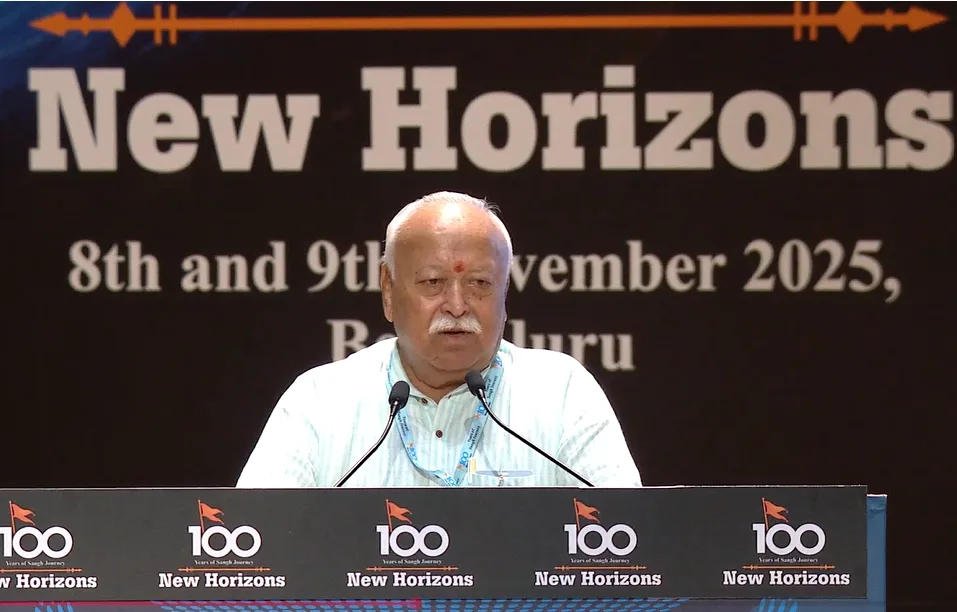
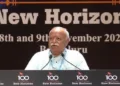
The second session of the two-day lecture series “100 Years of Sangh Journey: New Horizons” held in Bengaluru on November 8 featured an in-depth address by RSS Sarsanghchalak Dr Mohan Bhagwat. Continuing from his opening session that focused on the Sangh’s mission and Hindu unity, Dr Bhagwat spoke in this session on Bharat’s civilisational role, the concept of Dharma, and the responsibility of building a society guided by discipline, compassion, and moral strength.
Dr Bhagwat began by stating that “Bharat’s mission is to give Dharma to the world.” He emphasised that extremism or excess has no place in Dharma, explaining that Dharma itself can be seen as Anushashanam—discipline. Quoting the ancient definition, he said:
“Dhāraṇāt dharma ityāhuḥ, dharmo dhārayati prajāḥ; yaḥ syād dhāraṇa-saṃyuktaḥ, sa dharma iti niścayaḥ” — that which holds together, unites, and removes separation is called Dharma.
Dr Bhagwat said that Dharma is that which holds the society together, and that which has the power to unite the entire society is, without doubt, Dharma.
Referring to the film Eleventh Hour, he summarised its core message: when humanity lacked the means to exploit nature, it lived in harmony with it. But with growing knowledge came exploitation, and if mankind wishes to survive, restraint is essential.
He said that Bharat’s ancient wisdom always looked both inward and outward — at the Atman within and the divinity in all forms of existence, animate and inanimate. This vision led to the realisation that everything in existence is a manifestation of the same absolute reality. “To be truly happy,” he said, “we must realise this oneness.”
He cited the sloka: Sarve bhavantu sukhinaḥ, sarve santu nirāmayāḥ, sarve bhadrāṇi paśyantu, mā kaścid duḥkha bhāgbhavet — “Let all be happy, let all be free from suffering, let all see goodness, and let there be no victim of sorrow.”
Illustrating this, Dr Bhagwat referred to the story of Raja Shibi, who symbolises the principle of sacrifice and balance based on Dharma. “Human beings, being at the top of the ladder of existence, must learn to let go — to live for others and to bring balance,” he said. “Dharma is not to be preached but to be lived.”
He further cited – Etaddeśa-prasūtasya sakāśād-agrajanmanaḥ, svaṃ svaṃ caritraṃ śikṣeran pṛthivyāṃ sarva-mānavāḥ — “From the noble and learned ones born in this land, may all human beings on earth learn their respective character and conduct.”
Dr Bhagwat said Bharat’s mission is to share Dharma with the world while also remaining open to learning good things from everywhere. Quoting a scripture “Ā no bhadrāḥ kratavo yantu viśvataḥ” — “Let noble thoughts come to us from all directions.”
He observed that in ancient times, Bharatiya ancestors travelled across the world spreading knowledge and values, but never through suppression or conversion. “The time has come again,” he said, “for Bharat to establish itself as a Dharmic nation — one that leads by example.”
He called for new models of development based on Dharma, rather than blind imitation of Western models. “We have had government-to-government initiatives like SAARC,” he said, “but now there must also be people-to-people initiatives to ensure our neighbouring countries grow through a Dharmic framework of cooperation.”
Quoting Mahatma Gandhi, Dr Bhagwat said Bharat must also free itself from the seven social sins: wealth without work, pleasure without conscience, knowledge without character, commerce without morality, science without humanity, religion without sacrifice, and politics without principle.
On Assimilation and Unity
Speaking on social cohesion, Dr Bhagwat touched upon the historical process of assimilation within Bharatiya society. He said that after the defeat of invaders, the natural process of integrating Muslims with the Hindu social fabric as Bharatiya Muslims had begun, but Aurangzeb tried to reverse this process and failed. “In 1857, the process of assimilation revived again,” he noted. “Hindus and Muslims fought together for Bharat’s independence.”
He said the British became alarmed at this unity and deliberately created divisions to weaken the social fabric.
On RSS and its Present Tasks
Turning to the present, Dr Bhagwat outlined the aims of the RSS in its centenary year. “One of our foremost tasks,” he said, “is the networking of good people — Sajjan Shakti. We must connect and cooperate with all sections who work for national good.”
He said the first task for the centenary year is to reach every village and spread the Sangh’s work. Another priority area, he explained, is Sadbhavana Work — fostering harmony through dialogue. “We are organising meetings of caste leaders at the block level,” he said. “They will take up three key tasks — upliftment within their own caste or community, collective work to solve local social problems, and helping weaker sections of society.”
Dr Bhagwat added that the Sangh is also engaging with sections of the Muslim community to bridge social gaps and promote mutual understanding. “The objective,” he said, “is to restore unity, remove mistrust, and rebuild the sense of shared belonging that has defined Bharat for centuries.”
Dr Bhagwat concluded his address by reiterating that Bharat’s path forward must rest on Dharma, not merely as belief, but as disciplined conduct that sustains life, unites society, and brings balance to the world.










Comments