





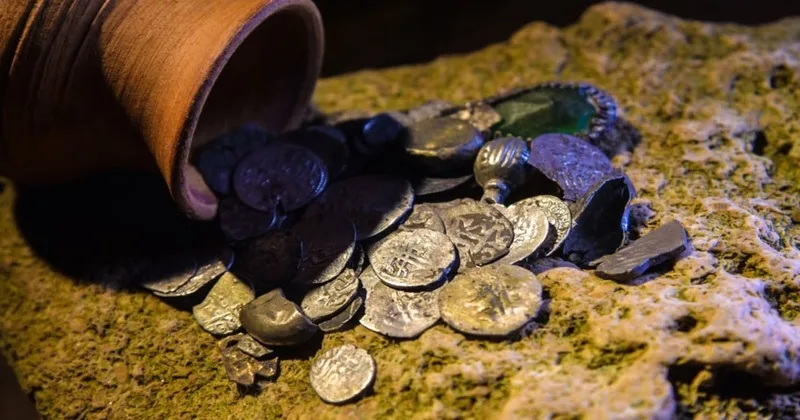
A remarkable archaeological discovery has been made in southern India, where restoration work at an ancient Shiva Mandir near the Javvadu Hills has revealed a buried pot containing 103 antique gold coins. Found in Kovilur village, Tiruvannamalai district, the treasure is believed to date back to the late Chola or early Pandya period, making it one of the most significant heritage finds in recent years.
The coins were uncovered beneath the sanctum sanctorum of the centuries-old Sivan Mandir during authorised renovation work. As workers dug beneath the Mandir floor, they stumbled upon a sealed mud pot. Upon opening it, they discovered a neatly stacked collection of gleaming gold coins, astonishingly well-preserved despite the passage of centuries.
Soon after the discovery was reported, officials from the Revenue and Hindu Religious and Charitable Endowments (HR&CE) Departments arrived at the site. The coins were carefully documented and transferred to secure custody for examination and preservation. Experts conducting initial studies noted that the temple’s architecture exhibits distinctive late Chola design features, further supporting the proposed dating of the find.
Preliminary analysis suggests that the coins may belong to a transitional period between the late Chola dynasty and the emerging Pandya rule, a time known for vibrant trade, maritime connections, and a Mandir-centred economy. Gold played a central role in financial exchange during this era, with Mandirs often functioning as both spiritual and economic hubs, receiving gold donations and managing land endowments.
The Chola dynasty, one of medieval South India’s greatest powers, reached its zenith between the 10th and 12th centuries, extending its influence far beyond the subcontinent through maritime trade and cultural exchange. By the 13th century, however, Chola authority began to decline. The reign of King Rajaraja Chola III, from around 1216 to 1246 CE, marked the final significant phase of Chola sovereignty.
The Sivan Mandir at Kovilur, where the coins were uncovered, may have been among the numerous shrines historically endowed with gold and jewels, reflecting both royal patronage and local devotion. The discovery of the coins beneath the sanctum indicates they could have been part of the Mandir treasury, an offering to the deity, or a votive deposit placed during turbulent times to protect sacred wealth.
The late Chola and early Pandya periods were marked by thriving trade across the Indian Ocean and a sophisticated monetary system largely based on gold coinage. These coins often bore dynastic symbols, tigers for the Cholas and fish for the Pandyas and frequently featured religious motifs and inscriptions linking the currency to divine protection and royal authority. The coins unearthed at Kovilur may carry similar markings, offering scholars fresh insights into the minting practices and economic networks of the 13th century.
Archaeologists and numismatists have begun analysing the inscriptions, iconography, and metallurgical composition of the coins to determine their exact origin. If confirmed as dating to the late Chola or early Pandya era, the hoard would provide tangible evidence of how temple economies functioned during this transitional period. It would also shed light on the ways wealth was stored, circulated, and safeguarded amid shifting political landscapes.
Beyond their economic significance, the discovery serves as a vivid reminder of Tamil Nadu’s layered history and underscores how ancient temples continue to reveal stories hidden beneath their foundations.
For the residents of Kovilur village, the discovery of the gold coins has become a source of pride and fascination. Local historians and devotees have flocked to the temple, eager to glimpse a tangible relic of their ancestors’ prosperity. Heritage enthusiasts view it as a direct link to the grandeur of the Chola civilisation, a vivid reminder of a time when faith, art, and commerce were closely intertwined.
As specialists continue their examination, the hoard is expected to make a significant contribution to the study of Tamil Nadu’s medieval coinage and Mandir traditions. The coins will undergo detailed scientific analysis and historical documentation before being carefully conserved for public display.
The find beneath the Kovilur Sivan Mandir stands as a remarkable testament to the enduring wealth and sophistication of South India’s temple culture. Far more than a glittering treasure, the 103 gold coins offer a living connection to the late Chola and early Pandya eras, a golden fragment of history finally brought to light after centuries of silence.














Comments