





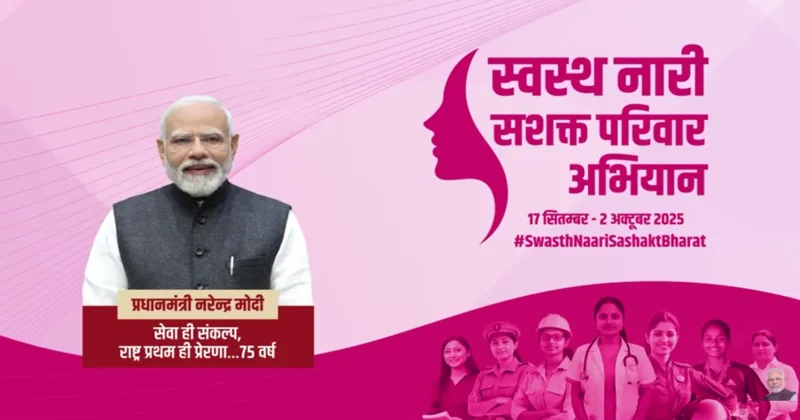
On September 17, 2025 India represented its dedication towards women health and created a history. The Swasth Nari, Sashakt Parivar Abhiyaan under the visionary leadership of Prime Minister Narendra Modi created three Guinness World Records titles, marking a defining moment in India’s journey towards women-led development also known as Nari Shakti Vandan. The Prime Minister lauded the achievement, calling it “a transformative impact on the lives of our Nari Shakti.”
Under the joint approach of the Ministry of Health and Family Welfare (MoHFW) and the Ministry of Women and Child Development (MWCD), this Abhiyaan is a nationwide movement focused on preventive, women-centric healthcare. More than lakh health camps were held across urban and rural India from tribal health care in Madhya Pradesh to metropolitan health centres in Delhi, ensuring that every woman, every mother and every daughter could access quality healthcare.
Record-Breaking Event that matters Women’s Health
The Guinness World Records recognized India for:
- The largest number of women screened for health conditions in a single day.
- The largest women’s health awareness sessions conducted simultaneously across districts.
- The widest public participation in preventive healthcare activities.
These records symbolize the power of Jan Bhagidaari (public participation) a cornerstone of Prime Minister Modi’s governance philosophy. Over 10 crore citizens were reached through the awareness campaign, while over 1 crore women underwent health screenings on a single day as per MoHFW reports.
This is very commendable! Such mass movements add impetus to our women empowerment efforts and have a transformative impact on the lives of our Nari Shakti. https://t.co/Hb2rSSOIXv
— Narendra Modi (@narendramodi) November 1, 2025
As a former Union Health Minister, Dr. Mansukh Mandaviya said, “The transformation of health in India rests on prevention first.” The SNSPA puts that into practice by incorporating early detection and counseling within communities, with special target areas of rural and tribal communities.
The Swasth Nari, Sashakt Parivar Abhiyaan is a unique initiative that marshals for the first time multiple arms of governance together on women’s health within a unified framework. It combines the technical-medical expertise of the MoHFW, the community outreach and mobilization strength of the MWCD through its extensive Anganwadi and women’s group networks and the on-ground execution capability of State Health Departments that assure smooth district-level implementation. This convergence of the ministries marked a significant change in the government’s approach, from piecemeal welfare schemes to an integrated whole-of-society model. The SNSPA evolved the strong foundations laid by earlier flagship missions like Poshan Abhiyaan and Mission Shakti-from nutrition, hygiene and sanitation to a more holistic framework of preventive, promotive and curative healthcare for women. This integrated approach strengthens not only institutional coordination but also India’s vision to empower women as the bedrock of resilient families and healthier communities.
Gaps in Women’s Health
According to NFHS-5, almost 57% of the women in the age group of 15–49 years are anaemic and only 66% receive full antenatal care. Diseases such as hypertension, diabetes and cervical cancer mostly go undetected until their late stages, especially within rural settings where access to healthcare is big task. The SNSPA aimed at bridging these critical gaps in health services for women. The health camps under SNSPA screened for anaemia, hypertension, diabetes and tuberculosis. Special focus was given to the early detection of breast and cervical cancers, reproductive health issues under gynaecological care and sickle cell disease among the tribal populations. Each camp also facilitated enrolment into flagship government health schemes such as Ayushman Bharat, PM-JAY, ensuring that the beneficiaries would not only get immediate care but also have access to health services on a continuance basis through digital health records under the Ayushman Bharat Digital Mission.
Digital Backbone of Health: SASHAKT Portal
Technology was the invisible but critical backbone of the campaign. The SASHAKT portal of MoHFW tracked every camp in real time, recording attendance and screened cases while ensuring the accuracy of data for follow-ups.
More than 1.2 crore screenings and 40 lakh counselling sessions were digitally recorded through this system in the campaign period. The frontline workers ASHA’s, ANM’s and Anganwadi workers uploaded the reports in real-time, which helped track the outcomes of patients at the district hospitals. Through its real-time tracking, it has set a new benchmark for accountability and transparency in social sector schemes.
The SNSPA went beyond health checkups, it placed health literacy as an integral part of empowerment. Workshops at the national level during Poshan Maah were held to spread awareness about menstrual hygiene management, nutrition for adolescent girls and pregnant women and changes in lifestyle that would help in the prevention of non-communicable diseases. These sessions were conducted at Anganwadi Kendras by doctors, ASHA’s and local women leaders, wherein community trust combined with medical expertise worked to strengthen health outcomes at the grassroots level.
Community and Corporate Participation for Viksit Bharat 2047
This massive movement was possible because it was not government alone. Local self-help groups, CSR wings of private hospitals and NGOs joined hands. In Gujarat, more than 8,000 women’s groups participated in awareness drives, in Odisha’s tribal blocks over 1,200 health workers conducted doorstep screenings, in Uttar Pradesh the Mahila Arogya Samitis mobilized communities for anaemia screening.
The private sector also contributed through diagnostic labs that offered concessional tests and pharmaceutical companies provided iron supplements under CSR obligations. It was a synergy that created a health movement rooted in public-private partnership.
Healthy mothers are the backbone of healthy families. The SNSPA was in tune with the long-term national vision of Viksit Bharat 2047 regarding reducing maternal mortality ratio below 70 per lakh and infant mortality rate below 20 by 2030. As per the Healthy States Index by NITI Aayog, the states implementing intensive maternal health programs had a 10–12% increase in reproductive health outcomes between 2020 and 2024. SNSPA amplifies this trend even further by embedding preventive care into community life.
A People’s Health Movement
The success of SNSPA is the shift in mindset it represents from “disease cure” to “health culture.” It is now seen as a Jan Andolan much like Swachh Bharat was for sanitation. Each health camp awareness drive reinforces the idea that empowering women’s health is empowering India’s growth.
The first phase of the campaign was completed, having reached out to more than 25 crore citizens through direct and digital engagement. The Abhiyaan has shown that when policy meets participation, transformation becomes inevitable.
The Swasth Nari, Sashakt Parivar Abhiyaan has done what was earlier supposed to be dream, it has united ministries, medical experts, citizens and technologies under a single purpose of empowering women through health. Creating three Guinness World Records is not just a feat of numbers, but a symbol of collective consciousness that India’s growth story is incomplete without the well-being of its women.
Prime Minister Modi said, “Such mass movements give further impetus to women empowerment efforts and have a transformative impact on the lives of our Nari Shakti.” From village health camps to digital dashboards, anemia awareness to antenatal care the message is clear Swasth Nari means Sashakt Bharat.













Comments