





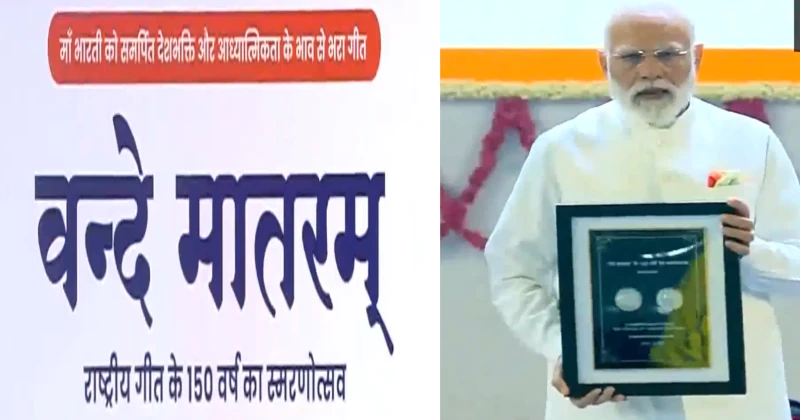
Prime Minister Narendra Modi on November 7, inaugurated the 150th-anniversary commemoration of the National Song, Vande Mataram, at a grand ceremony held at the Indira Gandhi Indoor Stadium in New Delhi. The event heralded the beginning of a year-long nationwide celebration from November 7, 2025, to November 7, 2026 dedicated to reviving the spirit of the song that once ignited Bharat’s struggle for freedom and continues to inspire generations with its timeless message of devotion to the Motherland.
The Prime Minister released a commemorative postage stamp and coin and launched a dedicated digital portal, VandeMataram150, designed to chronicle the legacy of Bankim Chandra Chatterjee’s immortal composition and showcase activities, exhibitions, and campaigns planned across the country during the year-long observance.
#WATCH | Delhi | PM Modi releases a Commemorative Stamp and Coin at the 150th anniversary commemoration of the National Song 'Vande Mataram'
The Prime Minister will also release a Commemorative Stamp and Coin on the occasion. This programme marks the formal launch of a year-long… pic.twitter.com/IOzb1fpsaI
— ANI (@ANI) November 7, 2025
The celebrations opened with a mass singing of the full version of ‘Vande Mataram’ from Kashmir to Kanyakumari, from schools and universities to public squares and government institutions. Citizens across all walks of life joined in chorus, echoing the very words that once resounded through the freedom movement. The main programme in Delhi saw Prime Minister Modi himself participate in the collective rendition, joined by Union Minister Gajendra Singh Shekhawat, Delhi Lieutenant Governor Vinai Saxena, and Delhi Chief Minister Rekha Gupta.
According to a statement issued by the Prime Minister’s Office (PMO), the year 2025 marks 150 years since Bankim Chandra Chatterjee composed ‘Vande Mataram’ on Akshaya Navami, November 7, 1875. Written originally in Sanskritised Bengali, the song first appeared in Bankim’s literary journal Bangadarshan and later featured in his celebrated novel Anandamath (1882). The novel depicted an ascetic revolutionary movement against tyranny, with Vande Mataram as its spiritual heartbeat symbolising the awakening of Bharat as the Mother Goddess.
The PMO emphasised that Vande Mataram gave poetic expression to India’s awakening spirit of unity, self-respect, and resistance to colonial rule. During the Swadeshi Movement (1905–1911), it became the rallying cry of countless patriots from Aurobindo Ghose and Bipin Chandra Pal to Lala Lajpat Rai and Madan Lal Dhingra. Its verses were banned by the British for their revolutionary symbolism, yet they continued to echo in secret meetings, protests, and processions.
“Through this commemoration,” the PMO noted, “the Government of India seeks to rekindle that same spirit of unity, devotion, and collective strength that the song embodied. The celebrations will ensure its legacy continues to inspire future generations.”
The Union Cabinet, chaired by Prime Minister Modi, had approved in October a comprehensive, country-wide campaign titled ‘Vande Mataram@150’ to ensure that the commemoration reaches every household and educational institution. The initiative is designed to connect citizens, especially youth and students, with the song’s original revolutionary spirit through creative, participatory, and digital engagement.
Throughout the year, the campaign will include:
- Mass singing events in schools, universities, and public institutions.
- Cultural performances, exhibitions, and art installations on the theme of Bharat Mata.
- Academic symposia tracing the song’s role in India’s intellectual and nationalist movements.
- Music festivals featuring multilingual renditions of Vande Mataram across regional languages.
- Digital storytelling initiatives using the hashtag #VandeMataram150 to highlight the song’s journey from 1875 to 2025.
A special series of programmes under the Ministry of Culture, Ministry of Education, and MyGov platform will promote translations of Vande Mataram into various Indian languages, ensuring that the song’s emotion transcends linguistic boundaries.
Simultaneously, in Patna, Bihar, Union Home Minister Amit Shah formally launched the nationwide Vande Mataram 150 campaign in a mass gathering that mirrored the Delhi event’s energy and symbolism. Joined by Union Ministers Dharmendra Pradhan and Vinod Tawde, Shah took the ‘Swadeshi Sankalp Patra’ pledge, reaffirming India’s commitment to self-reliance and cultural resurgence.
“For the whole year, the mantra of Vande Mataram will reverberate across Bharat,” Shah declared. “This is not just a celebration of a song—it is a reawakening of the nation’s soul. The dream envisioned by our freedom fighters is being realised today, as Bharat stands united, self-reliant, and confident under the leadership of Prime Minister Narendra Modi.”
He further announced that the campaign would have a digital extension, enabling millions to engage with the celebrations through social media, music collaborations, and citizen pledges. The translation of the song into multiple local languages will also be a key feature, ensuring inclusivity and emotional connection across linguistic lines.
Composed in 1875, Vande Mataram predates even the Indian National Congress. It was sung at the 1905 Calcutta Session of the INC, and its melody became synonymous with the Swadeshi Movement. The British colonial government, fearing its revolutionary influence, banned its public singing, yet it continued to be whispered and sung as an act of defiance.
Following independence, the Constituent Assembly adopted Vande Mataram as Bharat’s National Song on January 24, 1950, a day before the Constitution came into effect. The Assembly recorded a note of deep respect for the song’s historic role in the freedom movement, recognising it as a companion piece to the National Anthem Jana Gana Mana.
However, over the decades, political and ideological attempts were made to dilute the song’s visibility, often under the guise of secular sensitivities. Despite that, Vande Mataram retained its place in the hearts of millions as a symbol of civilisational pride, cultural unity, and reverence for the Motherland.















Comments