





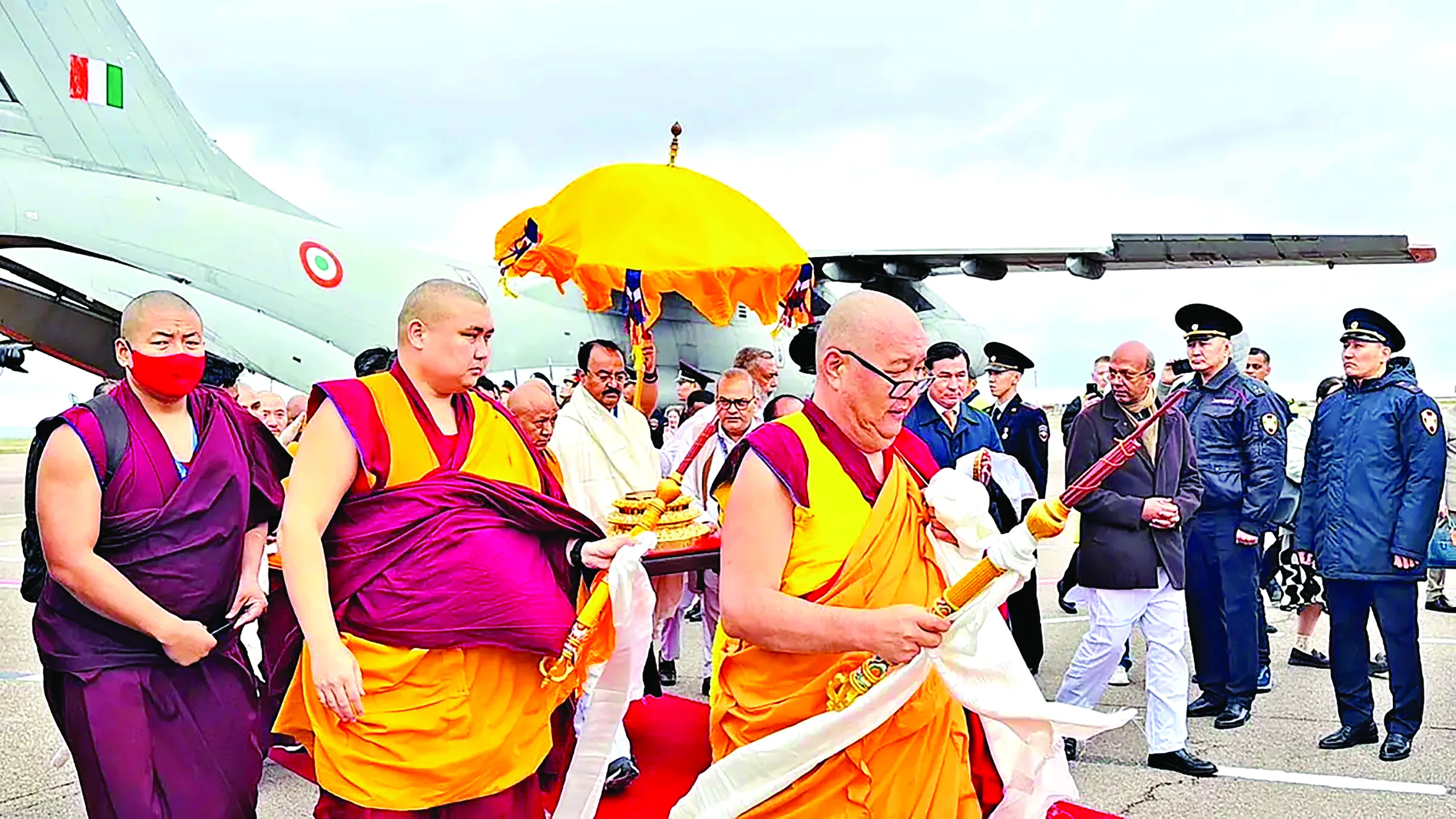
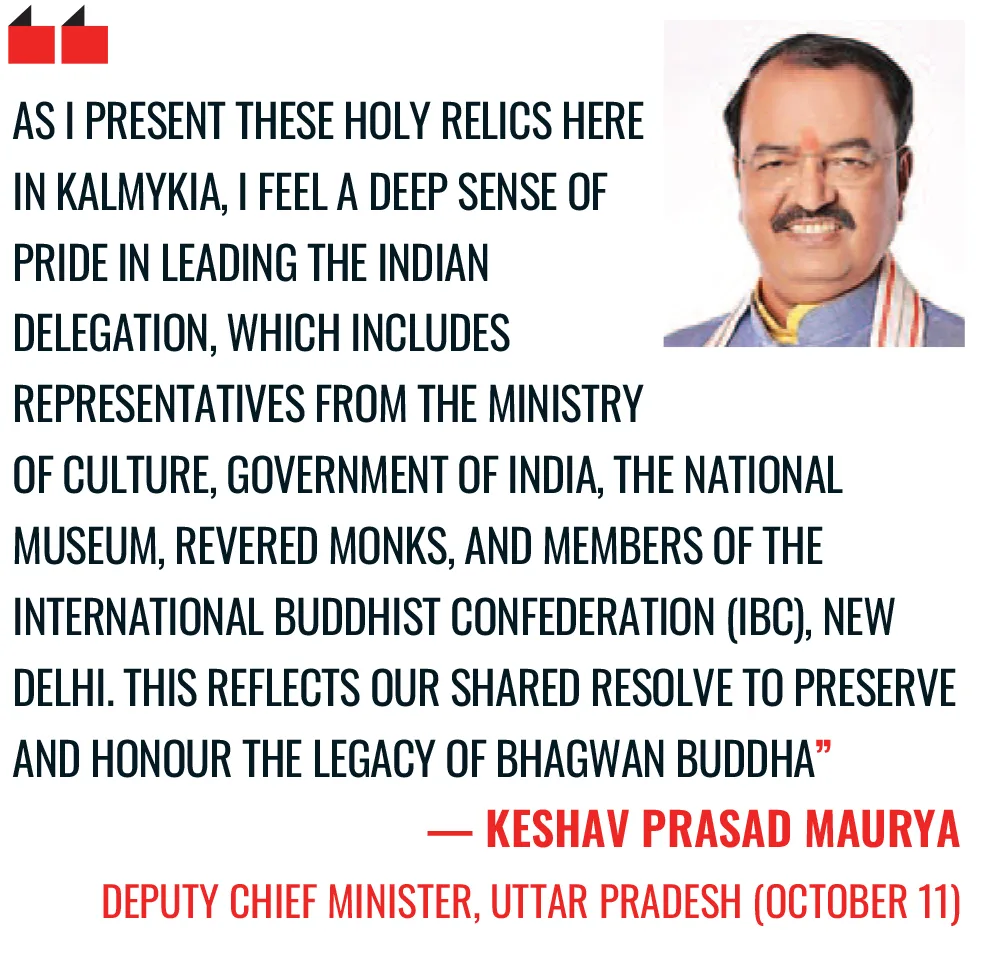
“Exposition of Holy Relics of Bhagwan Buddha to Kalmykia will strengthen the people to people ties between Bharat and Russia,” said Jammu and Kashmir Lieutenant Governor Manoj Sinha on October 18, at the iconic Geden Sheddup Choikorling Monastery, popularly known as the “Golden Abode” of Shakyamuni Buddha in Elista, Republic of Kalmykia, Russia. After paying his reverent homage to the relics, LG Sinha said that exposition of the Holy Relics of Bhagwan Buddha in Kalmykia is a landmark event that represents a historic homecoming of faith for the Kalmyk people, the only Buddhist nation in Europe. It stands as a powerful bridge of spiritual friendship between Bharat and Russia, showcasing Bharat’s efforts in cultural ties and the unifying power of Buddha’s teachings.
LG Sinha presented “Khatak” to the Holy Relics and lighted a lamp in the temple. He also offered prayers and presented “Khatak” in front of 19th Bakula Rinpoche. Sinha presented a Kashmiri shawl to Shajin Lama and received blessings. Jammu and Kashmir Lieutenant Governor Manoj Sinha on October 17 arrived in Russia to bring back the Holy Relics of Bhagwan Buddha to Bharat following their exposition in Elista, the Capital city of the Republic of Kalmykia. The holy relics of Bhagwan Buddha returned to Bharat following a “historic and spiritually significant” week-long exposition held in the Republic of Kalmykia in Russia. It is important to mention that in a significant cultural and spiritual milestone, the holy relics of Bhagwan Buddha arrived in capital city of Elista on October 11 aboard a special Indian Air Force aircraft from Bharat, marking the beginning of eight days exposition in Kalmykia Republic of Russia.
The holy relics exposition, a first in the Russian Republic, was organised by the Ministry of Culture, Government of Bharat in association with the International Buddhist Confederation (IBC), the National Museum, and the Indira Gandhi National Centre for the Arts (IGNCA). It was held in the capital city of Elista from October 11-18, 2025. The sacred relics, recognise as a National Treasure of Bharat, were brought to the capital city of Elista by a high-level delegation, led by Keshav Prasad Maurya, Deputy Chief Minister of Uttar Pradesh, and including senior monks. The delegation conducted special religious services and blessings for the predominantly Buddhist population of Kalmykia, the only region in Europe where Buddhism is the predominant religion.
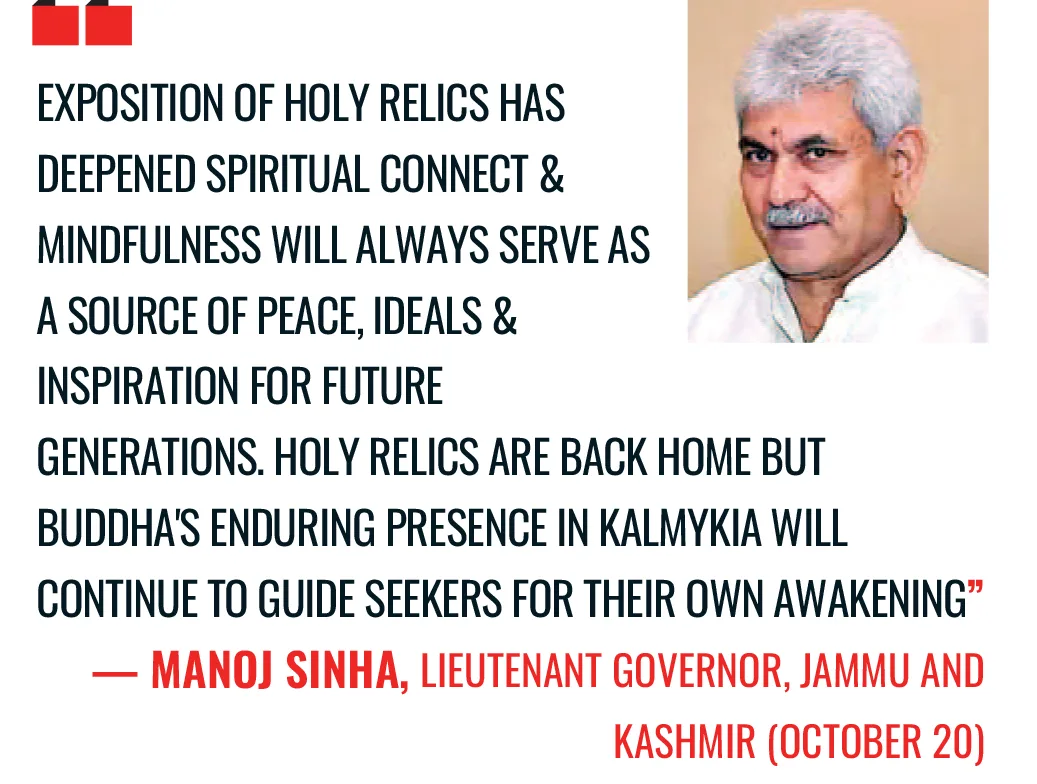
While speaking on this occasion, Keshav Prasad Maurya said, “As I present these holy relics here in Kalmykia, I feel a deep sense of pride in leading the Indian delegation, which includes representatives from the Ministry of Culture, Government of India, the National Museum, revered monks, and members of the International Buddhist Confederation (IBC), New Delhi. This reflects our shared resolve to preserve and honour the legacy of Bhagwan Buddha. Such exhibitions and pilgrimages strengthen people-to-people bonds between Bharat and Buddhist nations across the world, while also enhancing bilateral cooperation. During the sacred relic exhibitions held in Mongolia, Thailand, Vietnam, and now Russia, the devotion and dedication of millions of faithful devotees have testified to the deep cultural ties that connect Bharat with the world.”
“Recently, the Prime Minister of India, Shri Narendra Modi, described the return of gemstones associated with the Piprahwa relics to Bharat, after 127 years, as a moment of national pride. These gemstones, which had been taken to Britain in the 19th century and placed for auction, have now been repatriated to Bharat and will soon be displayed for public viewing. This moment reflects Bharat’s role as “the guardian and custodian of the world’s rich Buddhist heritage”. By sharing this sacred heritage, Bharat further reaffirms its identity as the birthplace of Buddhism and the protector of its eternal teachings. Through this timeless legacy, the universal message of Bhagwan Buddha — wisdom, compassion, peace, and non-violence — continues to resonate across the world, inspiring harmony and goodwill among all humankind,” said Keshav Prasad Maurya.
In a powerful display of spiritual devotion and shared cultural heritage, the exposition of sacred relics of Bhagwan Buddha from Bharat drew an unprecedented response in the Republic of Kalmykia, Russia. About One lakh seventy thousand devotees paid their reverent homage to the relics, This historic exposition, the first of its kind in the Russian Republic, is a testament to the deep civilisational bonds between Bharat and Russia. It revives the enduring legacy of the 19th Kushok Bakula Rinpoche, the revered Buddhist monk and diplomat from Ladakh, who was instrumental in reviving Buddhism in Mongolia and reigniting interest in the Buddha Dharma in Russian regions like Kalmykia, Buryatia, and Tuva. The Holy Relics received by the Head of the Buddhists of Kalmykia, Shajin Lama of Kalmykia, Geshe Tenzin Choidak, Batu Sergeyevich Khasikov, Head of Republic of Kalmykia and other eminent Buddhist Sangha members.
It may be recalled that it was the 19th Kushok Bakula Rinpoche, the revered Buddhist monk and diplomat from Ladakh who played a pivotal role in reviving Buddhism in Mongolia and subsequently, also instrumental in reintroducing interest in Buddha dharma in the three regions of Russia, namely Buryatia, Kalmykia, and Tuva.
The Sacred Relics were enshrined in the main Buddhist monastery in Elista, known as the Geden Sheddup Choikorling Monastery, also called the “Golden Abode of Shakyamuni Buddha.” This is a significant Tibetan Buddhist centre, opened for the public in 1996 and is surrounded by the Kalmyk steppe.
Exhibitions Celebrate Bharat’s Buddhist Heritage
A unique exhibition of Buddhist stamps, curated by Vinod Kumar of Dharwad, Karnataka—featuring around 90 countries was also be displayed. Another exhibition by IBC titled the “Sacred Legacy of the Shakyas: Excavation and Exposition of Buddha’s relics” was presented through panel displays. It traces the remarkable journey of the Buddha’s relics from their ancient enshrinement to their rediscovery. It opens with a map locating Piprahwa, identified with the ancient city of Kapilavastu, the capital of the Shakya clan. The panels guide visitors through the sacred geography in Bharat of the Buddha’s final days and the regions that hold the legacy of his timeless teachings.
An exhibition on ‘Bodhicitta’- Treasures of Buddhist Art from the National Museum of India and the National Mission for Manuscripts in Bharat was also displayed at the venue. It offers a unique opportunity for visitors to engage deeply with India’s rich Buddhist cultural heritage, spanning over two millennia. Kalmykia is a region that is characterised by vast grasslands, though it also includes desert areas, and it is in the southwestern part of the European territory of Russia, bordering the Caspian Sea. The Kalmyks are descendants of the Oirat Mongols who migrated from Western Mongolia in the early 17th century. Their history is deeply tied to nomadic lifestyles, which influences their culture. They are the only ethnic group in Europe that practices Mahayana Buddhism. Kalmykia had the 3rd International Buddhist Forum from September 24-28, 2025 in the Capital Elista. In a powerful display of spiritual devotion and shared cultural heritage, the exposition of sacred relics of Bhagwan Buddha from Bharat drew an unprecedented response in Russia. About one lakh devotees paid their reverent homage to the relics, enshrined at the iconic Geden Sheddup Choikorling Monastery, popularly known as the “Golden Abode of Shakyamuni Buddha.”
Depiction of the life of Bhagwan Buddha
The exposition of the Sacred Relics of the Buddha, organised by the National Museum, New Delhi, under the aegis of the Ministry of Culture, Government of India, in association with the National Museum of the Kalmyk Republic, aims to strengthen cultural and spiritual ties between Bharat and Russia, rooted in their shared Buddhist heritage. The exhibition titled “Depicting the Life of the Buddha: From Renunciation to Enlightenment” featured 28 paintings created by Padma Shri Artist Vasudeo Kamath over a period of more than a year. Each work of art narrates a key episode from Buddha’s journey, rendered with deep spiritual insight and masterly technique.
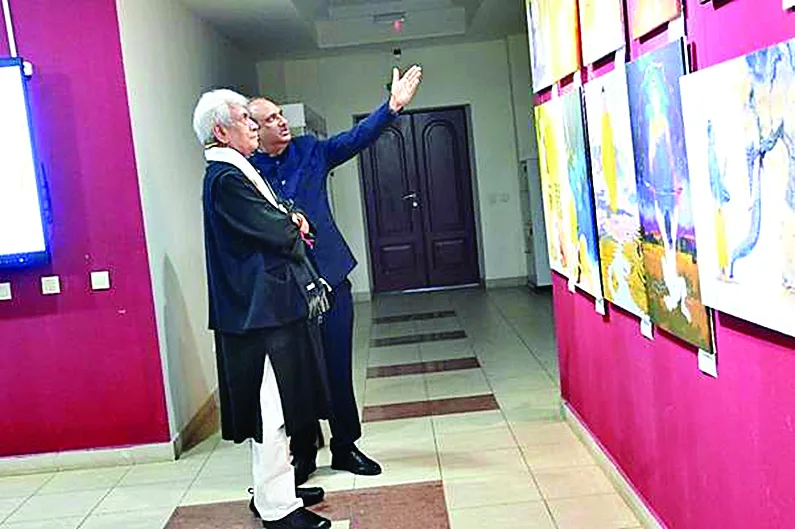
The series included depictions of Dipankara Buddha’s renunciation of Sumedha, Prince Siddhartha’s departure from the palace, the defeat of Mara, the attainment of enlightenment under the Bodhi Tree, the first sermon at Sarnath (Dhammachakra Pravartan), the donation of Jetavana monastery, Rahul seeking inheritance, Angulimal’s surrender, the subjugation of the elephant Nalagiri, and the renunciation of Sariputta’s mother, among others.
Each painting exemplified Kamath’s hallmark precision, subtle use of colour, and ability to translate profound spiritual moments into visual form. His works displayed the fusion of classical Indian aesthetics with universal human emotion, capturing both the divinity and humanity of the Buddha’s life.
On October 17, a queue of devotees stretched nearly one kilometer from the monastery, highlighting the profound resonance of this event. The Golden Abode, a significant Tibetan Buddhist center opened in 1996 and situated in the vast Kalmyk steppe, has witnessed a continuous inflow of pilgrims since early morning. This historic exposition, the first of its kind in the Russian Republic, revives the enduring legacy of the 19th Kushok Bakula Rinpoche, the revered Buddhist monk and diplomat from Ladakh, who was instrumental in reviving Buddhism in Mongolia and reigniting interest in the Buddha Dharma in Russian regions like Kalmykia, Buryatia, and Tuva.
A Vibrant Lecture Series For Enthusiasts
Professor Vinay Kumar Rao, faculty at the Special Centre for the Study of North East India, Jawaharlal Nehru University (JNU), New Delhi, delivered a series of three special lectures in the Republic of Kalmykia, Russian Federation, highlighting his extensive fieldwork and research on Buddhist art and cultural linkages between Bharat and Southeast Asia.
Speaking to students and faculty in the History Department at Kalmyk State University, Elista, Professor Rao highlighted the significance of the Buddha’s holy relics excavated from Piprahwa and examined the different aspects of the depiction of scenes related to the Buddha’s mahaparinirvana in Pali literature and in further reflected in sculptural representations. He clarified that there is evidence of stupas constructed over relics in India that dates to the Vedic era and predates the time of Buddha. The Mahaparinirvana Sutta itself describes in detail how the Buddha himself told Ananda how to build Stupas over the relics of Pratyeka Buddhas and Chakravarti kings. He explained how Buddhist sculptural art evolved from the Buddha’s symbolic presence in early Buddhist art to his anthropomorphic presentation in later periods. He explained how Buddhist sculptural art reflected the Buddha’s teachings on impermanence, transience, and the idea of non-self in relation to time and space through number of sculptural representations.
Bharat’s participation in hosting these sacred relics powerfully symbolises the shared Buddhist heritage and the enduring spiritual connection between the peoples of Bharat and Russia. As part of the ongoing First Exposition of the Sacred Relics of Lord Buddha in the Republic of Kalmykia, Russian Federation, a special art exhibition was organised featuring the works of eminent Indian artist, Padma Shri Vasudeo Kamath. The exhibition, curated specially for this historic cultural exchange, presented a remarkable visual journey through the life and teachings of Lord Buddha, blending spirituality, artistic mastery, and philosophical reflection.









Comments