





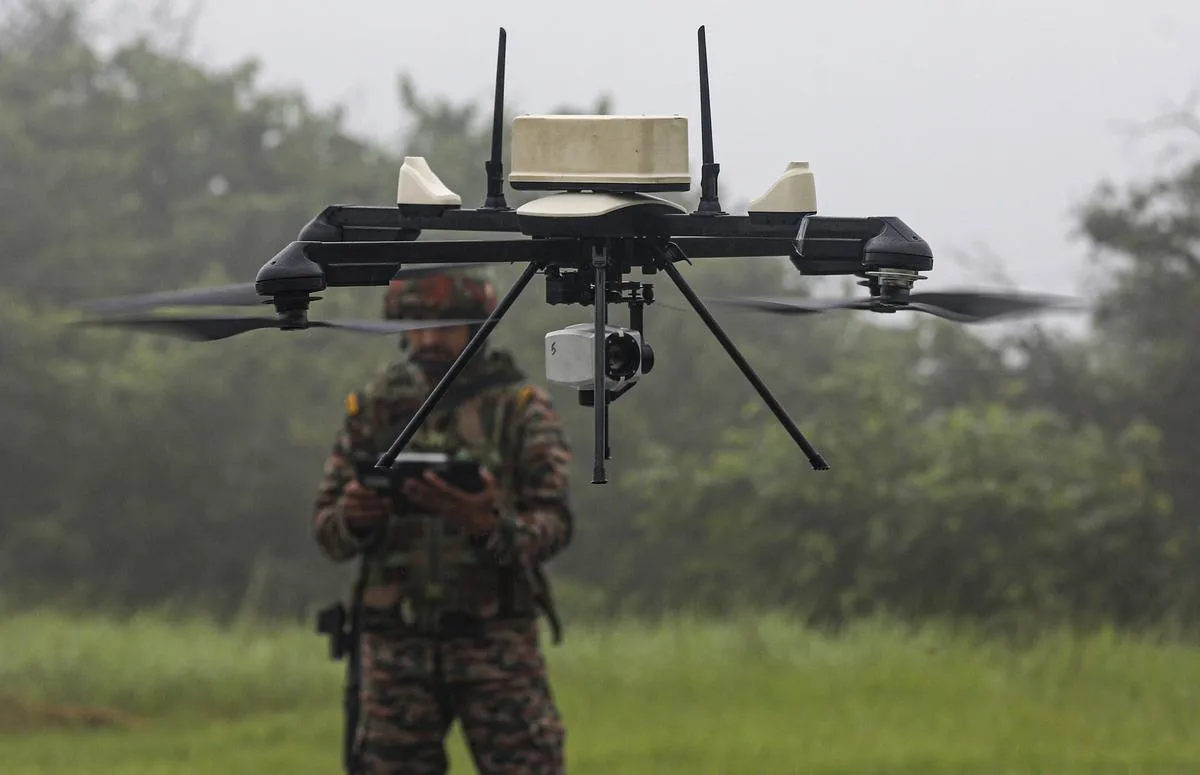
In a landmark demonstration of India’s growing self-reliance in defence technology, indigenously developed combat drones proved their operational excellence during Exercise Trishul, one of the Indian Army’s largest tri-service military exercises. Conducted under the Southern Command, these homegrown drones successfully executed high-precision missions under realistic and contested combat conditions, marking a major leap towards the Atmanirbhar Bharat vision of a technologically empowered military.
Guided by the doctrine “Eagle on Every Arm,” the Southern Command has built a robust in-house framework for the design, development, and mass production of Unmanned Aerial Systems (UAS). The initiative aims to integrate indigenous innovation, industry collaboration, and tactical application into a cohesive force structure capable of meeting the Army’s evolving battlefield demands, from surveillance and precision strike to electronic warfare.
Officials said the initiative reflects a strategic shift in India’s defence posture, moving from dependency on imported systems to domestic innovation. The Southern Command’s newly established Drone Hubs are driving this transformation. By merging the engineering expertise of the Corps of Electronics and Mechanical Engineers (EME) with the agility of India’s Micro, Small and Medium Enterprises (MSMEs), the Army has created a production ecosystem capable of rapidly developing mission-specific drone systems.
“These hubs are building platforms that enhance situational awareness, striking accuracy, and electronic dominance,” an Army source noted, emphasising that indigenous drone technology now forms a key part of India’s modern combat capability.
During Exercise Trishul, the indigenously built drones underwent rigorous field validation, operating seamlessly even in electronically jammed and hostile environments. Their endurance, precision, and reliability impressed observers, with performance metrics surpassing operational benchmarks.
“The trials confirmed that these systems are not just conceptually sound, but battle-ready,” a senior defence official said, adding that the exercise demonstrated India’s growing capacity to field indigenous technology in real-time military operations.
The success of these systems underscores the broader push under the Atmanirbhar Bharat initiative, which prioritises domestic defence production and reduced reliance on foreign imports. For the Army, this approach means faster innovation cycles, cost efficiency, and greater adaptability to local terrains and mission-specific needs.
The operational validation of India’s drone fleet was also evident during Operation Sindoor, conducted earlier this year. Indigenous loitering drones, equipped with 5-10 kg warheads and a range of up to 100 km, played a pivotal role in cross-border precision strikes on terror infrastructure in Pakistan and PoK.
During the mission, drones operated both as “eyes in the sky” and “swords on the battlefield”, conducting real-time reconnaissance and target engagement despite GPS interference. The operation underlined how unmanned aerial platforms can serve as both offensive assets and strategic deterrents in modern warfare.
By integrating indigenous drone technology into its operational doctrine, the Southern Command continues to position itself as a tech-enabled, future-ready force. The Army’s evolving drone ecosystem symbolises not just technological progress, but a strategic assertion of India’s defence independence, an “Eagle on Every Arm,” poised to safeguard the nation’s skies and sovereignty.















Comments