





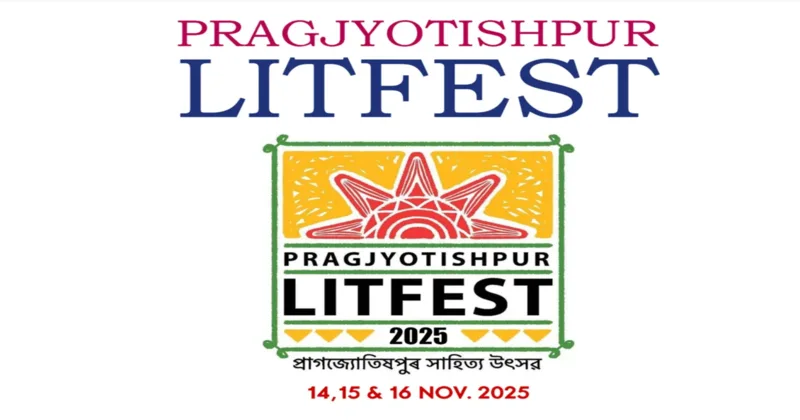
GUWAHATI: A unique confluence of author-translators, art-connoisseurs, critics, budding writers, commentators on Assamese lyrics, performing arts, translations along with history and young people is scheduled to take place from November 14-16 2025 in the prehistoric city of Guwahati in northeast Bharat as the 3rd Pragjyotishpur Literature Festival (PLF) takes its turn to mesmerise the audience with a series of fascinating deliberations.
Organised by Sankardev Education and Research Foundation (SERF) with the theme titled ‘In Search of Roots’, the annual Pragjyotishpur Litfest (PLF) at Madhavdev International Auditorium of Srimanta Sankaradeva Kalakshetra will host a number of luminaries while celebrating the region’s rich literary and cultural heritage.
The three-day festival with a series of panel discussions, interactive sessions, a workshop on contemporary nature writing, multilingual poetry recitations, etc is expected to emerge as an intellectual and interactive treat for thousands of literary enthusiasts aiming to redefine the legend of Pragjyotishpur.
Mentionable is that the present-day Assam is the central part of ancient kingdom Pragjyotishpur (also known as Kamrup), where its capital was located roughly in the present-day Guwahati. The kingdom was spread to Jalpaiguri, Bhutan hills (including some parts of Nepal), Rangpur, Sylhet, Mymensingh, Dhaka (now under Bangladesh), Tripura, Khasi & Garo hills, etc. Pragjyotishpur is also mentioned in great epics namely Ramayan and Mahabharat as well as in Kalika Puran, Yogini Tantra and Charyapada.
Pragjyotishpur was pronounced by Bhagwan Ram in the critical phase of his struggles after losing his wife Maa Sita. In Mahabharat days, Pragjyotishpur king Bhagadatta fought along with the Kauravas (against Pandavas) in the battle of Kurukshetra.
When it came to exist as the Kamrup kingdom, legendary king Bhaskaravarman (600–650 CE) used to rule over the land. He enjoyed a dignified and mutually respected relation with emperor Harshavardhan (of Kanauja and Thaneswara), whom he often offered valuable books as gifts. Bhaskaravarman was also a vibrant patron for Nalanda University, which was one of the greatest centres of learning around the world. Pragjyotishpur itself was an abode of learning, publications and intellectual exercises as these were the oldest traditions and practices for the residents. Many valuable books were written in this part of the world, where Madhav Kandali translated Ramayan in the local language. An intellectually sound society used to promote the learning and redefining of general science, craftsmanship, Astrology, Ayurveda & traditional healthcare, performing & visual arts.
Five intriguing sessions comprising the ‘Evolution of Assamese Performing Arts: From Ankiya Bhawana to Bhramyman’, ‘Evolution of Assamese Lyric Literature: Tracing the Journey from the 1990s to the Contemporary Era’, ‘Assamese Language, Literature and Journalism: Growth and Expansion’, ‘Transcending Language Boundaries: The Triumphant Journey of Assamese Translated Literature’ and ‘The Creative World of Novelist Birendra Kumar Bhattacharya: An Exploratory Journey’ are waiting for literature enthusiasts during the up-coming carnival.
Special session on Kalaguru Bishnu Prasad Rabha, a towering personality contributing enormously for Assamese music, painting, literature and also politics, a workshop on nature inspiring literature, outdoor multilingual poetry sessions bringing together voices from diverse linguistic entities including Assomiya, Sanskrit, Hindi, English, Bodo, Karbi, Mishing, Nepali, Bengali, Rabha, Tiwa, etc are also on the card.
The PLF 2024 concluded with a high note, inspiring the participants from various parts of the region with a number of engaging sessions and workshops embracing novice writers, intellectuals and cultural researchers. It was inaugurated by Dr. Malini Goswami, former vice-chancellor of Assam Women’s University, in the gracious presence of renowned economist Swaminathan Gurumurthy, Supreme Court advocate J. Sai Deepak, Jawaharlal Nehru University professor Anand Ranganathan, eminent historian Sanjeev Sanyal, SERF chairman Lt Gen (retired) Rana Pratap Kalita, organising president Taren Boro with many other distinguished personalities.
On the other hand, its closing function witnessed the presentation of PLF awards to veteran Nepali author Bidyapati Dahal and emerging author Suprakash Bhuyan (in the promising writer’s category), where renowned academician Dr. Amarjyoti Choudhury was present as the chief guest.
Lately, the Litfests become popular occasions for deliberation and interactions among the young people across Bharat, where the regional literary works are usually propagated with a great enthusiasm.
PLF president Phanindra Kumar Dev Choudhury, emphasised on showcasing the history, culture and languages of the land, once known as Pragjyotishpur (also later Kamrup kingdom), in the right perspective. Expressing dissatisfaction over the tendency of many highly educated individuals to undermine the heritage of their own land, Dev Choudhury exclaimed that many authors try to define Indian literature through the lens of foreign writers thus ignoring the serenity of ancient civilizations. Prior to the PLF, Guwahati witnessed three editions of Brahmaputra Literary Festival, which was patronized by the state-owned publishing institutions namely the National Book Trust (NBT) and the Publication Board Assam at Srimanta Sankaradev Kalakshetra. He hoped that the PLF 2025 will continue its endeavour to redefine the legacy of Kamrup-Kamakhya civilisation.











Comments